‘Catalogue of admissions’: Journalists’ body says Delhi Police affidavit admits the interference it denies
The Network of Women in Media tells the Supreme Court the police’s denials don’t hold up against their own admissions and asks for independent scrutiny.

The Network of Women in Media, India (NWMI) has told the Supreme Court that Delhi Police’s counter-affidavit, far from rebutting allegations of harassment of journalists at the anti-SIR protests, “itself reveals the extent of the interference complained of”.
In a rejoinder filed on November 21, NWMI said paragraphs of the affidavit “read like a catalogue of admissions” and that terms such as “mistaken identity”, “verification” and “merely removed” and “released upon identification” are euphemisms “deployed to soften the description of actual restraint”.
The NWMI’s original petition is one of several filed in the Supreme Court by journalists’ bodies, which allege that the Delhi Police violated the court’s October 11 order. That order directed the police not to obstruct journalists covering the anti-SIR protests, after journalists complained they were being prevented from doing their work.
‘Not a disclosure of legal authority’
The police had cited Section 172(2) of the Bharatiya Nagarik Suraksha Sanhita to defend removing journalists “for verification”. NWMI called this “a clever use of terminology, not a disclosure of legal authority”. It said the power applies only when a person defies or ignores an earlier lawful police direction. It added that Section 29 of the Delhi Police Act, which only names the officers who can issue orders regulating assemblies and public places, is “not a freestanding authority to seize, confine or transport every person present”.
The affidavit, it said, does not identify the specific direction given in each case, the rank of the officer who issued it, or what the journalist did to disobey it. Nor does it explain why removal was necessary instead of a “less restrictive measure”. As NWMI’s rejoinder stated, “The police cannot justify an interference with personal liberty simply by refraining from calling it a detention or arrest.”
Reel-makers – ‘A retrospective justification’
The police had argued that protections do not extend to “reel-makers” and content creators. NWMI called the label “a retrospective justification”. “A reel is a short-form vertical-video format… not a legal or professional status,” it said.
“The relevant question is what the person was doing,” the rejoinder added.
NWMI also called the police’s position contradictory. The affidavit, it said, relied on social-media posts, several of them Instagram reels, to show journalists reported freely, yet sought to discredit the petitioners’ social-media material documenting police action.
“It cannot have it both ways,” it said.
The material offered for the “reel-maker” label, it said, was an Instagram clip of an unnamed student and an OpIndia post about an alleged seller of press cards, neither linked to any journalist in the petition.
On accreditation, NWMI said it “cannot be converted into a police licensing regime for journalism”, noting the affidavit itself admits independent journalists “cannot be denied lawful newsgathering” for want of PIB accreditation.
Equipment seizures and harassment of women journalists
In its affidavit, the police said nothing was seized from journalists. NWMI said this “avoids the distinction between a formally recorded detention and the actual restraint”, and between seizure and “temporary deprivation of equipment or compelled deletion of recordings”.
“The absence of a station entry does not, by itself, disprove an incident of physical restraint,” it said, asking for seizure memos, inventories and chain-of-custody records.
On sexual harassment complaints closed by the Crime Branch, NWMI said the closure “reinforces the very concern underlying the prayer for an inquiry independent of the police force whose personnel are complained against”.
A woman’s reluctance to pursue a complaint, it said, “cannot be treated as conclusive proof that the conduct did not occur”. It also pointed to an FIR registered on October 13 against a woman journalist, whose own earlier complaint was never registered as an FIR.
The police had said 3,747 women personnel were deployed during the day (and 664 at night) and that women taken away in police vehicles were accompanied by a woman officer. But the NWMI said this does not identify who handled the women journalists, and that “crowd control is not a zone in which a woman’s dignity and bodily integrity stand reduced.”
On the alleged assault against Ryan Thomas of The Caravan, the Delhi Police’s defence “does not resolve the allegation of assault or explain the authority under which he was taken away”, said the rejoinder.
‘Neither necessary nor proportionate’
NWMI said that at a “pre-planned and heavily regulated protest”, police could have set up a press area, liaison officers, safe routes and protective helmets.
“On its own showing, the indiscriminate removals, physical restraints and conveyance of journalists were neither necessary nor proportionate.”
It urged the court to reject the police’s plea to dismiss the petitions, and reiterated its demand for “effective safeguards, independent scrutiny and production of contemporaneous records”.
Small teams can do great things. All it takes is a subscription. Subscribe now and power Newslaundry’s work.
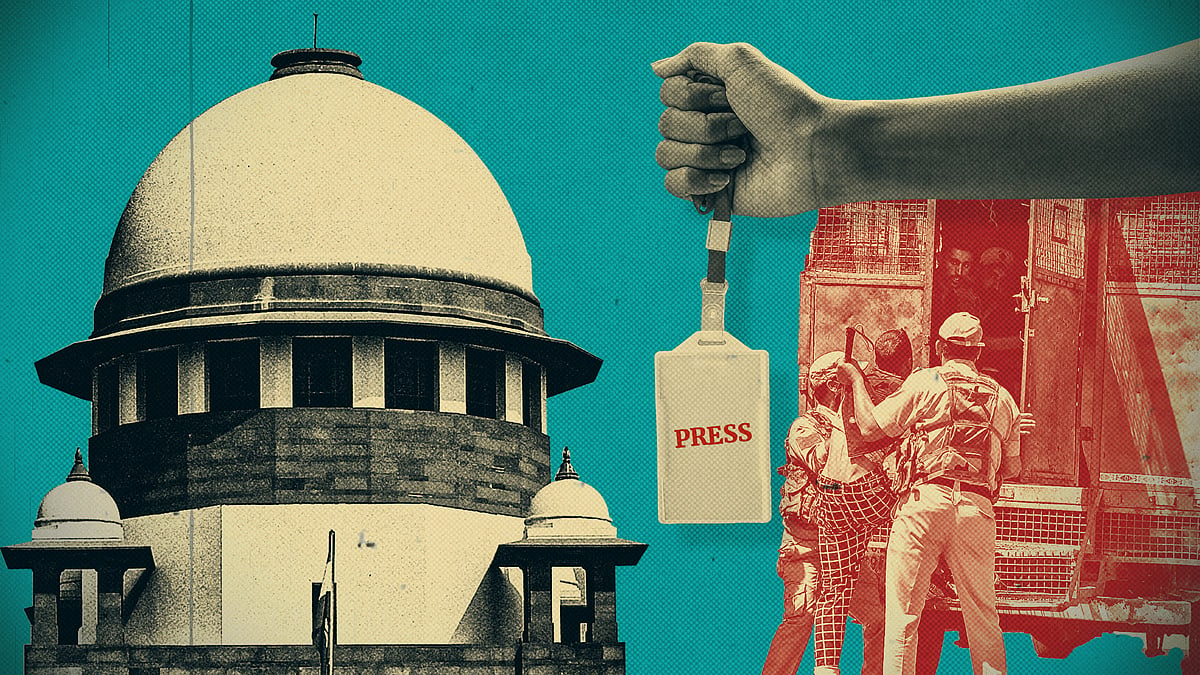 Anti-SIR protest: Journalists dispute Delhi Police’s affidavit to Supreme Court