Unmasking misogyny: How a Malayalam YouTube channel weaponises science against women
Malayalam digital platform Unmasking Anomalies cites psychology, neuroscience, evolutionary biology, and feminist scholarship to make sweeping claims about women and queer people. We followed those citations back to the research.

In July 2026, during a debate on 24 News’ Thammil Thammil about whether women should face restrictions on what they wear, a woman panellist posed a question that cut to the heart of the argument: If women’s clothes provoke sexual assault, what explains the rape of children and elderly women?
Muhammed Ameer, an ‘educator’ and one of the prominent faces of the Malayalam digital platform Unmasking Anomalies (UA), had an answer. “Consider”, he said, “the amount of sexual imagery men are exposed to every day, from hoardings and advertisements to models.” A man sees a sexually exposed woman and becomes sexually frustrated. Just as someone who cannot shout back at a boss might take their anger out on someone at home, he argued, sexual frustration can be taken out on a different target. This, Ameer said, was “frustration-aggression theory”.
When another panellist objected that this did not explain why women should change what they wear, Ameer was emphatic. “This is a psychological theory,” he asserted. “It’s not me saying this.”
It is an effective way to make an argument, enough to make the person sitting across from you in a debate pause and reconsider what they can immediately challenge. Once a claim is attached to a psychological theory or a scientific study, it can easily begin to sound like a ‘fact’ rather than an opinion. The reaction in the comments under the video shows how deceptively powerful this method is. “The UA team never goes wrong wherever they participate. They have done thorough research,” one viewer wrote. Another described the women on the panel as “a group of ladies devoid of even the slightest trace of intelligence or awareness.” The women, after all, could not respond well enough to the ‘science’ being cited.
But what happens when you follow that science back to its sources, and the argument doesn’t stand anymore? We will return to why Ameer’s claim does not hold up. But first, a little about the channel he represents.
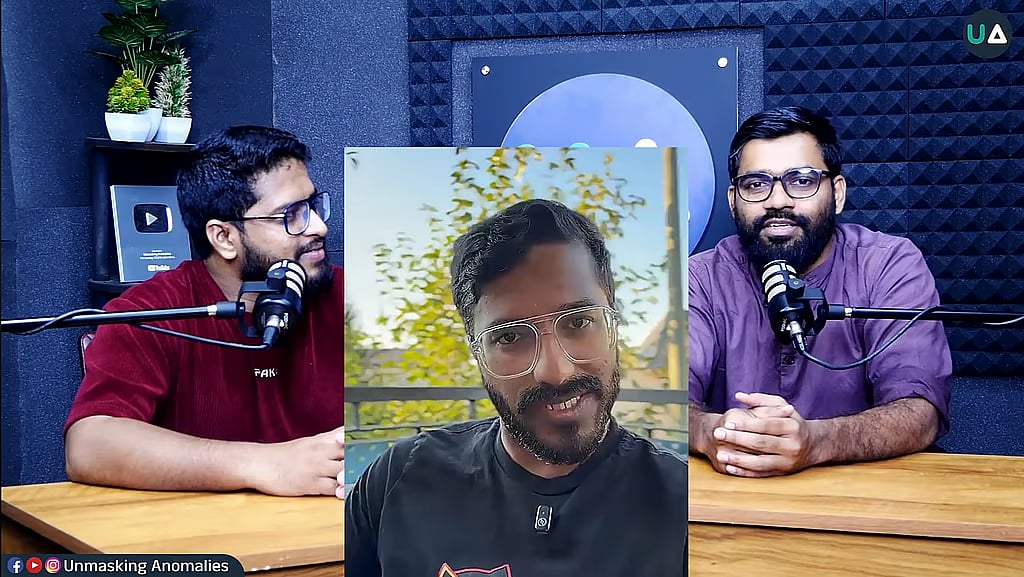
Unmasking Anomalies, formerly known as Unmasking Atheism, is an Islamic theological group, primarily known for its debates and arguments with atheist and ex-Muslim critics. But it has a second speciality. The channel’s main figures — Abdulla Basil CP, Muhammed Ameer, CP Abdu Samad, Hilal Saleem, and others — can be frequently seen refereeing debates about feminism, women’s clothing, and queer lives, using the vocabulary of psychology, neuroscience, evolutionary biology, and even feminist scholarship. It is this strand of the channel’s work that we are setting out to examine here.
We watched and analysed six primary videos and several shorter videos from UA, tracing their citations back to the original sources wherever available. When the research did not appear to support the conclusions drawn from it, we examined the studies, their methods, limitations, and caveats.
The channel’s approach bears resemblance to what is called the “scientific blackpill” in parts of the manosphere: cherry-picking research to make sweeping claims about how men and women are wired and how they should behave.
This is not to say UA is simply a blackpill platform. Its hosts have repeatedly stated that men are responsible for sexual assault regardless of what a woman wears, while many who adhere to the scientific blackpill tend to place the blame squarely on women. This bare-minimum position, however, does not undo the larger pattern in UA’s videos.
The channel’s speakers move easily from psychologists and criminologists like Neil Malamuth and Adam Lankford to feminist scholars such as Sheila Jeffreys and Sandra Lee Bartky, often selectively quoting or misrepresenting their work to arrive at conclusions that can ultimately be boiled down to: ‘science says women should stay at home and cover themselves.’
So, for this story, we followed the citations back to the source and asked a simple question: does the research actually say what UA says it says?
The ‘sexual frustration’ theory
The debate over sexual frustration is a useful place to begin, both because it illustrates UA’s method particularly clearly and because the exchange became one of the channel’s more widely viewed moments.
But follow Ameer’s argument back to the research he cites, and his claims begin to look considerably less certain. The frustration-aggression hypothesis, first proposed in 1939, is indeed a longstanding psychological theory, but it is not a theory of sexual frustration. In fact, the source Ameer is drawing on, as he has stated in later videos, is criminologist Adam Lankford’s 2021 paper, A Sexual Frustration Theory of Aggression, Violence, and Crime.
Now, there is an important distinction here between proposing a theory and having evidence that establishes the theory. Lankford’s work, which TNM read through in detail, is a review and theoretical paper. It draws on other studies, including the frustration-aggression theory, to propose a possible relationship between sexual frustration and aggression, while calling for further research. It does not present any empirical research of its own to back this theory.
Lankford is also clearly not establishing, at any point, that exposure to sexualised images can cause sexual frustration to build up, that this frustration is then displaced onto another person, or that women’s clothing has any demonstrated effect on rape. Read the paper here.
In fact, right in the introduction, Lankford rejects the old “dam-bursting” model of male sexuality — the idea that sexual pressure builds up over time and eventually has to be released somewhere. This model, he says, “misrepresents how the male body functions” and “ignores psychological and qualitative dimensions of sexual frustration,” among other problems. More importantly, he warns that because most crimes are committed by men, embracing the “dam-bursting” view could be seen as “excusing males based on their biology or blaming females for failing to please them.” Either, he writes, would be “highly offensive”.
The problems with Ameer’s argument had not gone unnoticed. The video drew responses from feminist activists, influencers, and psychologists, who questioned the way scientific research was being used to explain sexual violence and defend restrictions on women. Among those who took note was Darsana Varier, a sociology researcher and feminist.
The Thammil Thammil clip had left Darsana both intrigued and sceptical. Her own interest lay in studying gendered behaviour from a sociological perspective, and she wanted to understand what criminological and psychological research had to say on the subject.

“The first time we all heard about the frustration-aggression hypothesis was on Thammil Thammil when he cited it. But it sounded suspicious to me that a study would validate this relationship between sexual assault and clothing of victims, much less the claim that this relationship would result in increased assaults on children and the elderly,” she told TNM. “But of course, if studies were being done and published to explore this relationship, that would be kind of a huge finding for us.”
So she decided to read Lankford’s paper, and realised the problem. “UA’s primary citation (which is the Lankford paper) treats its own claim as an open question,” she said. In the paper, Lankford asks whether an increasingly sexualised American culture will lead to more sexual frustration or less, and what effects online pornography, masturbation, prostitution, and conjugal visits might have on short- and long-term sexual frustration. These are questions he identifies as requiring further research, not findings he claims to have established.
Yet Ameer had presented the idea as an established psychological explanation for sexual assault. “That’s when I realised their entire argument was standing on shaky grounds.”
The issue came up again when Darsana debated Ameer on the UA channel. Ameer doubled down on his Lankford citation to reiterate his position that sexualised imagery could cause frustration in men, which could in turn lead to assaults on women, children, and elderly people.
He specifically quoted these lines from the paper: “Research has found that under similar conditions (of sexual arousal), men express significantly more interest in engaging in kinky sexual behavior; in having sex with children or the elderly; and in being willing to use money, lies, alcohol, drugs, or coercion to get someone to have sex with them.”
But yet again, there is a problem with this argument. The source that Lankford uses to make this point is Dan Ariely and George Loewenstein’s 2005 study, The Heat of the Moment. The experiment involved just 35 male undergraduates at UC Berkeley, a university in California. Participants were asked to bring themselves to a state of high sexual arousal through self-stimulation (masturbation) at home and then rate a series of hypothetical statements on a scale of 0 to 100.
One of the questions was whether participants could imagine being attracted to a 12-year-old girl. When participants were sexually aroused after self-stimulation, that is, in the “heat of the moment”, the average score increased.
But to be clear, that is not the same as asking whether they would sexually assault a child. The question was about “imagined attraction,” not willingness to commit sexual violence.
Besides, the responses were hypothetical and self-reported. The researchers explicitly acknowledged in the paper that they could not know how accurately the answers predicted real-world behaviour.
There are, then, several steps between this experiment and the claims being made by the UA channel.
The chain goes something like this: A small study of 35 male students measures responses to hypothetical questions under induced sexual arousal. Lankford then uses it in a theoretical paper about how sexual frustration might contribute to aggression and crime, while also making clear that sexual frustration is not, by itself, a sufficient explanation for violence. UA, in turn, presents the broader argument as a “psychological theory” to explain why children and elderly women might be raped by sexually frustrated men, and uses it in a debate about regulating women's clothing.
The problem, as Darsana points out, was not simply that a study had been cited incorrectly, but that a new causal link was being inserted between what the study actually measured and the conclusion UA wanted to reach.
“If you want to draw a clear causal line between sexual harassment and clothing choices,” she told TNM, “that needs to be explicitly mentioned in whatever study you’re quoting.”
The viral “frustration-aggression” clip had brought UA significant backlash, following which Ameer and Samad, a clinical psychologist by profession, released a video defending their ‘science’. One of the arguments made in the video was that “feminists just want to keep saying that rapes happen. They do not want to acknowledge or address the root causes.”
That claim, too, is difficult to square when you consider the history of the feminist anti-rape movement.

Feminist activists did not simply ‘document’ rape. For decades, they have tried to understand why sexual violence happens, the social and institutional conditions that enable it, and what can be done to prevent it.
Historian Catherine O Jacquet’s account of the feminist anti-rape movement describes how women’s liberation activists challenged the idea of rape as an isolated individual act. They developed a feminist analysis that connected sexual violence to gender inequality and male power, while also challenging rape culture and victim-blaming, demanding that survivors be heard and believed, and pushing for changes to rape laws and medical practices.
Rose Corrigan’s history of the movement extensively documents how feminist activists helped establish rape crisis centres, provided support to survivors, and campaigned for legal reform.
In India, too, feminist activism has challenged not just the occurrence of sexual violence but the assumptions, laws, and institutions that shape how it is understood and addressed.
One defining moment, for instance, came in the Mathura custodial rape case, after the Supreme Court acquitted two policemen accused of raping a young Adivasi woman in custody. Four law teachers — Upendra Baxi, Lotika Sarkar, Vasudha Dhagamwar, and Raghunath Kelkar — subsequently wrote an open letter in 1979 challenging the judgement’s assumptions about consent, resistance, and Mathura’s sexual history. The letter helped galvanise a nationwide feminist anti-rape campaign that contributed to the Criminal Law (Amendment) Act, 1983, which introduced important changes to rape law, including provisions addressing custodial rape.
Another example is the Justice Verma Committee, constituted in the wake of the December 2012 Delhi gang rape following sustained public and feminist pressure. Its report examined sexual violence as an expression of power and recommended changes to criminal law.
Indian feminist scholarship has also examined the social beliefs used to blame women for sexual violence. Among these, for instance, is a 2019 study in which researchers Lipi Begum and Ravinder Barn explored how women’s clothing choices in Delhi and Mumbai were entangled with ideas about respectability, “Western” dress, and victim-blaming.
These are just a handful of examples of feminists asking precisely the questions Ameer and Samad allege they are unwilling to ask: why does sexual violence happen, what social and institutional conditions sustain it, who is held responsible, and what can be done to prevent it?
‘I am a biology teacher, don't deny science’
A few months before the ‘sexual frustration theory’ episode, Abdulla Basil CP, who is a dentist by profession and one of UA’s primary speakers, had appeared on 24 News’ Thammil Thammil for another discussion, titled ‘Are beauty pageants leading people astray?’ Highlights from the March 2026 debate have since become UA’s single most-viewed video, with nearly eight lakh views as of publication.

When the ‘debate’ inevitably reached the point of policing women’s clothing, Basil, as UA does, approached the topic through the lens of ‘biology’ and ‘neuroscience’. His argument began with a relatively straightforward observation about sexual attraction and responses to sexual stimuli before quickly moving to claims along the lines of ‘men have sexual thoughts, so women should cover up’.
This was another pattern Darsana said she noticed when she went back to the studies UA cited — a problem of validity, that is, whether a study is actually measuring the thing being claimed.
In several cases, she told TNM, studies examining how observers perceive women in sexualised clothing were being discussed as though they measured the likelihood of sexual assault. “They do not. A study can tell us that an observer is more likely to judge a woman in a particular way without telling us that the woman’s clothing makes sexual violence more likely.”
Basil, for instance, pointed to research based on functional MRI scans, which showed that when men see a naked woman’s body, the postcentral gyrus and other areas involved in object recognition become active. This, he argued, is evidence that men see naked women as “just an object”.
This, however, is not the case with women, he said, citing the argument that men and women respond differently to sexual images.
From there, he arrived at a more familiar conclusion that patriarchy has peddled for years: because some men have poor impulse control, women’s exposed bodies can face “consequences”, and clothing restrictions can therefore become a biology-based form of protection. He invoked convicted sex offender Govindachamy as an example of the kind of man he had in mind. Govindachamy was convicted of sexually assaulting 23-year-old Soumya, who was later thrown from a moving train in Kerala in 2011.
When other panellists on the debate challenged his argument, Basil, who is also a biology teacher, repeatedly had a simple response: “This is science, don’t deny science.”

But there is a much simpler distinction, hinged on basic biology, that gets lost in this discussion.
People can be aroused by sexually stimulating material. They can have sexual thoughts about other people. They can find other people attractive or experience an involuntary sexual response to someone’s body. None of those things, by themselves, is a sexual transgression. Arousal is a feeling, while sexual assault is a choice to violate another person’s autonomy. The distance between the two is precisely where consent, self-control, empathy, and accountability come in, and no brain scan can turn one into the other.
This ‘confusion’ became almost comical when Basil later issued an open “lie detector” challenge to people who had made videos criticising UA. The platform put out a reel calling on “male feminists” to take a lie-detector test to prove that they did not experience sexual desire when they saw “barely clothed” women.
“This is not about the women who made videos against us,” Basil clarified. Women, he suggested, might deny having such thoughts because they experience sexual stimulation differently from men, or even out of “ignorance”. That is, if a woman rejected his ‘scientific accounts’, she simply did not know any better.
Male feminists, Basil suggested, were a different matter. They were “foxes” who were “definitely lying”, he said, because they knew that men experience sexual thoughts when they see women in revealing clothes. So, he proposed, “let’s find out who is lying.”
There was, however, a rather obvious problem with the premise. The men criticising UA were not saying that men never experience sexual thoughts. They were making the much more banal point that experiencing a sexual thought does not mean a man is entitled to act on it, stare at a woman, harass her, or assault her. Many of them also responded with videos pointing that out, displaying little interest in the ‘lie-detector test’.
UA nevertheless followed up with another ‘results’ video, treating the exchange as though it had somehow exposed its critics as dishonest.
Subscribe now to unlock the story

Why should I pay for news?
Independent journalism is not possible until you pitch in. We have seen what happens in ad-funded models: Journalism takes a backseat and gets sacrificed at the altar of clicks and TRPs.
Stories like these cost perseverance, time, and resources. Subscribe now to power our journalism.
Disruptor
$90
Annual auto-renew
- checkPaywall stories on both Newslaundry and The News Minute
- checkStronger together merch – Fridge magnets and laptop stickers
- checkPriority access to all meet ups and events, including The Media Rumble
- checkAll subscriber-only interaction – NL Chatbox and monthly editorial call with the team
- closeRSS feed of all paywall podcasts
- closeFour free one-month NL-TNM gift subscriptions
Game Changer
$250
Annual auto-renew
- checkPaywall stories on both Newslaundry and The News Minute
- checkRSS feed of all paywall podcasts
- checkStronger together merch – Fridge magnets, laptop stickers, mug
- checkPriority access to all meet ups and events, including The Media Rumble
- checkAll subscriber-only interaction – NL Chatbox and monthly editorial call with the team
- checkFour free one-month NL-TNM gift subscriptions
Already a subscriber? Login