What the delimitation fight means and why this time is different
Lok Sabha seats have remained divided based on 1971 population figures for half a century. With a new bill before Parliament from November 30, here is what can change and what are the questions left unanswered.

Seven months after its delimitation plan was voted down, the government is trying again. Parliament reconvenes on Monday for a four-day sitting on a question India has put off for half a century: how many Lok Sabha seats each state should get. Seat shares have been frozen at 1971 population figures since 1976. That freeze lapses once the next census is published, and the government wants the terms settled before then.
The April bill, the Constitution (131st Amendment) Bill, would have raised the Lok Sabha’s maximum strength from 543 to 850 and tied the expansion to the 33 percent reservation for women. It fell short of a two-thirds majority, 298 votes to 230 against the 352 it needed, and the government withdrew the accompanying Delimitation Bill, 2026.
This time, the Union Cabinet has approved a different bill. The Constitution Bill (132nd Amendment) would write a uniform 50 percent increase in every state’s seats into the Constitution, raise the cap on the Lok Sabha to 850, and extend the freeze on each state’s share of seats to 2051. Boundaries within states would be redrawn on the latest published census, which means 2011 unless the 2027 figures are out first.
Two principles are in conflict here, and both have a basis in the Constitution. One holds that every citizen’s vote should carry equal weight. The other holds that states which brought down population growth, as national policy asked, and which contribute more to the Union’s revenues, should not lose political weight as a result.
This piece covers the history of the freeze, what the new bill does, the arguments that shaped it, the precedent set by fiscal devolution, and the questions it leaves open.
A short history
Articles 81 and 82 of the Constitution require Lok Sabha seats to be allocated among states in proportion to population, with constituencies within each state of roughly equal size, and require both to be readjusted after every census. Article 170 applies the same rule to state assemblies. Delimitation commissions followed the 1951, 1961 and 1971 censuses, and the House grew from 494 to 522 and then 543 seats.
In 1976, during the Emergency, the 42nd Amendment froze each state’s share of seats at 1971 levels until after the 2001 census. The reasoning was that states pursuing family planning should not lose seats to states that were not. The Janata government repealed much of the 42nd Amendment through the 43rd and 44th Amendments but kept the freeze, and no government since has tried to lift it.
The 84th Amendment of 2001 extended the freeze to the first census after 2026. Its Statement of Objects and Reasons called this a motivational measure for population stabilisation under the National Population Policy. The amendment did allow boundaries within states to be redrawn, initially on 1991 figures and, after the 87th Amendment of 2003, on 2001 figures. The commission headed by Justice Kuldeep Singh carried out that exercise, and its orders were finalised only in 2008.
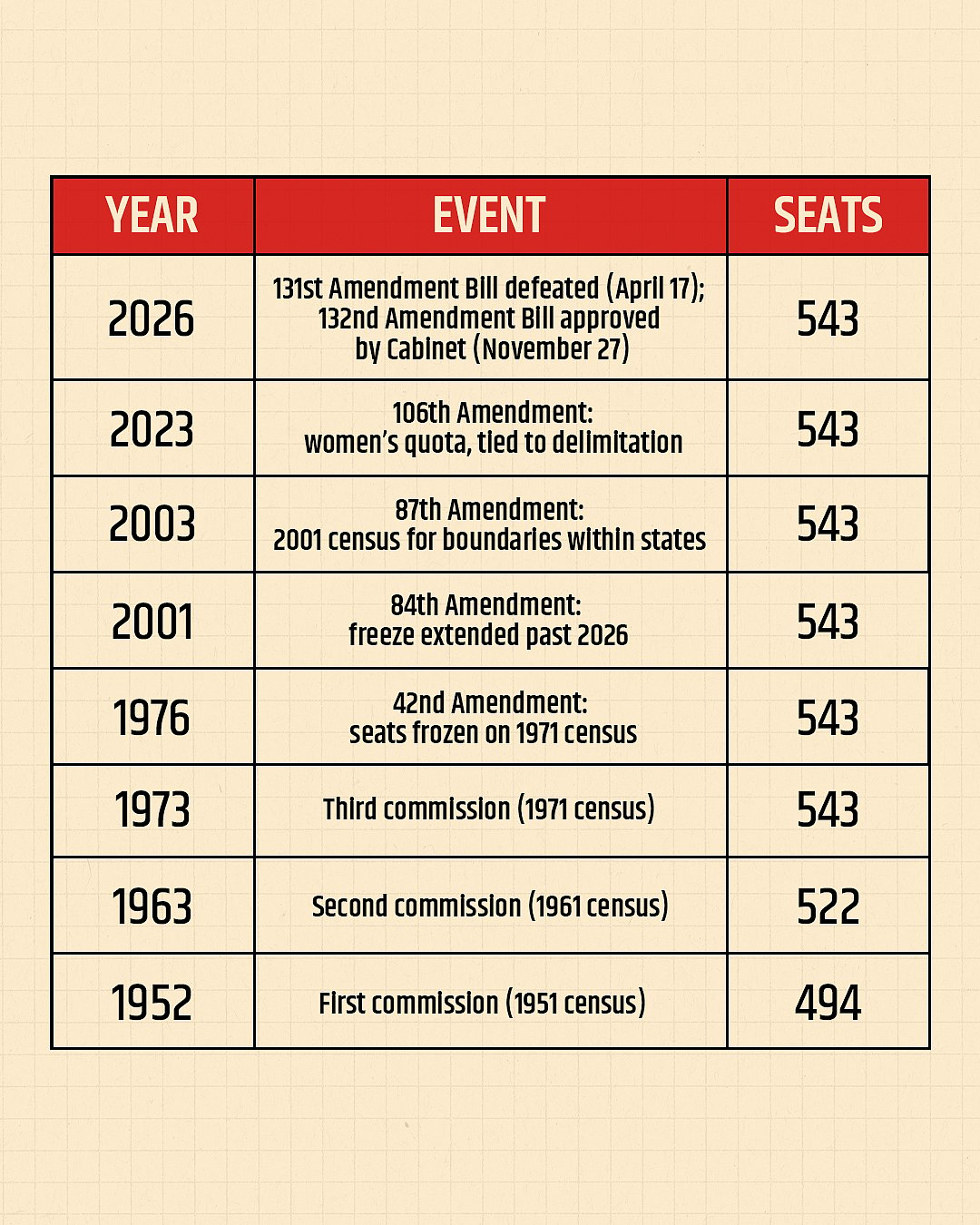
The 2021 census was postponed, and the current census has a reference date of March 1, 2027. PRS notes that a delimitation based on it is unlikely to be completed before the 2029 general election.
The 106th Amendment of 2023 reserves a third of seats for women, but only after a delimitation based on the first census conducted after the Act. The April bills tried to bring that date forward. Doing so meant reopening how seats are divided between states.
Where things stand
The government’s April package had three parts: the Constitution (131st Amendment) Bill, the Delimitation Bill and a Union Territories Laws Bill. Together they would have restored allocation strictly by population, raised the cap on Lok Sabha strength to 850 (815 from states and 35 from union territories), adopted the 2011 census as the base, let Parliament decide by ordinary law when to delimit and which census to use, and started the women’s quota from that delimitation.
The new package differs on the points that sank the first. The 50 percent increase for every state, which Amit Shah promised orally in April, is now in the text of the draft amendment. The freeze would be extended to 2051, so each state’s percentage of the House would stay the same, give or take rounding, even though larger states would gain more seats in absolute terms. Boundaries within states would move from the 2001 census to the latest published figures. The cap on state assemblies would rise from 500 to 650. An accompanying Delimitation (Second) Bill proposes a three-member commission of a serving or former Supreme Court judge, the Chief Election Commissioner or an Election Commissioner, and a state election commissioner, assisted in each state by five MPs and five MLAs without voting rights.
The bill still needs two-thirds of the members present and voting in each House. The NDA now has about 320 MPs. With 540 members in the House, two-thirds of all members voting is 360.
The DMK's 22 MPs, now committed to the bill, are not enough on their own: by The Statesman’s count, DMK support would leave the government 18 votes short, and adding the NCP (SP)’s eight and the YSRCP’s four would still leave it six short. The threshold falls if MPs abstain or stay away, so the outcome may turn on who is absent as much as on who votes yes. In the Rajya Sabha, the NDA has 155 members.
The arithmetic has shifted since April partly through defections, including 20 of the Trinamool Congress’s 28 MPs and six of Shiv Sena (UBT)’s nine, according to The Federal. The NCP (SP) has indicated it will support the new bill.
Stalin said on Friday that the party’s position had not changed and that Tamil Nadu’s 7.18 percent share must be preserved. But on Saturday, the party decided to back the bill.
The new bill goes most of the way towards the three conditions the DMK set after April: that the 50 percent increase be written into the bill, that the 1971-based proportions be frozen for another 25 years, and that the bill carry a schedule of each state’s seats. The first two are met, and the freeze keeps the 1971-based proportions in place without naming 1971. As for the third, reports on the draft do not mention a state-wise schedule, though a uniform 50 percent rise fixes each state’s number in effect.
The DMK opposed the bill in April, has since left the INDIA bloc, and has lost power in Tamil Nadu to Vijay’s TVK. The TVK government had the Tamil Nadu assembly pass a resolution seeking to keep the Lok Sabha at 543 seats and extend the freeze by 25 years. At the Southern Zonal Council meeting on August 20, however, Chief Minister Vijay asked only for a legislative assurance that no state would lose its existing share of seats. The DMK accused him of a U-turn, and the government said in the assembly that it remained committed to the resolution.
Timing could also affect the southern parties’ calculations. The Federal reports that if no amendment passes before the freeze lapses with publication of the 2027 census, the constitutional default would apply and seats would be allocated by population alone. That gives them a reason to settle in this session.
The Lok Sabha reconvenes on November 30 and the Rajya Sabha on December 2, with both expected to finish by December 3. In a newspaper article on November 26, the Prime Minister wrote that the April defeat should fill the country’s hearts with shame. Though Congress’s Jairam Ramesh and the CPI(M)’s John Brittas said the new majority is being assembled through defections. Brittas warned against using women's reservation as cover for electoral engineering.
The numbers
India’s population has grown by close to a billion since 1971, unevenly across states.
Bihar’s population rose by about 215 percent in that period and Kerala’s by about 70 percent. Carnegie estimates that about 8 percent of Lok Sabha seats, roughly 44, are misallocated relative to population. Uttar Pradesh’s and Bihar’s seat shares are each about two percentage points below their population shares; Tamil Nadu’s is about two points above and Kerala’s about one. The average constituency has about 2.7 million people, the highest ratio of any lower house in the world.
The bill would add seats in proportion to what each state has now and freeze each state’s share. The table shows each state’s seats and how many people each MP represents now and would represent under the bill.
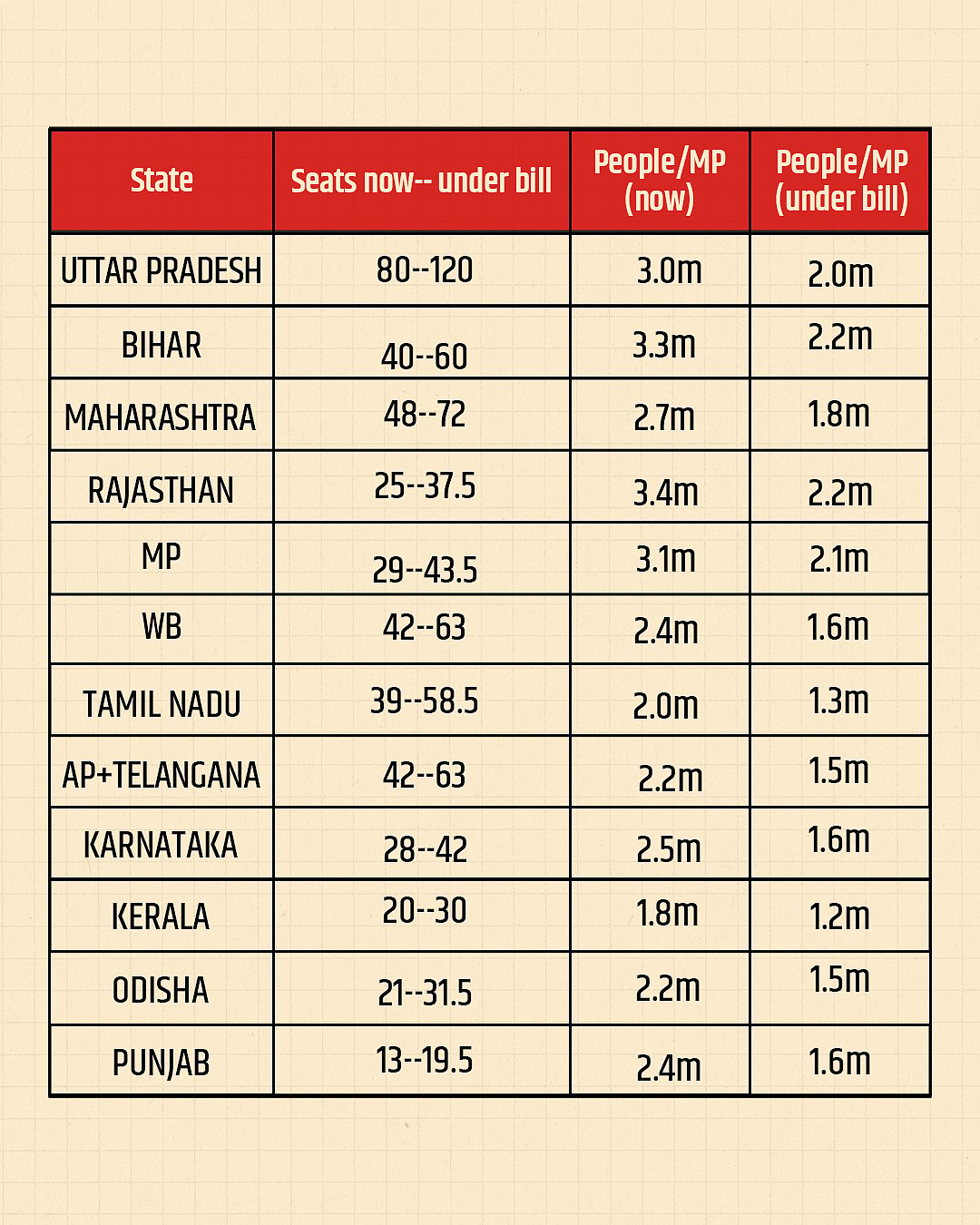
Every MP would represent about a third fewer people.
An MP from Uttar Pradesh would go from about 3 million people to 2 million, and one from Kerala from 1.8 million to 1.2 million. That is an improvement in its own right: Lok Sabha constituencies are the largest of any lower house in the world, and an MP with fewer constituents can, in principle, attend to them more closely.
The gap between states would not narrow. Because every state’s seats rise by the same proportion, the ratios between them stay exactly where they are. An MP from Rajasthan represents about 1.85 times as many people as one from Kerala today, and would under the bill too. A vote in Kerala would still carry nearly twice the weight of one in Rajasthan or Bihar.
A different formula could have narrowed the gap: Carnegie estimates that a House of about 775 seats, smaller than the bill’s roughly 815, would have let the extra seats go to under-represented states without any state losing one.
This is also why the southern parties insisted on protecting their percentage of seats.
The frozen shares already sit further from the population than they did at the 2011 census: Uttar Pradesh holds 14.7 percent of seats against 17.0 percent of the projected 2026 population, a gap of 2.3 points, up from 1.8 points in 2011. Between 2026 and 2036, the same projections have Bihar growing by about 12 percent and Uttar Pradesh by about 7 percent, against under 1 percent for Tamil Nadu and about 2 percent for Kerala. If the bill passes in this form, shares would stay fixed until 2051 while populations keep diverging, so the difference in people per MP between the northern and southern states would widen every year.
Where the redistribution now happens
If each state’s share of seats is frozen, the bill’s effect between states would be limited to adding seats in proportion. Its effects inside states would be much larger. This is where sitting MPs and parties stand to gain or lose.
Boundaries within states were last drawn on the 2001 census; the bill would move them to the latest published figures, in practice 2011, while every state’s seat count rises by half. Migration since 2001 has enlarged urban and peri-urban constituencies relative to rural ones, so equalising populations within each state would shift seats towards the cities. The same would apply to assemblies: the bill proposes raising the cap on assembly size from 500 to 650 and giving assemblies the same 50 percent increase.
Seats reserved for Scheduled Castes and Scheduled Tribes are allotted state by state in proportion to their share of the population, and the commission decides which constituencies are reserved. A new census base and a larger House would change both the number of reserved seats and where they fall.
On top of that, a third of seats would be reserved for women. The bill provides for women’s reservation for 15 years, followed by rotation. Combined with new boundaries and changes to reserved seats, this could leave a large share of sitting MPs with a different constituency, or one they can no longer contest.
The commission’s make-up therefore matters.
Under the new Delimitation (Second) Bill it would have three members: a serving or former Supreme Court judge, the Chief Election Commissioner or an Election Commissioner, and a state election commissioner, with five MPs and five MLAs from each state as non-voting associates. Carnegie refers to allegations of gerrymandering in recent exercises, citing Assam. The 2022 Jammu and Kashmir commission, which added six seats to Jammu and one to Kashmir, was criticised by Kashmiri parties on similar grounds. Delimitation orders have the force of law, and Article 329 sharply limits challenges to them. The Supreme Court held in 2024 that courts can still strike down an order that is manifestly arbitrary or unconstitutional, but the bar is high, which puts more weight on the commission’s independence.
The arguments behind the bill
The government’s formula is a response to arguments that have run for decades. They are worth revisiting briefly: they explain the bill’s shape, they are likely to resurface as Parliament debates it this week, and they will return when the freeze next comes up, in 2051.
Supporters of population-based delimitation start from equal votes, which Article 81 was written to secure. Upendra Kushwaha of the Rashtriya Lok Morcha, a BJP ally from Bihar, says a Lok Sabha seat in the South represents about 21 lakh people against about 31 lakh in Bihar and Uttar Pradesh, and calls the 1976 freeze a black law. The voters who lose out are concentrated in the poorest states, and supporters argue that weighting them less adds to an existing disadvantage.
They also question whether the original incentive still holds. Fertility has fallen across the country, to about 1.7 in Andhra Pradesh and Karnataka and about 3 in Bihar, the outlier, and it tends to follow female education and income more than state policy. Carnegie notes growing frustration in the North, where the cost of keeping 1971 shares falls mostly on the roughly 445 million people (2011 census) of Uttar Pradesh, Bihar, Madhya Pradesh and Rajasthan. The new bill would keep those shares until 2051, eighty years after the census they rest on.
There is a legal question as well. Some analysts argue that a flat 50 percent formula, by preserving 1971 shares, could be challenged for entrenching unequal vote values contrary to Article 81. Because the new bill would amend Article 81 itself, a challenge would have to argue that equality of votes across states is part of the Constitution’s basic structure. The courts have not ruled on that question.
The case against: the southern objection
The southern states have mostly not rejected equal votes in principle. Their objection is that seat shares are one part of a wider federal settlement. The 2001 extension was justified as an incentive for population stabilisation, and the South, which reached replacement fertility decades before the national average, argued that losing seats for it would turn a national commitment into a penalty. M K Stalin, then chief minister, described delimitation in February 2025 as a sword of Damocles over the southern states, and in March told newly married couples in Tamil Nadu not to delay having children.
The South also pointed to the absence of a federal check.
India’s Rajya Sabha is allocated broadly by population, so a shift in Lok Sabha seats would not be offset there. Carnegie’s 2019 study projected that under population-based allocation the ten Hindi-belt states and union territories would hold about 48 percent of an enlarged House, against about 42 percent now, and P Chidambaram estimated that the South’s share would fall from 23.76 percent to 14.53 percent. The southern states, which contribute a disproportionate share of national output and tax, argued that they would end up paying more towards decisions in which they had less say.
The April bills sharpened these fears. Amit Shah’s assurance on state shares was oral, and late in the debate he offered to return within an hour with an amendment. The bills would also have let Parliament choose the census and timing of future delimitations by simple majority. Party politics ran through all of it, since the states that would gain under strict proportionality are those where the BJP is strongest. A joint action committee convened by Stalin in March 2025 asked for a further 25-year freeze. It became the DMK’s main condition, and the new bill concedes it.
Fiscal devolution: states already carry unequal loads
The southern complaint about paying more for less say rests on how the Union shares its tax revenue. Through fiscal devolution, the Union already treats states unequally by design, and that arrangement is a clear precedent for the bargain the delimitation bill is trying to preserve.
A Finance Commission is set up every five years to decide how central tax revenue is shared with the states. It settles two things: how much goes to the states as a whole, and how that amount is divided among them. The 16th Finance Commission, covering 2026-31, kept the states’ overall share at 41 percent of the divisible pool, the part of central taxes open to sharing (cesses and surcharges are kept out of it). To divide that 41 percent, it uses a formula that weighs several measures. The heaviest, at 42.5 percent, is “income distance”: the further a state’s per capita GSDP falls below that of the richer states, the more it receives. Population, measured by the 2011 census, carries 17.5 percent. The upshot is that of every Rs 100 passed on to the states, Uttar Pradesh gets Rs 17.62 and Bihar Rs 9.95, while Tamil Nadu gets 4.1, Karnataka 4.13 and Kerala 2.38.
The table below sets each state’s share of the 2011 population beside its share of Lok Sabha seats (on the 1971 base) and its share of tax devolution under the 16th Finance Commission.
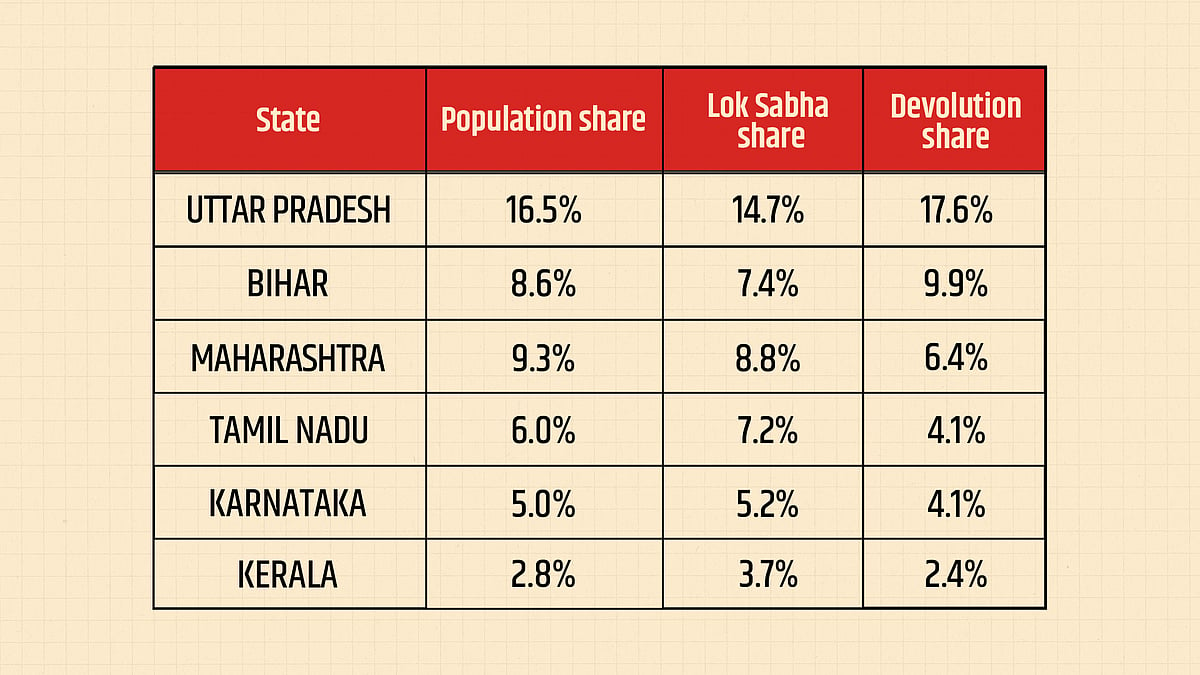
Uttar Pradesh and Bihar receive a larger share of devolved taxes than of population, and a smaller share of seats. Tamil Nadu and Kerala are in the opposite position. Carnegie describes this as a dual asymmetry that has long supported an informal federal balance, and warned that a purely population-based delimitation would remove the southern states’ side of it while leaving the fiscal transfers in place. The new bill would keep both sides until 2051: the southern states keep their premium in seats, and the northern states keep theirs in money.
The fiscal tilt has increased over time.
One summary of the 16th Commission’s report puts the combined share of Uttar Pradesh, Bihar, Madhya Pradesh and West Bengal at 42.5 percent under the 6th Finance Commission and close to 51 percent under the 15th, while that of Andhra Pradesh, Karnataka, Kerala and Tamil Nadu fell from 24.8 percent to 15.8 percent. An opinion piece in The Print estimated that Uttar Pradesh receives 2.73 rupees and Bihar 7.06 rupees for every rupee they contribute.
Estimates of this kind vary with method, and they tend to overstate the contributions of southern and western states, because GST and corporate tax are often recorded where companies are headquartered rather than where income is earned. The direction of the transfers, however, is not in dispute.
The two sides draw different conclusions from this history.
Southern parties take it as evidence that they already subsidise the rest of the Union. They accepted the outflow while their representation was protected; if they now lose seats as well, both the fiscal and the political arrangements would work against them. On their reading, representation is the counterpart to their fiscal contribution.
Supporters of reallocation see a federation that routinely accepts unequal burdens and has already moved its fiscal formula from 1971 population figures to 2011 ones without serious damage. It did so by compensating states that slowed population growth through a separate criterion, and they argue a seat formula could do the same.
If it passes, northern parties that backed reallocation would give up, for now, the extra seats strict proportionality would have brought them. With seat shares then fixed until 2051, any future rebalancing between the two regions is more likely to come through Finance Commission formulas, where the weights for population, income and demographic performance are revisited every five years, than through the composition of Parliament.
Impact on Parliament
Even with every state’s share frozen, a Lok Sabha half as large again would change how Parliament works.
The Rajya Sabha would stay at 250 members, so the ratio between the two Houses would move from 2.2:1 to 3.3:1. PRS points out that in a joint sitting a government with 56 percent of the Lok Sabha could then override an opposition holding two-thirds of the Rajya Sabha, and that the upper house’s weight in electing the President and Vice-President would fall. The executive could grow too: the 15 percent cap on the Council of Ministers is tied to the size of the Lok Sabha, so the council could expand from 81 to 122 members. Individual MPs, meanwhile, would get fewer chances to ask questions or raise issues, since many of those slots are allotted by ballot.
Several longer-term questions sit beneath the bill.
The first is who is counted where. The census counts people where they usually live, so long-term migrants from Bihar and Uttar Pradesh working in Bengaluru, Chennai or Mumbai count towards the populations of those states, although many remain registered to vote at home. Population-based seat counts and the electorates that vote in them are drifting apart, in a direction that complicates the North-South framing.
The second is what the population map will look like by 2051. India’s fertility rate is now around replacement level and most states are below it, so the northern states’ faster growth will slow over the coming decades. That bears on what a reallocation after the freeze would look like, and on whether another freeze would be needed at all.
The third is what kind of federation Parliament should reflect. The United States fixed its House at 435 seats in the early 20th century but reapportions them among states after every census, and balances that with a Senate in which each state has equal representation. The average congressional district has about 780,000 people, against about 2.7 million for a Lok Sabha constituency. India has it the other way round from most federations: its lower house no longer matches population, while its upper house almost does.
One proposed remedy is to make the Rajya Sabha represent states as units, with equal or compressed representation per state and a restored domicile requirement for members, so that a population-based Lok Sabha would be balanced by a territorial upper house. That would need its own constitutional amendment, and the large states would resist it. In 2021 the Madras High Court observed that Tamil Nadu’s seats had been cut from 41 to 39 in 1967 to match its population, and asked whether one person, one vote was the right standard in a federal structure. No court has yet answered that question.
What to watch out for
The disagreement is between two defensible readings of the Constitution: India as a union of equal voters, and India as a union of states, some of which met national goals on population and pay more into the common pool. Every government since 1976 has put off choosing between them. The bill would put the choice off again, to 2051, and leave both the fiscal and the political halves of the present bargain where they are.
The bill as drafted settles the 50 percent increase and the freeze, but both could change through amendments, and it needs two-thirds in both Houses.
There will be developments to look out for in this compressed session.
Whether the government agrees to a state-wise schedule of seats, or to amendments on the Rajya Sabha, Finance Commission criteria or separating the women’s quota.
How the commission would redraw boundaries within states, where most of the bill's real effects lie.
If the bill passes as drafted, the gap between states’ populations and their seats will remain, in a larger House, until at least 2051.
Bismarck called politics the art of the possible. Delimitation asks India’s politicians for something closer to the art of the impossible: a settlement in which the voter in Patna counts as much as the voter in Kochi, and in which Kerala and Tamil Nadu still recognise the Union as the one they chose to join.
For 50 years the political class has preferred to leave that question to the next generation. If this bill passes, it will have done so once more, until 2051.
 South Central 72: The delimitation question and Telangana caste survey
 On delimitation fears, some lessons from Jammu and Kashmir