Inside the twisted mind of a hired rapist
Over thirteen months, TNM spoke to ‘Pulsar’ Suni, the man convicted of abducting and raping a leading Malayalam actor in 2017. His words offer a chilling glimpse into the mind of a remorseless contract criminal.

There are some things ‘Pulsar’ Suni will not talk about. “I will never tell you, or anyone else, where the phone is,” he said matter-of-factly.
“Okay, but can you tell me if it still exists somewhere, or did you destroy it?” I asked.
He smiled, drank some water, and swatted a mosquito. “I’ve already told you too much. This is a promise I made to someone — that I will not speak about the phone. And I always keep my word.”
The phone in question is no ordinary device.
It is a crucial but missing piece of evidence in a case where Gayathri* (name changed), a leading Malayalam actor, was sexually assaulted by Pulsar Suni — once a driver to several Malayalam film elites.
On December 8, 2025, a Principal District and Sessions Court convicted Suni, along with five other men, for kidnapping Gayathri in February 2017. During the abduction, Suni sexually assaulted her in the backseat of her own car while the group drove through the bustling streets of Kochi.
This is a crime that stunned and polarised Kerala. At the nucleus of this case was one man — Malayalam superstar Dileep, who now stands acquitted.
The prosecution’s argument was that Dileep had commissioned Suni and the others to carry out the rape as an act of revenge against Gayathri for revealing his extramarital affair to his then wife, Manju Warrier.
The court, however, ultimately did not accept the prosecution’s theory of conspiracy, and Dileep was acquitted.
Suni was found guilty of charges including that of abduction and gangrape. The unsettling questions of who hired Suni and what motivated this crime remain unanswered by law.
At 11.03 am, as the judge read out the charges against Suni, he revealed no expression.
As the media followed Dileep out of court, Suni sat down, signalled to a friend and told him, “Find me some alcohol. Pour it in a regular bottle and give it to me before the police take me away.”
The police waited for the media frenzy to die out before taking Suni to Viyyur jail. Suni has already spent seven years, nine months, and four days in jail for the case, before he was granted bail by the Supreme Court in September 2024.
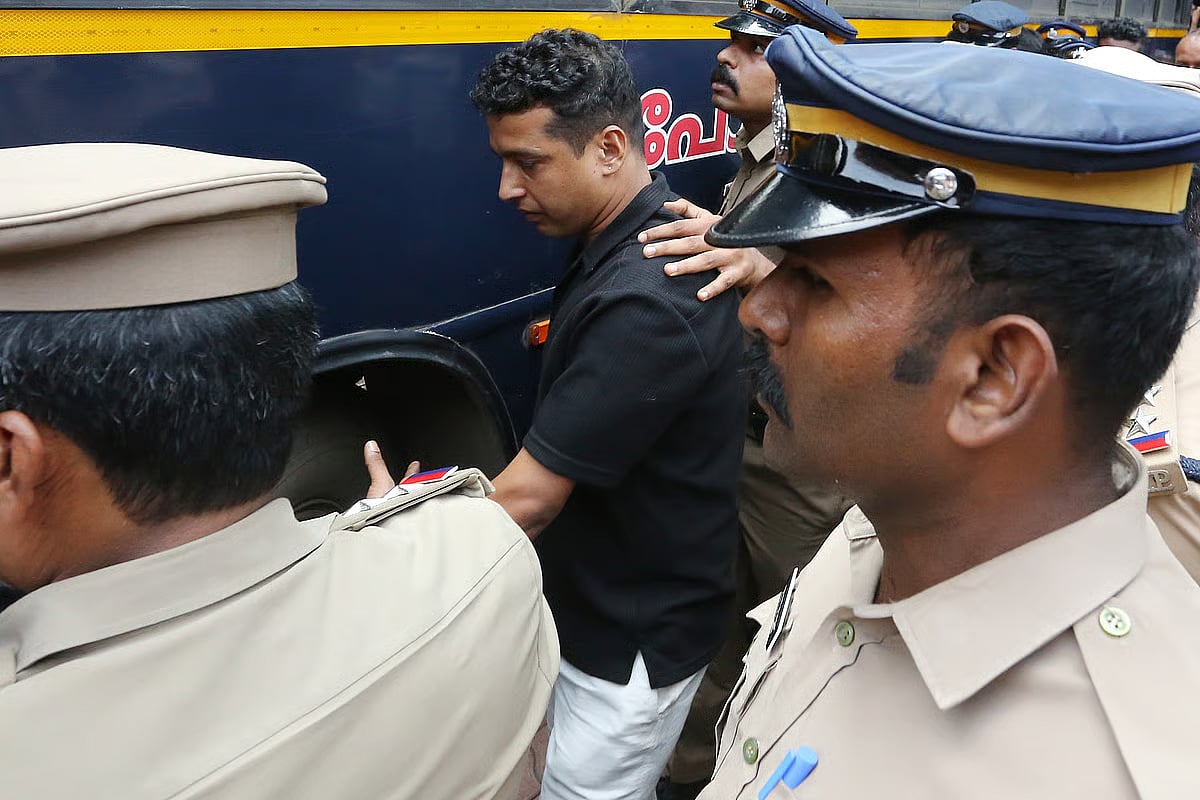
He was released under strict bail conditions that forbade him from interacting with the media. A month later, Suni consented to be interviewed by me.
Towards the end of our first brief phone call, he calmly added, “If by any chance word gets out that I spoke to you, it won’t just be bad for me but for you as well. Don’t misunderstand me, it is a threat.”
Over the next thirteen months, Suni spoke to me over multiple phone calls and four in-person meetings. This was the first — and so far, only — time he consented on record to provide a detailed account of his role in the assault to a journalist.
The only other time Suni spoke with the media was in April 2025 when Reporter TV, a Malayalam TV channel conducted a sting operation on him.
When I asked him why he had spoken to a TV journalist, Suni said he was aware of the conversation being recorded all along, but didn't think it would be immediately telecast. It was hard to tell if Suni was being honest, or if he was simply embarrassed about being caught on camera.
During our conversations, he admitted to his crime in no uncertain terms. He had abducted Gayathri. He had used the phone — the one he refused to speak about — to record eight clips of himself sexually assaulting her. And, he claimed, he had done this on the instructions of the man who hired him: Dileep.
But this is where Suni’s contradictions lie. In court, he has denied any role in the conspiracy and refused to reveal details of the plot or the money trail, ultimately weakening the case.
While speaking to us, Suni consented to be repeatedly interviewed for a text story. But on camera, he refused to say the same things.
When we first met in October 2024, he did not want to get into details of the crime. He was yet to give his statement in court and insisted that he planned on being honest with the judge.
His yoga teacher in jail, he claimed, had changed his life. He said his practice taught him to “start telling the truth.” His lawyer, he added, was not pleased.
Days later, he appeared before the judge, swore under oath, and lied.
He told the court that he wasn’t even in the car with Gayathri when she was assaulted but had been aware of a conspiracy to attack her. He admitted to being in touch with Dileep, and said he often worked for the actor’s wife and friends.
“In court, you can only speak like that,” he said casually, when I asked why he had lied so blatantly.
Over the course of one year, in Suni I met a man fuelled by a life of crime — restless to talk about it, and eager to be liked.
“Abducting someone is not a big deal. It’s like picking up a chicken from the street. There’s no real risk,” he once said, grinning.
Conversations with him offered me not just a glimpse into the mind of an unrepentant criminal, but also exposed how his chilling confidence was enabled by the Malayalam film industry.
That is precisely what makes Suni’s world view indispensable to understanding this case. Our interviews revealed more than just the contours of the crime he was hired to commit; they also opened a window into the world that made such a man possible.
Chapter 1: ‘Helping nature’
The first time I spoke to Suni over the phone, his curiosity overtook his skepticism.
“I heard you met ‘that man,’” Suni said, clearly referring to Dileep. “What did he say about me?”
Suni was talking about my meeting with Dileep in February 2024. I had interviewed Dileep for part one of this story: ‘An orchestrated nightmare: A sexual assault that unmasked Malayalam cinema.’
I told him that my conversation with the actor had been generic, and that he had emphasised on how he respects women a lot. This made Suni laugh. “Actually, what I don’t understand is why people say that I don’t respect women. I also respect women. Right?”
Subscribe now to unlock the story

Why should I pay for news?
Independent journalism is not possible until you pitch in. We have seen what happens in ad-funded models: Journalism takes a backseat and gets sacrificed at the altar of clicks and TRPs.
Stories like these cost perseverance, time, and resources. Subscribe now to power our journalism.
Disruptor
$90
Annual auto-renew
- checkPaywall stories on both Newslaundry and The News Minute
- checkStronger together merch – Fridge magnets and laptop stickers
- checkPriority access to all meet ups and events, including The Media Rumble
- checkAll subscriber-only interaction – NL Chatbox and monthly editorial call with the team
- closeRSS feed of all paywall podcasts
- closeFour free one-month NL-TNM gift subscriptions
Game Changer
$250
Annual auto-renew
- checkPaywall stories on both Newslaundry and The News Minute
- checkRSS feed of all paywall podcasts
- checkStronger together merch – Fridge magnets, laptop stickers, mug
- checkPriority access to all meet ups and events, including The Media Rumble
- checkAll subscriber-only interaction – NL Chatbox and monthly editorial call with the team
- checkFour free one-month NL-TNM gift subscriptions
Already a subscriber? Login