Get your Milton Friedman and Ayn Rand right: Zomato and Blinkit aren’t capitalism
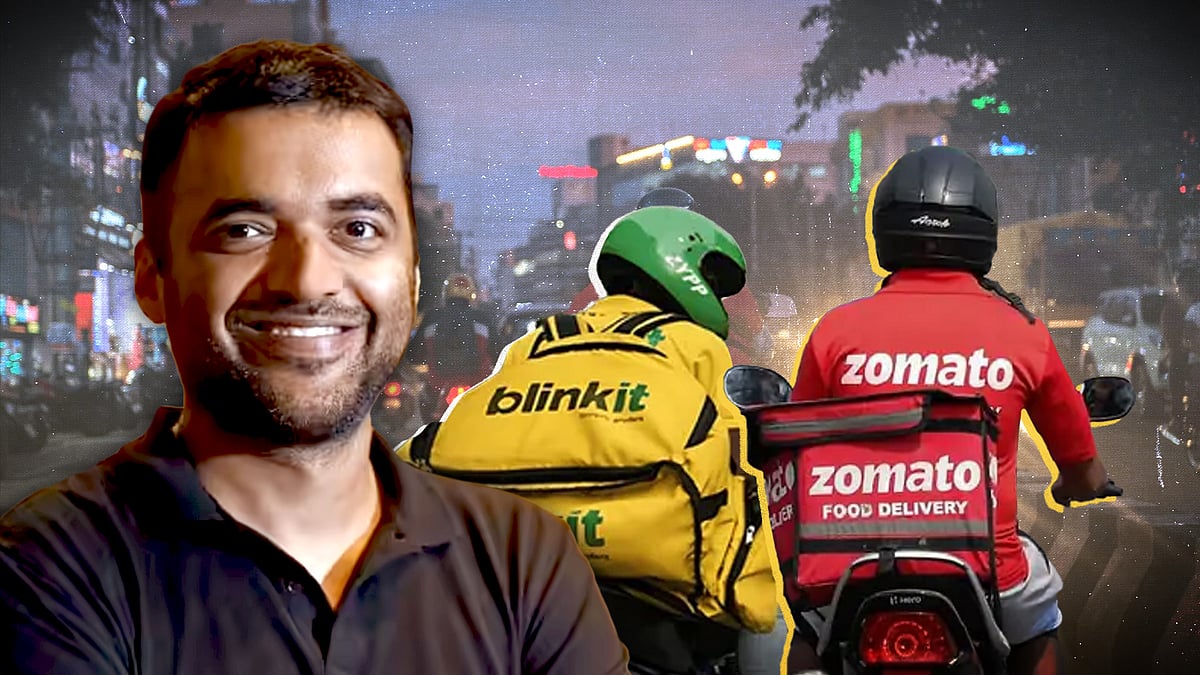
After being called a Marxist and a leftist for criticising India’s quick-commerce giants, Vivek Kaul responds the only way he knows how – by going back to first principles. By any honest capitalist test, the neighbourhood kirana store owner – bearing real risk without venture capital crutches – looks far more like the entrepreneur Rand admired than the likes of Deepinder Goyal.

-NaN:NaN:NaN
For a better listening experience, download the Newslaundry app


Late last week, I wrote a piece responding to Deepinder Goyal’s tweets on how he views India’s gig economy. It went viral – and as is inevitable with anything that does, it brought with it an equal measure of bouquets and brickbats.
Since then, I have been labelled a communist, a leftist, and a Marxist, for pointing out the large holes in Goyal’s arguments. I have also been told that I don’t understand what capitalism is – or how a free market works. Of course, along with this there has been some abuse as well – words that can’t be published here.
The most amusing of these was the claim that since Deepinder Goyal – the founder of Eternal – the company behind Zomato and Blinkit – has made a lot of money in life, he necessarily knows what he is talking about. And since I haven’t, my thinking, apparently, doesn’t really count.
Interestingly, many of the people accusing me of not understanding capitalism would swear by Ayn Rand, the novelist-philosopher who turned the entrepreneur into a moral hero. Rand believed that profit was not a dirty word but a signal of value creation. In her novels and non-fiction, entrepreneurs earned rewards by solving real problems for willing customers, not by relying on hidden subsidies or a desperate labour force.
All this has led to this piece, in which I try examining whether what the likes of Zomato, Swiggy, Blinkit, Zepto, Instamart, and others are doing, can really be labelled free-market capitalism. Or is it something else being passed off as capitalism? Indeed, are we witnessing a high-speed exploitation engine merely dressed in free-market clothing?
Ironically, many who called me names, think of Goyal and others like him, like Rand’s “Atlas”, the heroic entrepreneur standing against a hostile and an adversarial world. Given this, it’s only fair to ask: would Rand recognise this as the capitalism she championed? Therefore, it’s important to cut through the jargon and the narrative spin, in order to focus on what’s actually happening out there.
What is free-market capitalism?
Thomas Sowell – as right of centre an economist can be – in his book Basic Economics: A Common Sense Guide to the Economy, defines capitalism as “markets coordinated by price movements”.
He writes: “A free market economic system is sometimes called a profit system, it is in reality a profit-and-loss system – and the losses are equally important for the efficiency of the economy, because losses tell producers what to stop doing – what to stop producing, where to stop putting resources, what to stop investing in.” And this dynamic is at the heart of free-market capitalism.
Put simply, this is what free-market capitalism looks like in practice.
1) It is a system in which most forms of economic activity along with the resources, are owned by individuals or private companies, and not by the government.
2) These private owners decide what to produce and how much to produce. They sell their products or services at a certain price. At this price, they expect to make a profit.
If they constantly keep losing money on their business, then sooner or later they shut down, unless they keep getting bailed out by someone else. Given this, profit and loss act as signals – profits encourage more production, losses tell businesses to stop wasting resources. The point being that the risk of the business is being borne by the entrepreneur.
3) Entrepreneurs make decisions based on incentives like profits, costs, demand, etc.
4) What an economy produces and consumes is shaped mainly by these private decisions, not by government orders. This leads to efficient allocation of the limited resources that any economy has. And that in turn leads to maximum overall welfare.
Or as Milton Friedman – an economist who championed the free market more than almost anyone else in the second half of the twentieth century – wrote, along with his wife Rose, in Freedom to Choose: A Personal Statement: “When workers get higher wages and better working conditions through the free market, when they get raises by firms competing with one another for the best workers, by workers competing with one another for the best jobs, those higher wages are at nobody's expense. They can only come from higher productivity, greater capital investment, more widely diffused skills. The whole pie is bigger – there's more for the worker, but there's also more for the employer, the investor, the consumer, and even the tax collector. That's the way a free market system distributes the fruits of economic progress among all the people.”
This is how free market capitalism has been defined by people who have believed in it.
How does a quick delivery business work?
There are two sides to any economic transaction – supply and demand. Most startups in the business of delivering things – or companies which are technically also referred to as platforms – usually subsidise the demand side. The quick delivery business is no different.
They offer discounts on many products they sell to get prospective buyers to buy things. This leads to a situation where they are constantly losing money for long-ish periods of time.
Why are they doing this? They are trying to cash in on what’s referred to as the network effect. Let’s take the humble landline telephone, invented by Alexander Graham Bell in 1876 to understand this.
Bell made the first telephone call to his assistant, Thomas Watson. But a telephone was of little use if no one else owned one. As David Evans and Richard Schmalensee write in Matchmakers: The New Economics of Multisided Platforms: “A telephone was useless if nobody else had one. Even Bell and Watson started with two. A telephone was more valuable if a user could reach more people.”
If the telephone had remained a device used only by Bell and his assistant, it would have been a largely pointless invention. Its value increased only as more people began using it. The larger the number of users, the more useful the network becomes for everyone.
Platform companies are perpetually trying to build their network and cash in on the network effect. Uber did this by subsidising the supply side of drivers – by initially paying them much more than usual – and the demand side of consumers – by charging them much less than usual.
This worked in two ways. With drivers being paid more they were more likely to download the app and offer their service. And with consumers being subsided they were more likely to download the app and use the service being offered by the drivers. A perfect match.
Of course, the idea is to grow big first and think about profits later. Indeed, something like this played out even during the dotcom bubble of the 1990s. As Evans and Schmalensee write: “By the mid-1990s, when the dotcoms flooded the market, supported by plentiful venture capital funding, the view that entrepreneurs should build share quickly and worry about money later was the accepted wisdom.”
Given this, venture capitalists have historically championed a strategy of aggressive expansion, fuelling platform businesses with capital that empowers them to intentionally sustain losses in pursuit of market dominance.
The quick delivery business in India, of which Goyal’s Eternal is a part, has been no different. The idea has been to subsidise the buyer in the act of delivering stuff as quickly as possible – even in less than 10 minutes.
So, the price the buyers pay on average doesn’t really help the companies in this space make money. The question is why are they ready to bear losses.
Losses help companies acquire customers. The more the number of customers a company has, the more the number of suppliers that will be interested in doing business on the platform.
In the case of a food delivery business this means more restaurants will be happy to list on the company’s app, allowing the company to make money from the restaurants. It allows them to make money from advertisements as well.
In case of quick commerce – involving delivery of vegetables, fruits, groceries, and many other items – the acquisition of customers encourages suppliers of products and services to list on the app. This then becomes another source of revenue for the company.
The trouble is that reaching a state of market dominance in India’s quick commerce space, where there is a lot of competition, isn’t going to be easy. Blinkit, Zepto, Instamart, BigBasket, Flipkart Minutes – are all competing for the same share of the consumer spending pie.
And this is a market that the two big boys – Reliance and Amazon – have not yet seriously entered. (I have no information on if they have plans of doing so, but given their business structures, it seems likely.)
So, what’s the idea? It’s to outlast competitors and keep funding losses up until then. As Evans and Schmalensee write: “Network effects [mean] that one firm… [will] control the market…. These [are], therefore, winner-take-all markets.” Ultimately, that’s the game. But that game has its repercussions as well.
No free lunch
As the old cliché goes there is no free lunch in economics. The cost of subsidising the consumer has to be borne by someone. Now, as this piece on CNBC TV18 points out, for an average order size of around Rs 600-700, the quick commerce companies are losing money. So, if delivery partners are paid even Rs 10 more per order, the company will lose more money unless customers spend much more per order.
This shows how fragile the system really is. Given that the companies are happy subsidising the customer, they have to squeeze out costs somewhere else, which is what they have been doing with gig workers. So, there is no free lunch.
Also, the business model of Goyal and others like him only works because India has a huge supply of youth entering the workforce. There aren't enough jobs going around for them, which pushes them to become gig workers.
This isn’t a choice they are making. It's a Hobson's choice – take gig work or nothing at all. The lack of choice is forcing them to make this choice. Indeed, if the gig workers “stopped their two-wheelers,” and did not log onto the apps to pick up deliveries, the “supposed” brilliance of the founders would vanish immediately.
Further, I have been reprimanded by many that at least such companies are creating jobs. Now, whether they are doing so at the aggregate level of the Indian economy is debatable – but we will get to that.
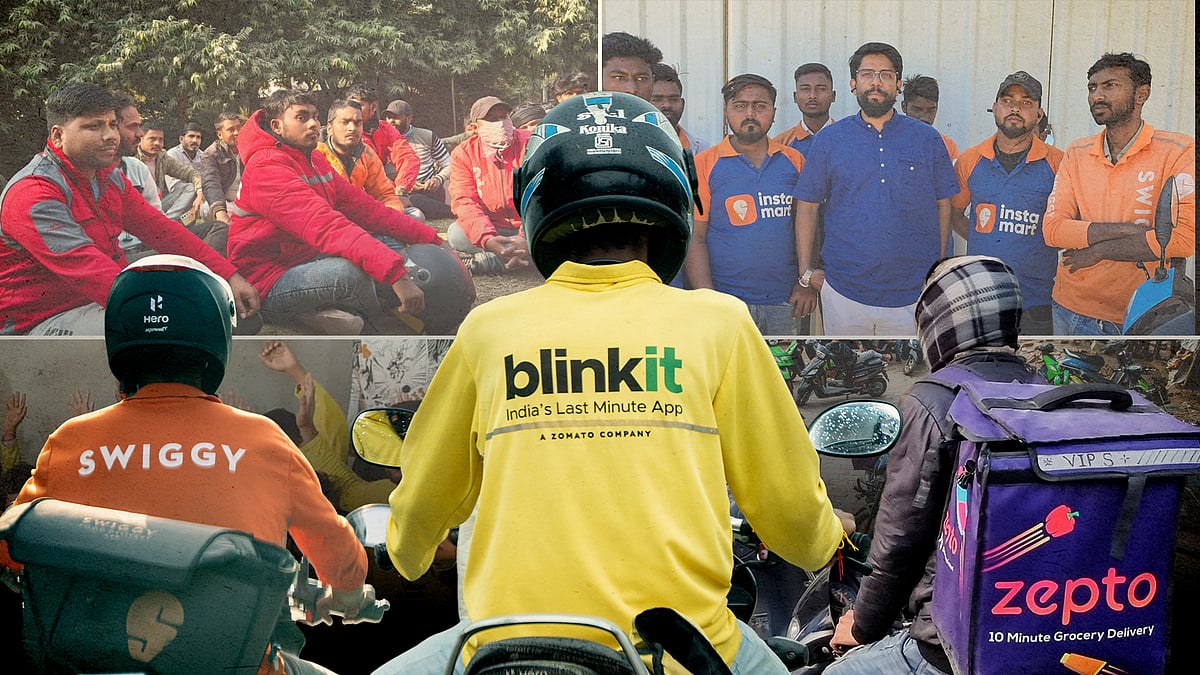
Indeed, it’s the lack of choice for a large number of Indian youth that is basically funding Goyal’s business model. So, it is important to call out his holier than thou act. For all the technology, and spin accompanying that technology, there would be no Zomato, Blinkit and Swiggy, without the desperation of India’s gig workers.
That’s the right way to look at it. It is a system built on fragility. A large part of the “free lunch” the consumer enjoys is effectively a transfer of value from a gig worker who really has no other options. The entrepreneurs are cashing in on this desperation by building a business around it. (Of course, you might argue there are many others doing the same. But then multiple wrongs don’t make a right.)
Why this isn’t free market capitalism
1) In a free market, a business losing money would be told by the “price signal” to stop. Here, money pumped in by venture capitalists and later by retail and other investors through initial public offerings (IPOs) acts as a cushion. It allows entrepreneurs to postpone hard market truths, absorb losses, and instead adjust what they can control – most notably, labour costs.
2) As Milton and Rose Friedman wrote: “A free market system distributes the fruits of economic progress among all the people.” That clearly doesn’t seem to be happening here, with the gig workers bearing a substantial portion of the cost.
3) The Friedmans also wrote that free market capitalism makes the whole pie grow bigger. Is that happening here? Or is quick commerce through its discounts just destroying the local kirana store and the mom and pop shops from whom we could possibly buy our groceries and other items of regular and not so regular use? In the process, is it destroying jobs elsewhere? If ten gig workers replace 5 local shop assistants and 1 small business owner, the “net job creation” might actually be negative or neutral for that matter.
In October 2024, the All India Consumer Products Distributors Federation (AICPDF) had said that the rapid expansion of quick commerce in India, over the past year, had led to the closure of around 200,000 kirana stores.
In that sense, India’s small business owners are true capitalists. They are competing without the safety net of venture capital, bearing the full brunt of market risks, and operating on real price signals rather than artificial subsidies.
Unlike Goyal and other platform titans who can afford to lose crores to capture a market, these small entrepreneurs must be continuously profitable to survive. In the Randian sense, the local kirana store owner – fighting an uphill battle against a subsidised giant – is the truer embodiment of the independent, risk-bearing entrepreneur than the platform founder propped up by investor cash.
What I am trying to say is that the way quick commerce companies operate creates second-order effects; effects that haven’t been studied seriously enough. That’s why I don’t buy the simple “at least they are creating jobs” argument. I’m open to being convinced – but I need evidence. Pointing only to the millions of gig workers in India, without examining what is being displaced or lost elsewhere, doesn’t really cut it.
Of course, free market capitalism often destroys jobs. There’s nothing new about that. But it also creates new ones. Take the horse, once central to transport. Before modern machines, people travelled between cities on horseback and moved around towns in horse-drawn carriages. Entire industries existed around this system – horse breeding, carriage making, and even the cleaning of horse manure from city streets.
The arrival of railways and automobiles made most of these jobs obsolete. Horses were no longer needed for large-scale transport, and the livelihoods built around them disappeared.
At the same time, new kinds of work emerged. Factories began producing trains and cars. Drivers, mechanics, and locomotive operators found employment. Building railway lines and national highways created millions of jobs in construction and engineering.
This dynamic also leads to further rounds of innovation. As Martin Wolf notes in The Crisis of Democratic Capitalism, electricity led to refrigeration, the telephone, skyscrapers, air-conditioning, and the early computer.
How is this dynamic playing out in the case of quick commerce companies? Is quick commerce truly expanding the economic pie through genuine utility, or is it merely a high-speed redistribution of existing wealth that replaces small, local businesses with exhausted gig workers? That is a question well worth asking.
4) Free market capitalism is expected to lead to efficient allocation of the limited resources that any economy has, leading to maximum overall welfare. The question is why are resources being thrown to deliver stuff in under ten minutes or even half an hour for that matter. What problem are we solving here?
Which is why we see so much of narrative construction or storytelling from the entrepreneurs running platform companies and the venture capitalists backing them. The idea is to simply hide the inefficiency of the system they are building.
To that extent Deepinder Goyal is no different. As he recently tweeted: “[Gig working] will bring more people into the fold, who will be able to earn some money, upskill themselves and later join India’s organised workforce. Not to mention, consistently send their kids to school - which will fundamentally change the fabric of our nation one generation later.”
This sounds so much like WeWork Inc’s mission which was “to change the world’s consciousness”.
Lately, Goyal has also been giving us gyan on aging. (On a slightly different note all this sounds so similar to the tagline of Karan Johar’s 2001 movie Kabhi Khushi Kabhie Gham: “It’s all about loving your parents.”)
After this is published, some eager beavers are likely to point out that, oh but Eternal – the company behind Zomato and Blinkit – is profitable. Yes, it is.
In 2024-25, it made a net profit of Rs 527 crore. But that was on account of its other income of Rs 1,066 crore. This is money primarily made by investing the cash it has raised from its initial public offering and from further rounds of funding by large investors.
Or take the case of Swiggy which made losses of Rs 3,117 crore in 2024-25.
In November 2024, Swiggy came up with an initial public offering (IPO) to raise Rs 11,327 crore. Of this, Rs 6,828 crore was an offer for sale – meaning existing shares were sold to the public, and large investors cashed out. Funny thing: the business had lost close to Rs 15,700 crore in the five year period from 2019-20 to 2023-24.
There’s nothing illegal about this, but you can see what’s happening here. It is a game of “passing the parcel”, where early large investors exit with crores while retail investors inherit the losses.
In December 2025, about a year after its IPO, it raised a further Rs 10,000 crore more by selling shares again to large investors to be able to continue funding its large losses.
Indeed, businesses that survive only because someone else keeps absorbing its losses can’t be heroic in Ayn Rand’s world – they are being propped up.
Now, Zepto, another big player in this market, is looking to raise up to Rs 11,000 crore through an IPO. Typically, such IPOs are sold at extremely high prices. Indeed, over the years, the steady stream of storytelling that has been carried out by entrepreneurs and venture capitalists – helped along by a largely pliant business media not used to asking questions and an army of podcast wallahs – has led retail investors, directly and indirectly through mutual funds, to clamour for shares of such companies.
But the fund raising of such companies doesn’t end with the IPO. They keep selling shares even after their IPO in order to fund their losses. Of course, not all of them will survive. Some will get sold. Some will simply shut down. And a huge misallocation of resources would have eventually played out.
But the company that manages to outlast everyone else will end up making a lot of money. And that’s what everyone in the business is hoping for. In the absence of Randian value-creation, the business model will eventually shift to extraction – becoming what Tim Wu, a professor of law at Columbia University in New York, who has worked extensively with the US government, calls a poker room in a casino.
As he writes in The Age of Extraction – How Tech Platforms Conquered the Economy and Threaten Our Future Prosperity: “The business model of today’s platforms might be usefully compared to that of a casino’s poker room. What the casino wants more than anything else is for players to show up and stick around. What exactly they do – who bets on what, who wins and who loses, is irrelevant. Because no matter what happens, the casino always takes its cut.”
And that’s the end game. But if you win because you had the biggest bank account, you haven’t really succeeded in a free market.
6) Further, venture capital and other investor funding actively distort the market. By propping up and keeping loss-making businesses alive for years, it prevents capital from flowing to more productive and sustainable uses.
It also misallocates human talent. It is like Wall Street hiring people with PhDs in the sciences to trade stocks and derivatives, pulling them away from genuine research that would benefit humankind far more than any trading ever can.
Also, money keeps chasing scale, speed and hype, instead of businesses that are actually likely to create long-term value and stable, real jobs. This also disincentivises genuine innovators, who know from the outset that their work is unlikely to attract serious funding.
Indeed, Ayn Rand admired the entrepreneur who stood alone, took risks, and bore the consequences. What we see here is different. Risk is cushioned by venture capital, losses are socialised onto workers, and success depends on outlasting rivals. This is not the capitalism that Rand spent her life writing and talking about, as did Milton Friedman.
The conclusion
The way quick commerce business operates, it does not reflect real market prices, something which is at the heart of capitalism and the free market. Like Uber did earlier, these companies use huge amounts of venture capitalist money to keep prices low and deliveries fast. This has trained customers to expect cheap, instant service.
Because prices are kept artificially low, customers behave differently. They order more and more often because delivery is “free” or has very low order levels. Companies open more dark stores to show growth. A dark store is a small warehouse set up specifically to process online orders, not to serve walk-in customers. Workers hustle harder to earn the same amount of money. None of this would happen in a normal market where prices reflected real costs.
So, when gig workers ask for higher pay, they are not being unreasonable. But under the current business model of companies that’s simply not possible. Hence, all the spin around creating jobs etc., and saying things like, workers turning up to work shows that the system is not unfair.
If workers are to be paid more, something else must change: prices must go up, free deliveries must reduce, or delivery times must slow down. This is difficult in a very price sensitive market like India. Also slower deliveries over a few hours are unlikely, simply because that’s the idea that the entrepreneurs have sold, both to their investors, and to the world at large.
Which basically means the entrepreneurs will have to keep squeezing those who they can. Further, their model is built around labour arbitrage – or India’s huge unemployment and underemployment problem. They don't need a worker to stay for years on end; they just need a fresh supply of young workers who see the Rs 15,000-20,000 monthly payout as attractive for a few months before they get burnt out.
As Goyal put it on X, the “attrition percentage is 65% in a year”. And millions of Indians entering the labour force every year will keep making up those numbers. This is labour arbitrage wrapped in tech jargon, with venture capitalists continuing to fund this illusion.
The goal isn't necessarily to be efficient today; it’s to outlast everyone else until they are a monopoly. Once they are the only option, they will raise prices and reduce speeds, and consumers will have no alternative because by then their brains will be trained to the whole idea of deliveries within minutes. Of course, with only one or two companies surviving, the options available to gig workers will reduce further.
Finally, since I have been labelled a Marxist, it is only fair to look at what the man himself actually wrote. In the first volume of Capital, Karl Marx observed that “piece-wages [the payment per-delivery model] become... the most fruitful source of reductions in wages... committed by the capitalists.”
Whether one views this through the lens of Friedman or through the lens of Marx, the conclusion is the same: this is not a triumph of productivity, but a triumph of extraction. In Ayn Rand’s world, “Atlas – the entrepreneur” carries the world on his shoulders. But in the world Goyal has built, the real “Atlas” is a 26-year-old on a scooter, carrying a bag of groceries he was paid too little to deliver, for a company that hasn't earned a real profit, funded by investors who are simply betting that when the music stops, they will be the last ones standing and holding the prize.
Vivek Kaul is an economic commentator and a writer.
In times of misinformation, you need news you can trust. We’ve got you covered. Subscribe to Newslaundry and power our work.
 When privilege pretends to be economics: Why Deepinder Goyal gets it royally wrong
 ‘A small mistake can cost us our lives’: Why gig workers are on strike on New Year’s Eve