Hindutva and the Mamankam revival: Rebranding a medieval Kerala festival as Kumbh Mela
On the banks of the Bharathapuzha in Kerala, the medieval martial assembly of Mamankam is being revived as Kumbh Mela under the leadership of Juna Akhada, a monastic order from Varanasi. Historians are not amused.

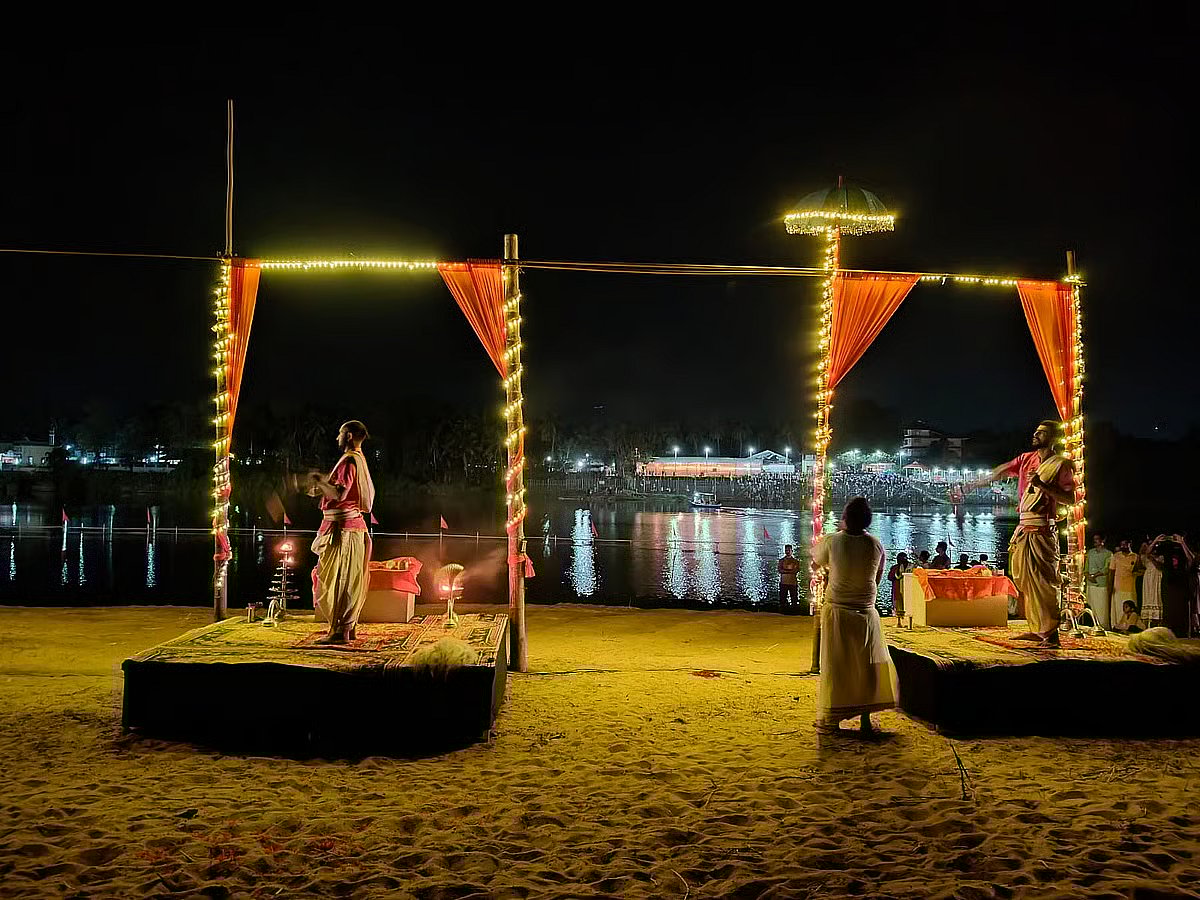
As dusk settles over Bharathapuzha in Thirunavaya, the historic sandbanks where the festival of Mamankam was once held, a spectacle it has never experienced before begins to unfold. A Kashi ghat-style river aarti. Flames blur into ribbons of light as priests standing on specially raised platforms swing multi-tiered brass lamps in sweeping arcs. A soundscape of bells, Sanskrit chants and drums builds in layers, turning the crowds ecstatic.
For a visitor, the ritual held as part of ‘Maha Magha Mahotsavam’, which began on January 19, momentarily dissolves the distinction between the Bharathapuzha and the Ganga. Branded as ‘Kumbh Mela of Kerala’ by the organisers – Varanasi’s Juna Akhada and Mata Amritanandamayi – the festival seems to be far removed from the Mamankam of the history books.
The Sri Panch Dasnam Juna Akhada is the oldest and the most influential Shaivite monastic order from north India, which plays a significant role in Kumbh Mela.
The Mamankam festival, held once every 12 years in Thirunavaya, now in Kerala’s Malappuram district, too had a religious character, but it was inseparable from statecraft. A high-stakes 'Game of Thrones’, Mamankam was the ultimate political arena for asserting regional hegemony in medieval Malabar, according to historians.
The festival was originally presided over by the Chera Perumals. After the decline of the Chera Empire (circa 12th century), the right to be the Rakshapurusha or protector of the festival, became a symbol of who holds the sovereign authority over Kerala.
This right of presidency belonged to Valluvakonathiri, the ruler of Valluvanadu in north-central Kerala. Over time, this symbolic supremacy was forcibly appropriated by the Zamorin of Kozhikode, and this led to the banks of the river witnessing the free flow of blood as suicide squads from Valluvanad attempted the Zamorin's assassination during the Mamankam assembly.
The last Mamankam was held in 1755 and the Mysorean invasion of Malabar in 1766 by Hyder Ali is widely considered to be the reason why it ended.
Subscribe now to unlock the story

Why should I pay for news?
Independent journalism is not possible until you pitch in. We have seen what happens in ad-funded models: Journalism takes a backseat and gets sacrificed at the altar of clicks and TRPs.
Stories like these cost perseverance, time, and resources. Subscribe now to power our journalism.
Disruptor
$90
Annual auto-renew
- checkPaywall stories on both Newslaundry and The News Minute
- checkStronger together merch – Fridge magnets and laptop stickers
- checkPriority access to all meet ups and events, including The Media Rumble
- checkAll subscriber-only interaction – NL Chatbox and monthly editorial call with the team
- closeRSS feed of all paywall podcasts
- closeFour free one-month NL-TNM gift subscriptions
Game Changer
$250
Annual auto-renew
- checkPaywall stories on both Newslaundry and The News Minute
- checkRSS feed of all paywall podcasts
- checkStronger together merch – Fridge magnets, laptop stickers, mug
- checkPriority access to all meet ups and events, including The Media Rumble
- checkAll subscriber-only interaction – NL Chatbox and monthly editorial call with the team
- checkFour free one-month NL-TNM gift subscriptions
Already a subscriber? Login