BJP govt said Delhi logged 200 ‘clean’ days in 2025. So why did this winter feel this bad?
December saw not a single day of breathable air, and January brought more ‘severe’ spells despite heavier rain. For weeks, stepping outside still meant checking the AQI first.

On paper, the capital’s air seemed to be improving.
The BJP government says Delhi recorded nearly 200 days last year when the average Air Quality Index (AQI) stayed below 200 – considered “moderate” or better – about 15 percent more than the previous four years and broadly in line with National Clean Air Programme targets.
But step outside during winter, and the numbers tell another story.
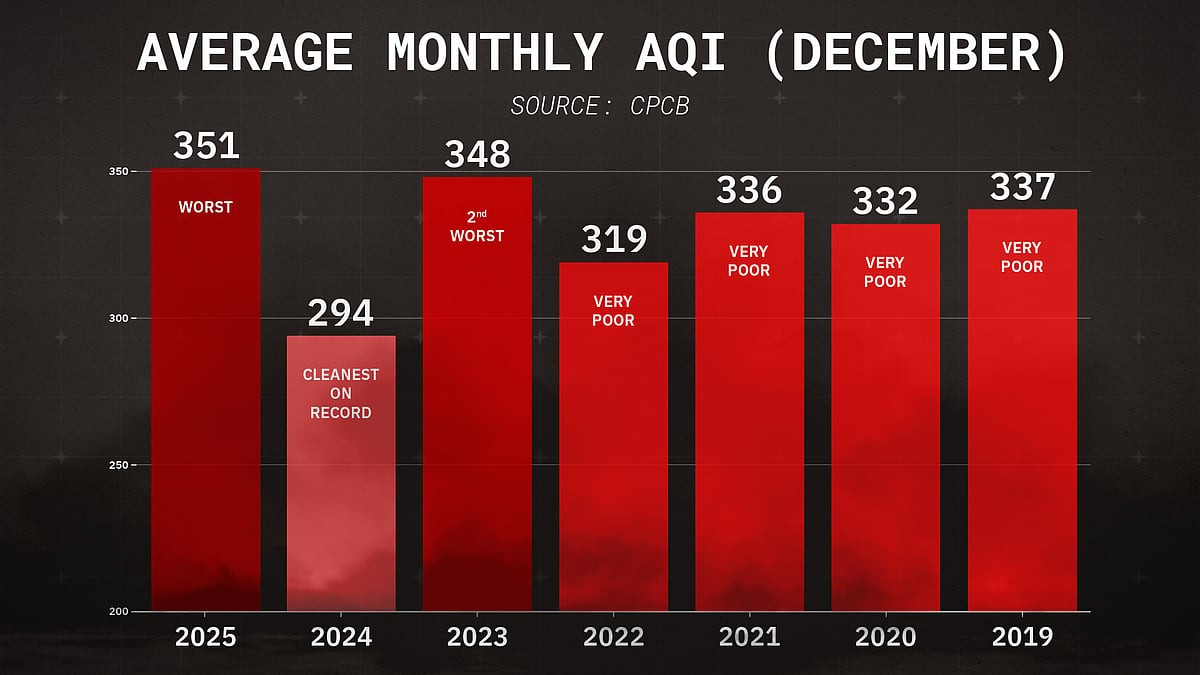
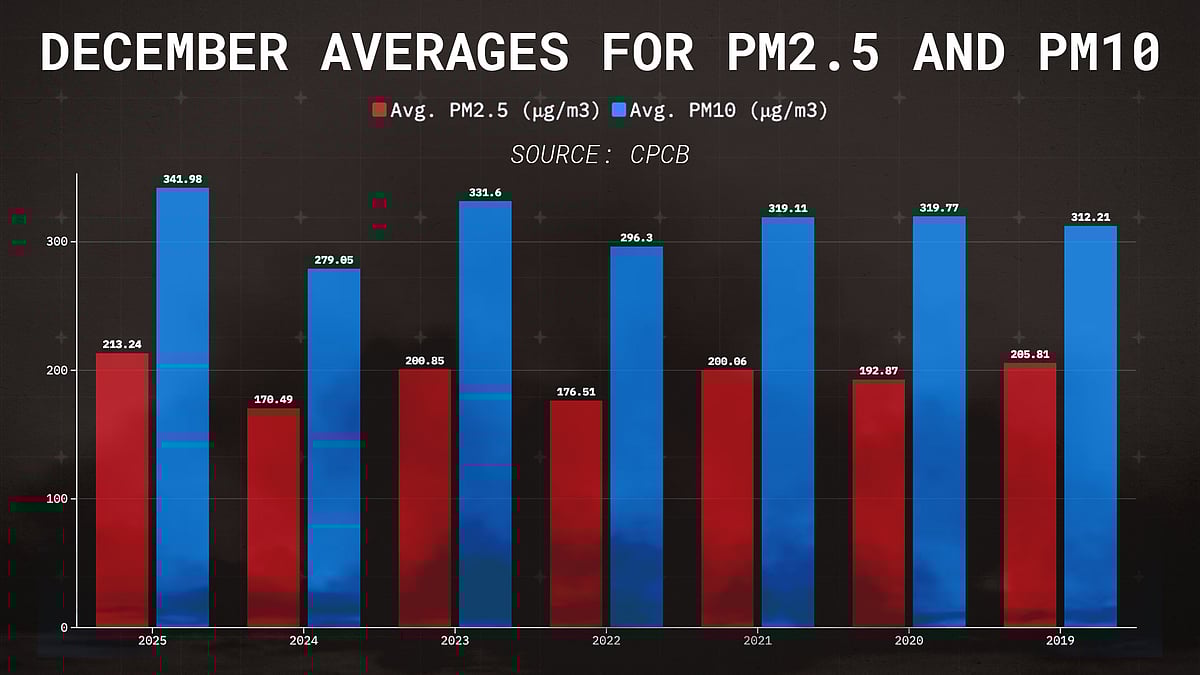
In fact, December 2025 was the most toxic the city’s air has been in seven years, with a monthly average AQI of 351, according to an analysis of the Central Pollution Control Board’s data. The daily average AQI hovered above 300 on 22 days, and fell into the ‘severe’ category on five days. The air was at its worst on December 14, when AQI spiked to a hazardous 461. Even the “cleanest” day – Christmas – managed only 234, still firmly in the “poor” category. The trends reflect in PM2.5 and PM10 numbers too.
Even January this year failed to offer any respite. Despite receiving 33 percent more rainfall, this January was more polluted than the one last year.
This January, 17 days recorded AQI above 300, two days were “severe”, and only two days dipped below 200. In contrast, January 2025 had avoided the “severe” category altogether. The two-day severe spell lasted from January 17 to 19, with AQI peaking at 440 on January 18. Air quality improved slightly in the final week, largely due to rainfall.
“If there was no rain in the last week of January, this January may have seen a record high average AQI,” Gufran Beig, founder of SAFAR and chair professor at NIAS, told The Times of India.
Interestingly, a reply by Union environment minister Kirti Vardhan Singh in the Rajya Sabha maintained that Delhi had just eight ‘severe’ AQI days in 2025. Of these eight ‘severe’ AQI days, five fell in the month of December, as per CPCB records.
But why this winter?
Dr Mohan P George, a scientist and former additional director at the Delhi Pollution Control Committee, told Newslaundry that it could be an enforcement issue.
“It seems that the action required to tackle pollution in Delhi itself has not been taken properly. We have seen biomass burning continue. There is construction-generated dust and resuspended road dust, but effective enforcement to control these sources is lacking. And then you have vehicular emissions – a constant every year. A few days of rain in January provided a brief respite.”
“Meteorological factors are significant. However, I don’t think any major meteorological changes were observed this winter compared to previous winters. We did get some rain, although it came late in January,” he added.
“For example, when I talk about biomass burning, we are among the greenest cities in the country, where municipal bodies regularly prune trees. After pruning, horticultural waste is dumped in parks or open areas, both assigned and non-assigned, and then most of it is collected and burned elsewhere. There is, of course, municipal solid waste, which isn't managed properly. Given how cold it has been this winter, people have also used these resources liberally for heating,” he said.
Manoj Kumar, an analyst with the Centre for Research on Clean Air and Energy, also attributed the surge to an enforcement issue.
“If you look at the DSS (Decision Support System developed by the Indian Institute of Tropical Meteorology and Ministry of Earth Sciences) composition, it’s always the same major sources, only their contributions [to air pollution levels] vary. If you look at vehicular pollution, it’s consistently around 20 percent, ranking among the top two sources of air pollution. Meteorology is an influencing factor, but the question remains, why are these emissions happening in the first place?” he asked.
Kumar cited the January 2026 report by the Commission for Air Quality Management (CAQM), titled Report of the Air Quality Experts on Identification of the Causes for Worsening AQI in Delhi-NCR, which did a meta-analysis of all major pollution sources between 2015 and 2025. They reiterate the same major sources – vehicles at the top, followed by biomass burning, construction, and industry.
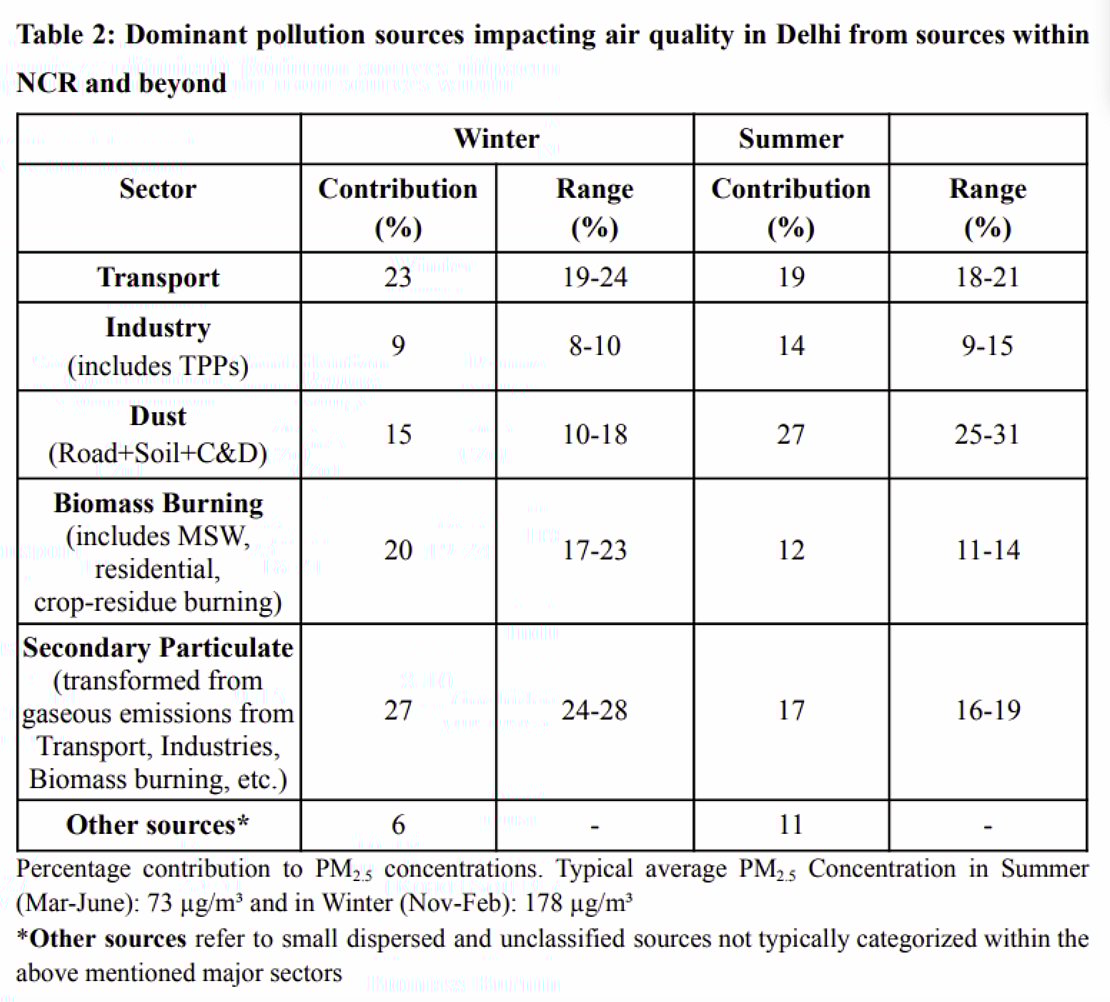
“Year after year, industrial emission norms are not met. Also, there has been a rapid increase in vehicle registration this year, and I’m not talking about EVs,” said Kumar.
According to recent research by the Centre for Science and Environment (CSE), local sources remain a major reason why this December was particularly bad. In their study, the think-tank argued that winter pollution in Delhi did not "dissipate" after stubble burning in neighbouring states, which occurs in October-November in Punjab, Haryana, and parts of Uttar Pradesh. In fact, they argue that it intensified.
As Anumita Roychowdhury, executive director, Research and Advocacy at CSE, noted: “Rising pollution trends in December are indicative of two things. The first, which we all know, is that atmospheric conditions aggravate pollution levels. This was particularly evident this December, when we saw consistently high levels and a very dry month with no rain.”
“More importantly, rising levels in December highlight the significant impact of local pollution sources. While the early winter (October and November) is influenced by stubble burning and smoke from farm fires, these external factors largely subside by December. Therefore, if pollution remains high, it points directly to internal sources within the city and the surrounding region – specifically vehicles, industry, and waste burning,” she adds.
Local sources encountered a new factor in January: increased moisture. However, this had little impact on the deteriorating air quality. Despite 33 percent more rainfall than in January 2025, pollution levels remained high.
As Roychowdhury explained, “A lot of these monthly variations are explained by the changes in their atmospheric conditions. This January saw some rain, and there was some immediate washout effect. However, the moment the rain stops, the pollution gets trapped again. Also, the added humidity from rain in cold conditions leads to condensation, which traps more pollution. It’s a vicious cycle. Only, consistent heavy rains get you some real respite.”
So, what’s the way forward? To address these local pollution sources, Roychowdhury explains that seasonal enforcement measures are insufficient; instead, structural and systemic changes are required.
“For instance, reducing vehicular pollution requires a massive transition to zero-emissions, meaning the electrification of the vehicle fleet must accelerate to eliminate tailpipe emissions. Simultaneously, we must upscale integrated public transport to curb the explosive growth of vehicles on the road. Similarly, waste burning can only be eliminated by achieving 100 percent collection, segregation, and material recovery, and by eliminating waste dumps, so that waste is not burnt in the open. Finally, the industrial sector must undergo an energy and technology transition to adopt clean fuels and processes,” she said.
“Now, these kinds of solutions require infrastructure and system-level changes, and that demands upscaled action throughout the year. If you are trying only to sprinkle water during the winter, that is not going to solve this problem,” she added.
With inputs from Udai Singh and Uttkarsh Godhaar.
This piece is part of a collaborative campaign to tackle air pollution. Here’s how you can join the Fight To Breathe. Click here to power this campaign.