The sacred geography they bulldozed: How Modi’s vision erased Kashi
What happens when a civilisation as layered as Banaras is flattened into a ‘destination’? When faith becomes content, and devotion becomes footfall?

Mahadev floats in ghostly neon blue inside a glass box. As he tilts his head to swallow the poison of Samudramanthan, a cloud of blue smoke hisses out and helicopter style blades spin. The drama is irresistible.
Visitors line up for a chance to whizz. The ticket counter is open. Men sit around with 3D visors rapt in simulated Kailash Parbats and Shiva verses as hi-vis devices download quick anime mythology lessons.
3D centre at Kashi Vishwanath Complex
Brightly coloured god projections illuminate the walls at night for an immersive feel. The non-stop recorded hymns on loudspeaker are set to soothing rather than rousing. Interactions are mostly hands-free and digital. The effect is a spa-like, ‘virtual’ atmosphere. The messaging is Hindu Lite – easy to digest, bite-sized doses of modern religiosity.
Welcome to the grand plaza of the Kashi Vishwanath Corridor (KVC). Hospital-clean to the point of sterility.
Immersive atmosphere at KVC with ever-changing pictures of gods and soothing, repetitive shloks.
“Yeh aastha nahin vyapaar hai,” says Vinod Pandey, a small goods shopkeeper whose shop narrowly missed the bulldozer that made all this possible.
He is not far wrong. Many in Banaras have compared KVC to a mall but it is more like the western notion of an ‘attraction,’ based on tourism, footfall and merch.
It requires maintenance, a regular stream of income and multiple sub-attractions. Its prize attraction the Vishwanath temple, is ticketed and crowd controlled. The grand plaza has food courts, toilets, entertaining sub-attractions, galleries, a multipurpose hall, a baby feeding room, a Gita Press bookshop, city museum, Mumukshu Bhawan, three banks and reel friendly, brightly lit steps to the river, among other pose-y spots. Like the Akshardham temple in Delhi that has a boat ride and an INOX theatre, this is a destination family day out with a quick dose of feel-good spiritual business.
To many whose new middle class sensibilities burnished by summer travels to Europe, are now revolted by what lies just outside KVC’s pristine walls – flying ash, crowds shoulder-brushing each other in narrow galis, leaky pipes, piles of rubbish at corners, shops bursting at their seams and decaying buildings – this might even be a sigh of relief in architectural form.
Then why is a vast, clean, modern plaza in the heart of Banaras such a bad idea?
Geography is one answer.
In the late 1980s, as part of the initiative to clean the Ganga, the World Bank offered a $90 million loan to build a highway along the ghats of Banaras, one of the world’s oldest living cities.
Aghast at the possibility of cars whizzing alongside the most ancient quarter of the city and its fragile historicity, conservators and planners working with the newly formed Indian National Trust for Art and Cultural Heritage (INTACH) proposed instead, a project to restore the ghats. They even sent a young architect to shift residence there to understand how native Banarsis lived in this ancient maze like city with its (to outsider eyes), chaotic, often alarmingly unmanageable conditions.
Over the course of several months, they discovered something momentous that its citizens knew all along.
Beneath the bedlam of the narrow galis dotted with innumerable tiny mandirs, the shops, homes, the processions of the dead, the oozing drains, the smoke, ash, stray livestock and tangle of electric wires; lay a complex, wondrous cultural geography settled over centuries, that many scholars had termed “sacred geography”, a term that few were familiar with then.
Its base was not laid on standard western Cartesian grids. It didn’t have the prevailing North-South axis modern architects and planners were trained on. Nevertheless, this astonishing geography was “logical, cognitive and rational,” says planner and urban conservation doyen AGK Menon who headed the INTACH project. “We realised it was a fully planned city according to cultural tradition – specifically the tradition of pilgrimage.
According to Prof Rana PB Singh (formerly IIT-BHU), a cultural landscapes expert and contributing member of the premium International Council on Monuments and Sites (ICOMOS) that protects cultural heritage sites globally; the Gyanvapi Kund was its sacrum mundi or sacred space, from which five concentric rings radiated in larger circles.
The fourth circle was the 13th century, 80 km Panchkroshi Yatra circuit (See map below) as a microcosm of the larger parikramas around India. It covered 108 temples that replicated the pan India parikrama temples and took five days to circumnavigate – clockwise, keeping the city on the right.
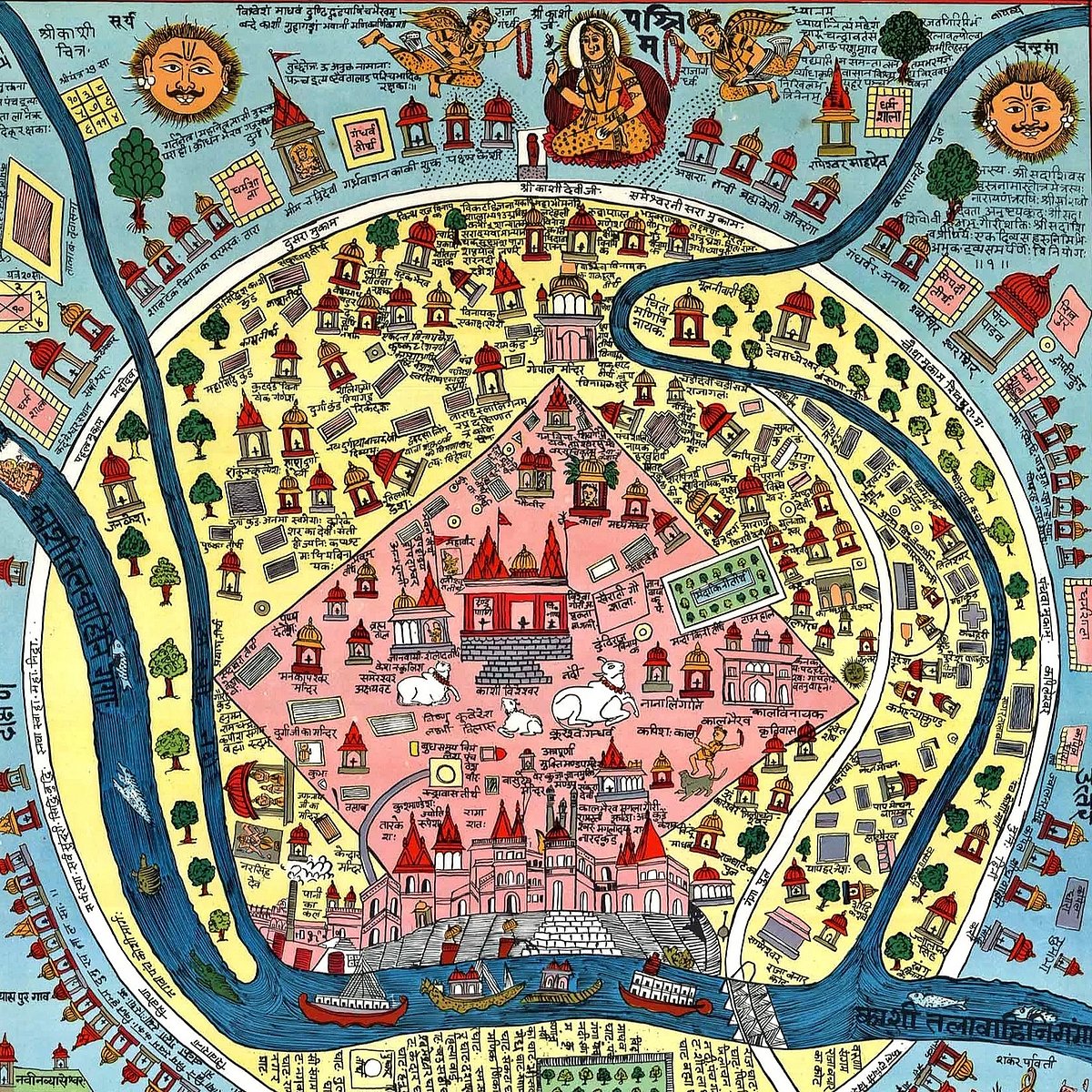
Banaras’ unique sacred geography
American scholar and author of the seminal book Banaras: City of Light, Diana Eck, described Banaras as a city where physical space and faith were interlinked. Instead of grids and intersections, its shrines and temples became the landmarks that mapped the city. The intricate urban web of galis, ghats, upper and lower levels represented a cosmological order for pilgrims who traversed them. Each was interconnected, one leading to the other, creating an extraordinary urban layout unlike any other; layered and formed over centuries.
“The tirths of Kashi are seen as circling the city in larger and larger circles constituting a vast geographical Mandala,” she writes in another work, India A Sacred Geography.
Every ancient map of Kashi depicts it as such – a circle, mapped by shrines and sacred sites. Its maze of narrow galis are intensely alive with humanity because, as Mahant Vishambar Nath Mishra of Sankat Mochan temple and professor electrical engineering at IIT-BHU says, “Venice se compare karte hain but ours is a living heritage, occupants hain, dus bees generations se.”
This network of deeply connected shrines, sites and galis forms an integrated, cohesive “living landscape” that its residents and visitors always understood, and still continue to navigate profoundly well.
Corridor development rips through sacred geography
Into this intricate web of sacred geography and antiquity, crashlanded the 2022 Kashi Vishwanath redevelopment project. The demolitions at Manikarnika Ghat in January 2026 are simply an extension of this.
Both are part of this regime’s nationwide Corridor Development strategy. This strategy actively seeks to maximise footfall at key religious sites and important spaces by creating corridors of ‘modernisation.’ By positioning itself as the ‘saviour’ of religion and bountiful patron, bringing ‘modernity’ to neglected sacred spaces, the regime’s aim is to build a legacy.
In fact, the term ‘modernisation’ is mere word-bait for a drastic process of amputation inside the ‘corridor’ while the areas around it remain resolutely unmodernised, untouched by repair. A more fitting term would be Bubble Development since the gap between the pristine and untouched remains as vast as before.
A non-negotiable of this ‘modernisation’ mission is the ‘clean slate’ requirement that demands complete destruction. Every single thing on the land must be demolished to ensure a clean piece of land to build something new. This leaves no place for conservation. Zero worth is assigned to old neighbourhoods, generational settlements, trees or heritage.
This is a developer mindset at work. It assigns value purely and only to land– so financial reparation is considered compensation enough. The citizen is not given the luxury of refusal.
Corridor Development also chooses the most valuable part of the city to erase – its defining identity.
So it’s India Gate in Delhi, Kashi Vishwanath in Banaras, Gandhi’s Ashram in Ahmedabad etc. The ‘clean slate’ clause then methodically wipes away histories of the site and its routes, its native associations with the city and the ecologies that surround it. It also immediately cuts off access to citizens by putting up entry barriers.
In Delhi’s Central Vista, the ‘clean slate’ strategy destroyed 2,000 trees, wiped out its prime public arts centre and grabbed 100 acres of public land earmarked for the citizen. In the Kashi Vishwanath ‘redevelopment’, it bulldozed 5.5 acres of living, organic settlements, systematically ‘clean slating’ homes, ghats, trees, historic streets that interconnected the city over centuries and establishments, indifferent to their irreplaceable significance.
A look at the time-stamped ‘clean slating’ shows how the city’s unique geography is slashed through jaggedly, breaking up the invaluable spatial patterns built over centuries that connected the city’s temples and mythologies in ways that can no longer be accessed because of large physical walls that block them.
The same script was followed at Ayodhya whose central town was practically wiped out. Vrindavan’s Banke Bihari Temple stands next in line to be thus ‘modernised’.
Banaras needs change: Conditions are untenable.
Journalist Vyomesh Shukla argues that modernization is urgently required and there is nothing new about sweeping changes in Banaras as a look at its layered settlements will prove.
If we go further back in history he says, Manikaranika’s cremation ghat itself is not the ancient Mahashamshan of Banaras.
That was built over centuries ago - by destructive changes that invaders or foreign rulers initiated, adding roads, mansions and bazaars on top of the actual grand cremation ground. The original wound is of course – the destruction of the temple at Gyanvapi itself, replaced by a mosque. “Adi Vishvweshvar ke vigrah ke sthaan par Razia Sultan ki masjid”, writes Shukla in an article in Hindi newspaper Dainik Jagran.
Plus Manikarnika’s untenable realities are inevitable fodder for change, he says, describing the terrible conditions at a recent funeral he attended there.
“We arrived slightly drenched by the drizzle. Amidst the terror of filth and the slippery ground, all possibility of mourning vanished as I focused on trying to avoid breaking my head and getting home safe. Suddenly several logs rolled from the woodpile hitting a young man who fell unconscious. By God’s grace he was not severely injured but the conditions were such that any mishap could have happened. I realised the Ghat’s residents are inured to its dangers and chaos.” (translated from original)
24/7 cremations at the Manikarnika Ghat site. The demolitions have made the conditions even more untenable.
Can anyone even argue that this doesn’t need urgent intervention? Conditions around Manikarnika are simply unsustainable.
But what exactly is it that needs to change?
‘Dream Vision’ architecture and its standard playbook
The answers should come from conservation experts, historians and heritage professionals. Instead they come from a standard playbook the government has developed over 12 years on mega urban projects – as seen in the new Parliament, Ayodhya Ram Temple, Nicobar Port project, Kashi Vishwanath etc.
The playbook privileges power over rules.
Therefore it advocates stealth and speed, non-compliance of existing regulations and institutional arm-twisting. It shuns stakeholder consultation, and is resolutely anti-expertise refusing to take institutional or professional advice.
Naturally, the architecture this playbook produces also privileges power.
It is commerce oriented, not citizen oriented, always maximised for the outsider (tourist, bureaucrat, visitor), rather than the insider resident. It is barricaded from citizens who can henceforth no longer access the land taken away from them. It exists as an alien bubble with no bearing to its surroundings architecturally or functionally.
All these features are ticked off in the Kashi Vishwanath Corridor and its Manikarnika follow up.
Finally the overarching force that drives this architecture and strategy is not any professional considerations but a very personal “dream vision” of Prime Minister Modi as quoted repeatedly by his then Urban Development Minister Hardeep Puri and the architect for both Kashi Vishwanath and Central Vista projects, Bimal Patel.
In Central Vista, the “dream vision” envisaged every single bureaucrat in very close proximity to the PMO – in an age of digital work-from-home. This required the ‘essential’ demolition of 18 existing buildings.
In Kashi Vishwanath, the “dream vision” was a direct path to the Temple from the Ganga even though the temple still doesn’t face the river nor was it ever placed to have direct access to it. It became a planning ‘imperative,’ for which the complete demolition of 500,000 square feet of historic galis described in 300 year-old texts, 400 homes, 143 temples and two ghats - Khiraki and Jalasen – was considered absolutely ‘essential’.
“Sabse badi galat cheez – kaheen nahin likha hai ki dono (temple and river) jude hain. Aap snaan karke mandir jaiye aur vidhiyaan kariye. Yeh sirf tourism badhane ke liye hai – but Banaras was never a tourist city!” says Prof Singh.
In Ayodhya, unhappy with circularity and layered antiquity, the ‘dream vision’ led to the demolition of 4500 homes to lay a massive 13 km linear ‘grand’ avenue Ram Path and other ‘sacred’ pathways leading to the ‘grand’ destination Ram temple backed by retail, footfall, hotels, entertainment and merchandise for - that old regime favourite – a “world class city.”
This “dream vision” has no professionally qualified basis, nor any architectural integrity, or expertise in contemporary planning or conservation. In its profound ignorance of historical sensibilities – the understanding of local conditions is not even considered.
Yet it is imposed on every project, deciding ‘imperatives’ and ‘essentials’ that have no bearing. Yet it is indulged at huge, ugly, wrecking-ball cost to the citizen. The havoc this playbook and ‘dream vision’ have exacted on cities is in fact the legacy that will remain instead of the legacy of ‘modernisation’ its patrons actually want it to leave.
The new Manikarnika
The new Manikarnika development is thus no different. Locals have dubbed it “ISBT” – a reference to Delhi’s Inter State Bus Terminal that it bears an uncanny resemblance to.
Its so called ‘essentials’ also require 6.5 acres of ‘clean slate’ land by the removal of galis, temples etc on this most precious of Banaras' ghats. Its land will also be maximised for larger tourist footfalls with the new 3,15,921 square feet electric Shamshaan with multiple crematoriums and bathrooms as key features. It will also be user-friendly and commerce oriented with “wood plazas” displacing the small wood shopkeepers that currently line the path to the cremations.
It will also have a ‘dream vision’ direct path being created so the dead don’t have to negotiate Banaras’ galis on their final journey. For this, the clean-slating of 400 shops, and erasure of a once flourishing and ancient quarter of Dalmandi for this path is also considered ‘essential’.
“Kyon bhai?” asks Prof Singh. “Taking benefit of Manikaranika, (can) you do anything? Phir kya democracy? Yeh to Banaras ka Master hai. What is the point?”
KVC as role model of the ‘Dream Vision’ brand
Taking KVC as the OG model of the ‘Dream Vision’ brand, the question arises – does ‘Dream Vision’ architecture actually work? In Banaras, the answer depends on more questions. Who is it aimed at? What kind of religious practice does it encourage? How does it fit into Banaras architecturally, emotionally, spiritually?
KVC is plotted as a grand destination, a Vatican or Mecca type place where multitudes gather at a massive plaza in holy devotion through organised time slots, ticketing and barriers for crowd control. Its architectural features that define its ‘modernity’ include colonnades, the grand gateway, the pyramid of steps sweeping up from the river and a luxurious spaciousness that bears no context with the ‘galiyon ka sheher’ it is built in, where space is rationed, restrained and economical.
The Vishwanath temple that Banaraswasis traditionally skipped in earlier for a quick darshan on their way to work, school or play is now walled off and physically separated from the galis like a Buckingham Palace, with security manned entry gates.
Getting in requires lining up for tickets, standing over an hour or more in a queue before you inch your way in, in a path made by tightly circumscribed barriers that snake across the courtyard but allow no deviation, winding their way for the darshan that is a literal half-second before a minder physically hustles you out through barriers to the exit.
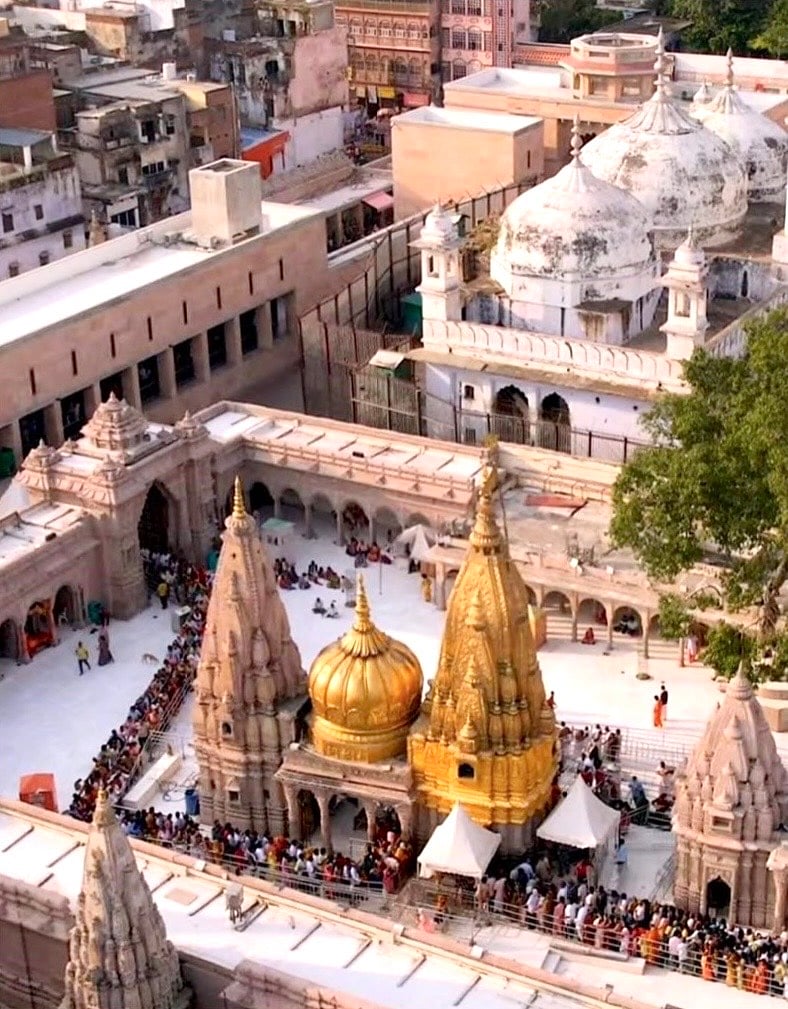
Just like that, a personal relationship with god has been transformed into an official one that requires permission.
Locals protested at this new system that made them foreigners in their own city so an awkward double dance was created for them. ID cards certifying their residency now allow them to enter any time without the lines. Yet their darshan is equally fleeting, their ownership of the place now a mere stamp on a card.
Both Kashi Vishwanath itself and a few other smaller yet equally ancient mandirs spread across the complex that were spared the demolition; are weather beaten and bear the scars of time. Yet it feels like they don’t belong to the soil they stand on. A freshly laid, pristine white marble covers the entire temple area. It has no meaningful connection to the city’s miles of stone paved galis just outside or the temples that rise from it. Denuded of their ancestry in their surroundings, they stand out sharp and distinct.
It’s hard to forget Mahant Mishra’s words on the madhi goddesses. (See: When the bulldozer came for Mahadev’s city).
“You place value on it only when it is in place. If you put it in a museum it is a showpiece.”
The contrast with the rest of Banaras – human, pulsing with non-stop energy, dirty, alive and throbbing – could not be more jarring. One is organic, authentic, lived and real emerging layer after layer over centuries, based on the small, individual relationship of human and god. Entry is free and at any time. The resident Banarasi is the pivot of his city.
The other is an instant noodle, imposed after destruction, dominating with its size and might, barricaded from its neighbourhood by high physical walls as if ashamed of the chaos outside, putting conditions between human and god, like ticketed entries and time slots. The outsider – tourist, visitor, ticket buyer – is the pivot of this enterprise.
“Kashi Vishwanath Corridor was planned by Gujarati people, implemented by Gujarati people and the occupants are Gujarati people,” says Mahant Mishra underlining how the power equation has completely slipped out of the hands of local residents.
The solution for a fragile eco-system
What should have happened instead? What could have been the solution? Why does this alien architecture, denudation, destruction of spatial geography and physical separation matter?
The first thing is to address the astounding neglect that has led to such staggering dysfunction. Banaras deserves regular funding that treats its sewage, garbage and electric wires; and repairs its magnificent old buildings regularly. It needs conservation expertise that will clean up the galis that are the very key to the city’s identity and USP.
It requires alternate forms of development away from the ghats. It needs conservative tourist management that preserves its antiquity, modernizes the cremation structures to be more sustainable and protects its delicate, fragile geography from the devastating damage of mass tourism.
So no one - least of all Banaras residents, is disputing the issues raised or arguing that the dire situation Shukla describes doesn’t need change. The questions are spot on.
It is the answers that are so grotesquely wrong.
“Safai kijiyega, not structural change. Yeh toh nahin ke madhi, moorti, gali ka hi safaya ho jaye,” says Ambrish Chaturvedi, a resident who runs a Banarsi brocades business. “Humein bataya Kyoto ki tarah hoga par Kyoto mein jyon ka tyon nahin hota. Even if a tree is growing inside stone walls, it is retained – they don’t disturb it,” says Prof Singh.
Corridor Development overrides everything. Instead of upgradation, systems and preservation as answers to Shukla’s very pertinent questions, clean-slating has become the go-to option for anything that seems, ugly, dysfunctional and deemed unworthy of revival or care. Because of their one dimensional land-only valuation; the authorities shun the very expertise in heritage or conservation that would allow them to bring alive spectacular city assets.
An example of this is Sundar Nursery in Delhi – for decades used as an ordinary nursery, uncaring of its old monuments, its pathways grown over, its potential unseen amidst endless beds of plants sold to the few buyers that stopped by. Its priceless land value meant it could theoretically have been bulldozed, acquired as a mall or sold as land parcels to developers.
Instead the government supported the Aga Khan Trust for Culture (AKTC) to step in with its expertise to provide the loving care that has turned it into the magnificent city asset it is today. Conservation architect Ratish Nanda, who headed the project, also brought in a new museum, restaurants and auditorium. The jewel in the crown is the vast green parkland inspired by Mughal formal gardens, master planned by the remarkable landscape architect the late Prof Mohammed Shaheer, dotted with 15 historic monuments and a restored lake. Described by Architectural Digest as a “great new public place”, it is thronged by visitors and residents.
Banaras’ superpower, the Brahmastra of its charm, is its lived-in galis, each alive with the sights and sounds of temple bells, filmy gaane, politics, love talk, gossip, commerce, funeral processions, wedding processions, subziwallas, homes and everything else in between.
Banaras, the galiyon ka sheher, the city’s unique cultural superpower.
All they needed for any redevelopment is the sensitivity and respect they deserve. Instead they received a form of disgust and shame that made it clear they were not worth saving, a liability rather than an asset.
Architect Patel was questioned about the criticism on the KVC demolitions of galis and temples that had created the special character of Banaras built over years. He denied the destruction of temples and clarified his view that the destruction of galis and Banaras’s cultural character for the KVC complex was no loss at all.
“Yes ma’am you’re right about that”, he said in an interview to The Print. “Everything acquires a ‘character’ – even a slum acquires a ‘character’! ... here you had sewage flowing freely, you had encroachments on top of temples, you had encroachments on top of old monuments, you had sewage dribbling down the sides of buildings – all of this has ‘character’ – okay?” he ended, sarcastically emphasising it was necessary to create a new modern typology of buildings and urban fabric entirely to replace this.
The debate on ‘modernity’: What it is defined by and based on
The answers lie deeper in. The actual debate here is not on architecture but modernity. Who defines it and more importantly what defines it?
The Corridor playbook defines modernity as an accepted Western paradigm of a spacious site, clean slate, order and structure, separation from chaos. The chaos is identified with tradition, dirtiness and disorder that must be kept outside and one that no effort is made to improve. KVC’s smooth modern pink sandstone high walls neatly cut off the weatherbeaten facades, the crumbling carvings, the ancient and the attendant chaos of 24-hour cremations.
Yet this is actually, exactly the standard colonial gaze that has defined India since British rule. As defined by the British, there was White town, wide and spacious and Black town, crowded and dirty.
The problem is that the ones currently seeing through this colonial lens are not the British but the Indians.
The internalised colonial gaze
The official line may wax eloquent about the great glory of the Indian civilization, its antiquity and achievements from maths to astronomy to music and medicine. Yet the denigration of history so apparent here, the dismissal of its value reveals a well hidden shame. That is what Corridor development is, at its most basic and raw - a shame based ‘modernity’ whose primary motivation is to erase and/or avenge.
The resolute ignorance of geography, the adamant dismissal of expertise, the obstinate refusal to save a single tree, home, neighbourhood or cultural landscape and the tone deaf response to history by proponents of this shame based ‘modernity’ – these are all evidence of this.
Circling back to Vyomesh Shukla’s unasked yet critical question: If the original wound of a destroyed temple is ‘acceptable’ as ‘heritage’ or ‘conservation’ what’s wrong with destroying a few galis and homes for a ‘modern’ corridor more in sync with today’s world? After all, as Prof Rana PB Singh writes, “There is no major religious sanctuary in the city of Banaras that predates the time of Aurangzeb in the 17th century” because he destroyed them all including its greatest temples whose sites were then “forever sealed from Hindu access by the construction of mosques”. Gyanvapi Mosque is of course the prime example.
The answer to this lies in the actual understanding of modernity.
In a modern nation, this means not viewing them as sites of humiliation and shame as the coloniser/invader intended, but with the maturity to understand that denudations and depredations of earlier times are witnesses and links to understand old histories and medieval hatreds. A modern nation has to have the confidence to do that and move ahead.
Erasing them like medieval feudals and warlords did is simply the same tactic the Taliban used when it wiped out the Bamiyan Buddhas because they were too ashamed to say they once existed as Buddhists before they were Muslims.
“Modernity didn’t come evolved to us like the West,” says AGK Menon. “They had an organic evolution after the Industrial Revolution. We had a decisive break through colonial masters. They turned the gaze from our environment to theirs. We made that the referent and embedded it in our thinking.
“Projects like KVC and the ISBT Manikarnika crematorium site are products of that broken link,” he adds. “The colonial damage we have all suffered.”
Supplanting an imported theory of urbanisation grown from the West’s own experience, is setting up for failure in India’s vast diversity and iniquity and its own layered, civilisational way of living. Yet Indian architects trained on Western paradigms dismiss these crucial differences or hold them in contempt.
Brand Dream Vision too swears by these paradigms and embodies a horror of ‘dirt’ and ‘chaos’. So therefore – the very Western emphasis on linearity and the use of Western architectural archetypes like the Vitruvian dome, grand plaza, grand avenue, direct access to the river etc.
HCP, the architectural firm that designed the Corridor, used these because they couldn’t understand Banaras’s traditional layered, circular, temple mapped geography and dismissed it as unplanned chaos, unworthy of saving.
They didn’t see the way the temples big and small were linked, including Vishwanath with its Vishwanath gali, creating a logical, cohesive path to follow for pilgrims that are the city’s raison d’être. Or the way horizontal galis parallel to the ghats give glimpses of the Ganga every few minutes at their intersections with verticals – now crudely blocked by the Corridor’s large walls and gated entry. They broke the circularity of Kashi’s ancient pilgrimage maps and its yatra cannot complete its old tradition today simply because no one cared to cater to it.
“Plotted hai bhai! Because of Corridor, dono orr se rasta band ho gaya. Yatra khandit ho gayi," says Prof Singh. “Waise aap chalein – par Yatra toh disconnect ho gayi!"
“Our architects don’t know how to deal with Indian cities,” says Menon. “Colonial rule got us caught in the binary of modern vs traditional. If it’s traditional – it must be destroyed – because it’s not worth saving. We’re already trained with that thought process.”
Yet what if order in India lies doesn’t lie in the symmetry and geometry of the Western paradigm, but its own marvellous paradigm that caters to its ‘chaos’ and diversity? Shekhar Kapur, admittedly no great historical scholar but a pretty good director of hit films that had the pulse of his audience, once described India as a place that thrives in so-called “chaos” or what HCP describes as “haphazard”.
But the concept of modernity through Western eyes is offered by Corridor Development as a ‘cause’ to get rid of this ‘chaos’, of places with dribbling sewage or collapsing monuments without recognising or respecting the cultural/historic sanctity they embody or trying to preserve them for modern times.
This sterile imitative Western ‘modernity’ has no intellectual base. Therefore it cannot define Indian urban modernity by India’s own unique data sets, and complex issues. Like a square in a circle, it can only impose an imitative, ill-fitting Western frame on a squirming and unhappy city.
79 years after Independence we’re not slaves. But the Hindutva project is stuck in the slave model everyone else has moved on from. It keeps reminding us we are slaves that are being ‘freed’ by ’modern’ Corridor Development.
Not realising that Corridor Development itself represents the real colonial malaise buried so deep within, we don’t even know we are suffering from it.
Proud and ashamed, we toast its ‘modernity’ without realising the idiotic schizophrenia of our moment.
This is the second part of ‘Bulldozers in Kashi’, our new reader-powered NL Sena. As Banaras is reshaped in the name of vikas, we’re reporting on who is being displaced and what is being left out. If you think these stories matter, help us report the rest.
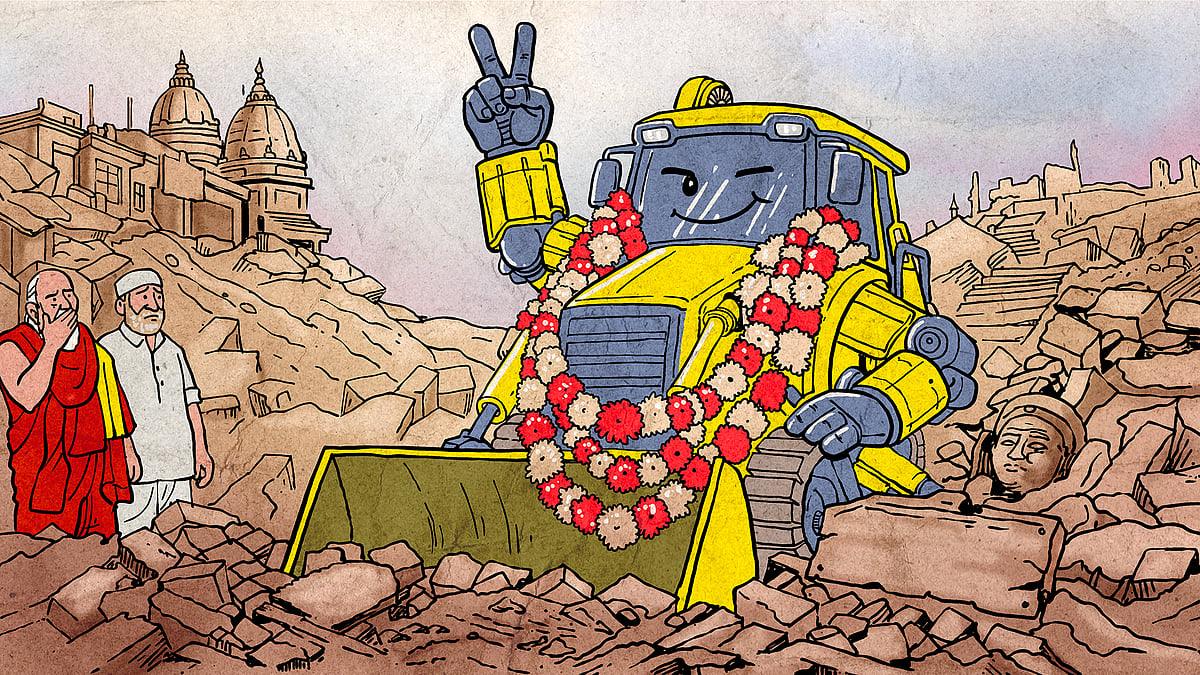 When the bulldozer came for Mahadev’s city