‘Go back, you Bihari’: Why BJP’s ‘outsider’ pitch in Assam is hitting a cultural wall
The BJP’s nomination of a Hindi-speaking candidate in Guwahati has sparked a backlash, exposing the limits of its attempt to redefine ‘outsider’ politics along religious rather than ethnic lines.

In 1985, a popular Assamese skit lampooned a Hindi-speaking businessman as he fumbled through the language, mixed up cultural references, yet remained completely unfazed. Staged on the heels of the anti-‘outsider’ Assam Agitation, it regaled Assamese audiences across the state while capturing a deeper anxiety: that their culture was steadily being hijacked by the “outsider.”
Decades later, the caricature has found an uncanny real-life parallel in poll-bound Assam: Vijay Gupta, a septuagenarian Hindi-speaking businessman who traces his roots to Uttar Pradesh, has been fielded by the BJP from a constituency in the heart of the capital, Guwahati.
The nomination has triggered a furious backlash – both online and on the ground – in Assam, where who counts as an “Assamese” is a lightning rod subject.
“Go back, you Bihari,” reads one of the many angry comments on a grainy clip of the 1985 skit that has now surfaced online, referring to Gupta’s migrant roots – even if he was born and raised in Assam, where his family has lived since 1925.
There is anger on the streets too.
“We are embarrassed that a party like the BJP couldn’t find a ‘bhumiputra’ (son of the soil) for such an important constituency,” said Mukut Deka, a voter. “What direction are we headed?”
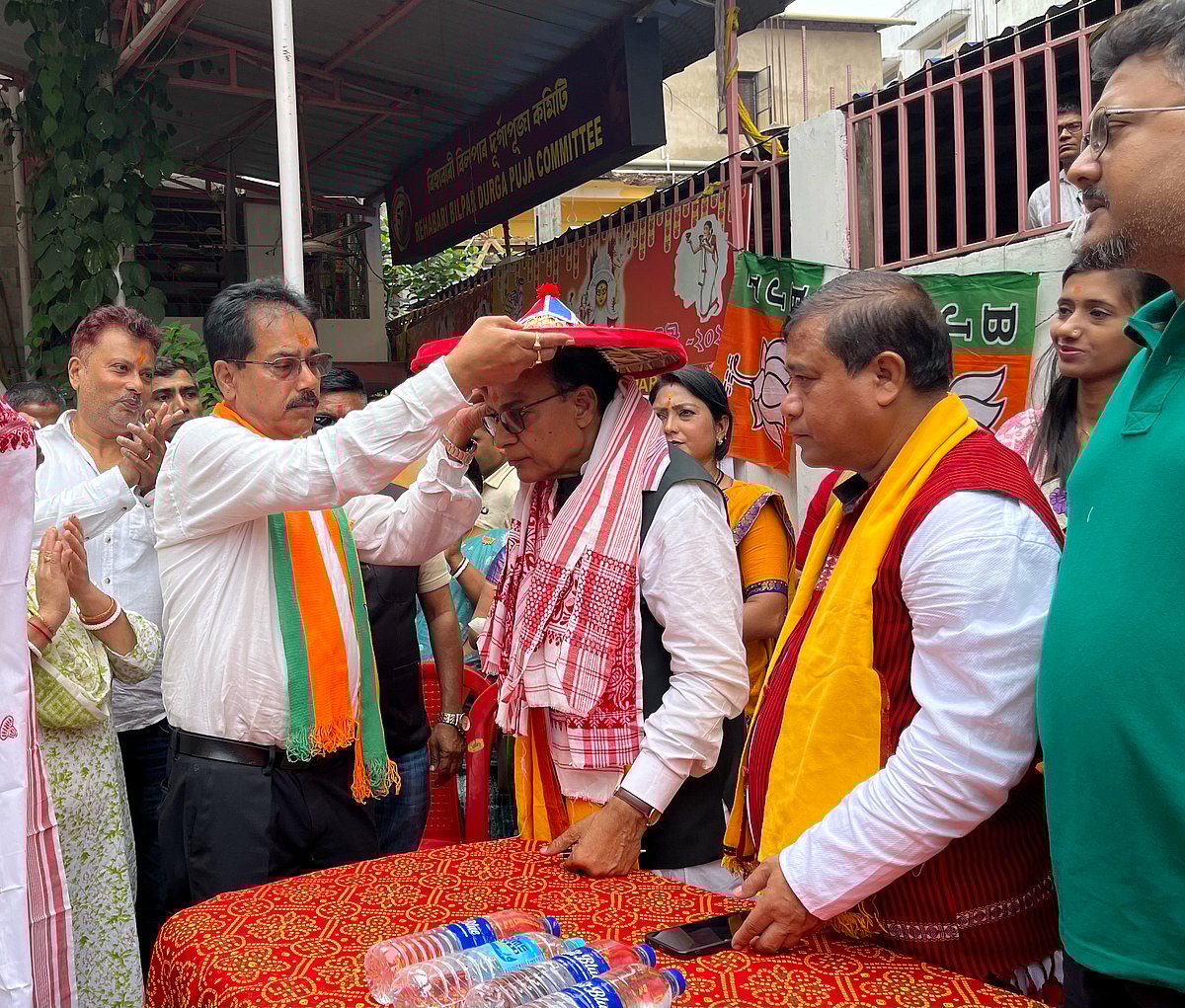
A fractured opposition means BJP’s wider dominance may not be under immediate threat since the saffron party is widely projected to win a third straight term. But analysts say the episode lays bare the limits of its attempt to recast Assam’s “outsider” politics along religious lines, defying wider historical anxieties of the Assamese.
“Assam’s unique demography is unlike that of any other state in India,” said Chandan Sharma, a professor of sociology at Tezpur University, pointing to the state’s diverse ethnic and linguistic groups, their competing sub-nationalisms, and a broader anxiety around resource control. “While the BJP now draws support from a chunk of these communities, visible fractures have emerged within the support base.”
The Karbi Anglong dilemma
The BJP rode to power in Assam in 2016, championing the cause of the ‘jaati, maati, bheti’ (community, land, base) – leveraging a decades-old faultline: anxiety over immigrants changing the state’s demography.
Over the past decade, the party stitched together a potent support base comprising Assam’s diverse ethno-linguistic groups under a composite “Assamese-indigenous–Hindu” political identity, casting Muslims of Bengali origin as the “invader”.
But the “outsider” in Assam has historically cut across religion and ethnicity, with even Hindi-speaking people from other parts of India seen as outside the “Assamese” framework.
For the BJP, this tension first came to the fore palpably during the protests against the Citizenship Amendment Act (CAA) in 2019. Expedited citizenship to Hindus from Bangladesh incensed the Assamese, who saw it as a betrayal of the BJP’s poll promise of protecting indigenous interests.
The party managed to paper over the crisis, but it resurfaced again last year in the tribal-dominated hills of Karbi Anglong, when Karbis began demanding the eviction of alleged illegal settlers from grazing lands.
Their demand appeared to align with the BJP’s broader push across Assam to reclaim land from alleged encroachers. Except that the Karbis’ resentment was directed not at Bengali Muslims but at Bihari settlers – a community that is a strong support base of the BJP.
Angshuman Choudhury, a researcher from Assam, said that despite the significant political transformations of the past decade, these ethnonationalist sentiments would continue to offer “a political counter-imagination to Hindutva”. “But whether this is enough to weaken the party’s electoral strength remains to be seen,” he said.
Tensions escalated when a hunger strike by Karbi protesters was forcibly broken up by the police, triggering clashes between the two groups that left two dead.
“The BJP was making the right noises earlier, but after this, they are seen as both pro-Hindi-speaking and anti-tribal,” said Karbi politician Holiram Terang.
The upheaval could now hurt the BJP in at least two of the five constituencies across the two Karbi-dominated districts, locals say.
“While we moved quickly to douse the fires, and tensions around the evictions have since eased, both Karbis and Biharis are left with a sense of being let down by the BJP,” said a BJP leader from Karbi Anglong, requesting anonymity. “In Assam, people are very conscious about their identity, so these issues could very well resurface in the future.”
As they have in Guwahati, with Gupta’s nomination.
The battle for Guwahati
Neither Gupta nor his Gen-Z rival, Kunki Chowdhury, is a political heavyweight.
Yet Central Guwahati has quickly emerged as one of the most closely watched contests in an election otherwise widely seen as a personality battle between Assam Congress chief Gaurav Gogoi and the BJP’s Himanta Biswa Sarma, who is seeking a second term as chief minister.
Star campaigners from Delhi, including Union Minister Amit Shah and Congress leader Pawan Khera, have descended on the constituency.
Online content creators have joined in: reel after reel lampooning Gupta, pointing out his thickly accented Assamese, emblematic of the “outsider” who has little regard for the state’s language or culture, but only around for extractive commercial gain at the expense of locals.
Chowdhury, in contrast, is being projected as the cultural antithesis: 27-year-old, fresh-faced, and unmistakably Assamese. Her campaign, on the ticket of the Assam Jatiya Parishad – a regional party born out of the 2019 CAA protests and now allied with the Congress – often features the music of Zubeen Garg, whose recent death triggered an emotional outpouring across the state. Many supporters refer to her as “Assam’s daughter”, a symbol of hope against what they see as the BJP’s willingness to accommodate corporate outsiders.
A rankled BJP leadership has been quick to train its guns on Chowdhury, with chief minister Sarma, known for his polarising rhetoric, repeatedly alleging that she is “anti-Hindu”, even brandishing purported photographs of her mother “eating beef” before the press — an invocation that has led to a counter-mobilisation in support of Chowdhury.
Others, meanwhile, have come to Gupta’s defence.
On a rainy March afternoon, ahead of a campaign in a residential locality in Guwahati, an aide introduced him as a hard-working party member of three decades.
“There is a lot of chatter on social media,” he said. “Let me tell you, those are conspiracies. Vijay Gupta has not just worked for the BJP for 30 years – he has worked for Assam. If he is not Assamese, then who is?”
Hindi-speaking migrants like Gupta – many tracing their ancestry to Bihar, Uttar Pradesh and Rajasthan – form a sizable population in several urban centres in Assam and have been among the BJP’s earliest supporters in the state.
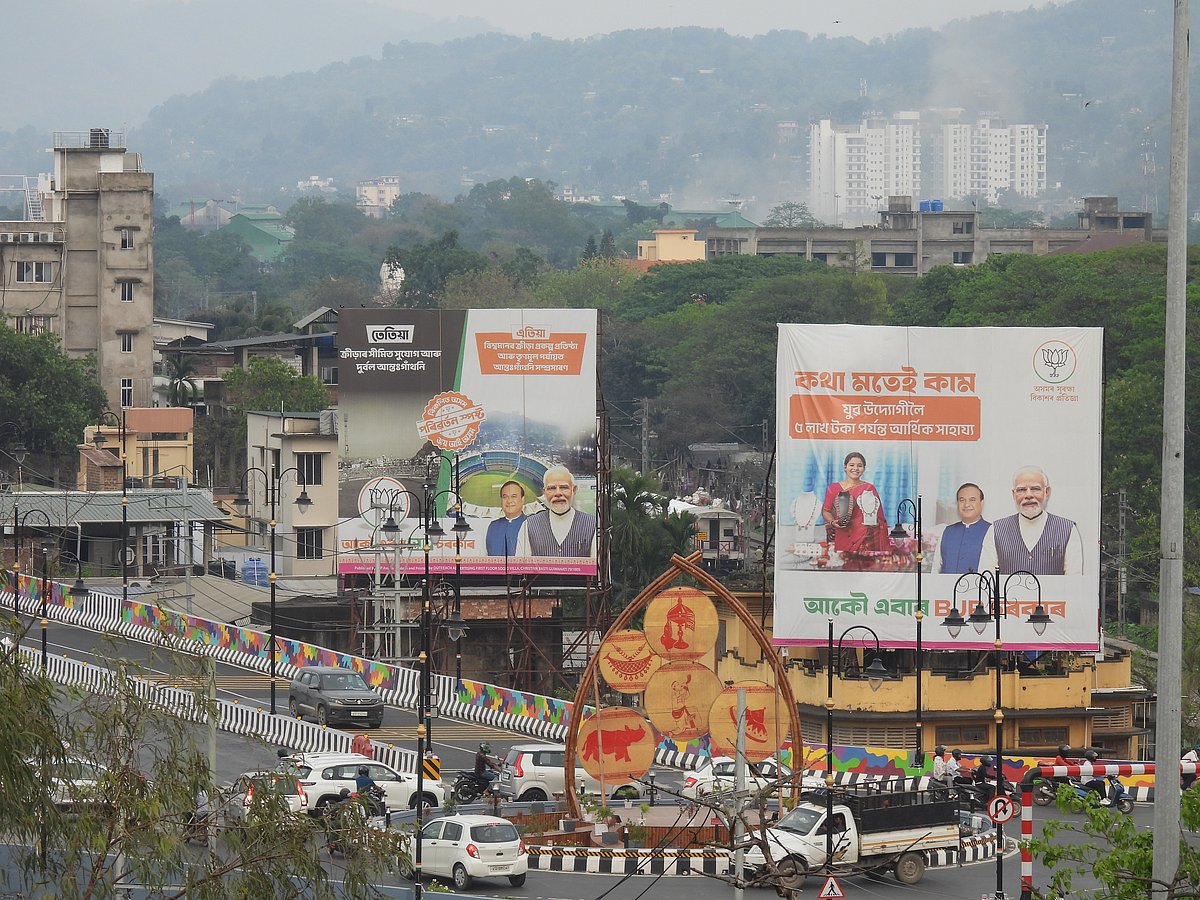
“These are not people who came yesterday. In BJP’s early days, it was people like Gupta who stood by the party,” Siddhartha Bhattacharya, one of the party’s old guard leaders, told reporters.
But even senior leaders admit the balancing act has not been easy.
Ashok Singhal, a BJP veteran of migrant origin and now a minister in the state government, said his surname meant he had to “prove himself every day”, likening it to an “agnipariksha”. But he was quick to add that these challenges were created by opposition parties to fracture the BJP’s social coalition. “But the people of Assam are with us. We are a rainbow alliance cutting across caste, community, creed and language,” he told Newslaundry. “This government has shown it is committed to protecting the identity of indigenous people.”
Yet some of his own party members aren’t too sure.
“The BJP does good work, and that’s why I am with them,” said a 36-year-old party member on the sidelines of Gupta’s campaign. “But seeing them field a candidate who still fumbles with the language, despite living here for decades, is upsetting. If he can’t get the words right, it suggests he doesn’t care about our culture.”
Who is an ‘outsider’?
The BJP began making inroads in Assam in the early 1990s, though with modest electoral success, before finally coming to power in 2016, ending a 15-year Congress rule – and shedding, along the way, its reputation as a party of North Indians.
“For long, there was a perception that the BJP was a ‘Marwari–Bihari’ dol, a party of outsiders,” said a party office-bearer, who did not wish to be named.
“That began to change after leaders like Sarbananda Sonowal came to the fore. Gradually, it became a party of tribes and ethnicities — of both the hills and the valleys,” he said.
Under Sonowal, the party courted communities previously aligned with the Congress, while consolidating support among Hindu migrant groups.
Chief Minister Sarma’s hardline stance against Bengali-origin Muslims – seen by many Assamese as the biggest threat to indigenous interests – has further strengthened that position. His government has carried out eviction drives on an unprecedented scale and invoked a partition-era law to deport people to Bangladesh – something he has repeatedly said only his government has achieved.
But party insiders say the contradiction in narrowing the “outsider” to a religious category in a state where linguistic nationalism runs deep was always likely to resurface.
“As a party worker, my worldview is Hindu – be it Bengali, Bihari, or Marwari. As long as one is Hindu, that is how we function,” said the BJP office bearer. “But our supporters don’t necessarily think like that.”
Angshuman Choudhury, a researcher from Assam, said that despite the significant political transformations of the past decade, these ethnonationalist sentiments would continue to offer “a political counter-imagination to Hindutva”. “But whether this is enough to weaken the party’s electoral strength remains to be seen,” he said.
Indeed, across Assam, the BJP is running an aggressive campaign – driven not just by what many describe as the persona of “mama”, the popular nickname by which chief minister Sarma is known, but also by a visible development pitch and an array of cash benefit schemes. The 2023 delimitation exercise – after which boundaries of several constituencies have consolidated Hindu votes – also gives the BJP an edge.
“The BJP may very well win here – and across the rest of Assam,” said Deka, the Guwahati voter who is unhappy with Gupta’s candidature. “But the entire episode has certainly left a bitter taste in our mouths."
Tora Agarwala is a Guwahati-based independent journalist.
Elections are not just about who wins, but about the questions that often go unasked – and this time, they matter more than ever. Support our new NL Sena on the five upcoming assembly polls to help us follow the missing voters, the shifting politics, and the stories that could shape India’s future.