‘No disease’, only ‘impediment removal’: Delhi meet flags Bengal’s 90 lakh voter deletions
Political activist Yogendra Yadav said the deletions could critically affect the election in at least 19 constituencies in Bengal.

Two days after the Election Commission of India released another list of deleted voters in West Bengal’s controversial special intensive revision, political activist Yogendra Yadav on Wednesday said that deletions would “critically” affect the governing Trinamool Congress in 19-25 constituencies in the upcoming assembly polls. In the 2021 state polls, the TMC came to power by winning 215 seats against BJP’s 77 in a house of 294.
Around 90 lakh names – or 12 percent of the total voters – have been deleted from the voter list, bringing down the total of voters from 7.66 crore to 6.77 crore. These deletions include the last round of cuts of 27 lakh of the total 60 lakh names which were under adjudication.
At the Constitution Club of India, barely a km from the Election Commission’s office, Yadav was joined by Supreme Court lawyer Prashant Bhushan, economics professor Dr Dipankar Dey and Suman Bhattacharyya from Desh Bachao Ganomancho, a civil society group at a press conference titled ‘Stealing an Election? Disenfranchisement of 92 lakh voters in West Bengal and its implications for Indian democracy’.
Yadav said that the SIR process has challenged constitutional values. “What’s happening in West Bengal in the name of SIR challenges the foundations of this republic, of our constitutional values, of our democratic institutions,” he said.
Yadav questioned the Bengal SIR, saying that there was nothing “unusual” about the state’s voter rolls. To buttress his point, he said one should look at the elector to adult population ratio of the state, which he called “ideal” in the country.
“Before the SIR, the adult population of West Bengal in December was 7.67 crore. What was the voter number? 7.66 crore. I have never seen such an ideal match: 99.67 percent. So there was no disease, to begin with, that could be cured,” he said.
He said another reason why the SIR was conducted was because of rumours that significant additions to the voter roll had been undertaken and electoral registration officers (EROs) were partisan. Yadav countered these with another data point.
Last year during regular revision of voter rolls, 41 percent to 50 percent form-6 applications were rejected by EROs, he said. Form-6 is filed with election officials to add a voter’s name. “Had the bureaucracy been partisan, the rejection rate should have been just 5 percent. There is no evidence of partisanship,” he said.
He said even the stage 1 of SIR – under which enumeration forms were distributed, and absent, dead and shifted voters were deleted – was not unusual to necessitate appointment of micro observers and judicial adjudication.
The percentage of Bengal voters that were deleted under the “absent and shifted”, “dead” and “duplicate” categories was not far off from the data for the other 10 states that had undergone SIR. In the first stage of SIR, 4.3 percent of the voters were deleted under the "absent and shifted” in Bengal compared with Goa’s 5.9 percent, Kerala’s 5.5 percent and Rajasthan and Madhya Pradesh (4.3 percent each). The average across 11 states and UTs where SIR has been undertaken was 9 percent.
Separately, 3.2 percent of the voters were deleted in the “dead” category in Bengal compared with the overall average of 2.9 percent. Another 0.2 percent were deleted because of “duplication” against an average of 0.8 percent for 11 states/UTs.
On the percentage of unmapped voters (those who could not be linked to their family members in the 2002 voter list), Bengal was not an outlier either. As many as 4.5 percent of the total voters remained unmapped against an average of 5.3 percent for 11 states/UTs.
In the first stage, around 64 lakh names were deleted and another 60 lakh names were put “under adjudication”. In the second round, of the 60 lakh cases, 27 lakh were deleted. These cases were heard by around 700 judicial officers under the Calcutta High Court’s supervision.
Calling the SIR a “special impediment removal exercise”, Yadav said it was done to remove BJP’s impediments in its path of achieving “permanent majority”. He said these “4-D impediments” are: desperation of BJP to capture Bengal by any means; deterioration of the saffron party’s organisation in Bengal; determined opposition; and demographic impediment (a big chunk of people who are against the BJP).
He compared the SIR case being heard in the Supreme Court with ADM Jabalpur Vs Shivkant Shukla. In the ADM Jabalpur case, the Supreme Court suspended constitutional rights during the Emergency.
“Almost all institutions are disintegrating. People’s only hope is from the judiciary. With this faith, people are seeing this case… What the ADM Jabalpur case was to Emergency, this SIR process is to our electoral democracy today… Our hope is that this last wall (of protection) would not collapse,” he said.
Calling ECI a “BJP agent”, Supreme Court lawyer Prashant Bhushan drew attention to the Lal Babu Hussein case (1995). He said that the Supreme Court had held that a voter who had voted in the previous election can’t be removed.
Elections are not just about who wins, but about the questions that often go unasked – and this time, they matter more than ever. Support our new NL Sena on the five upcoming assembly polls to help us follow the missing voters, the shifting politics, and the stories that could shape India’s future.
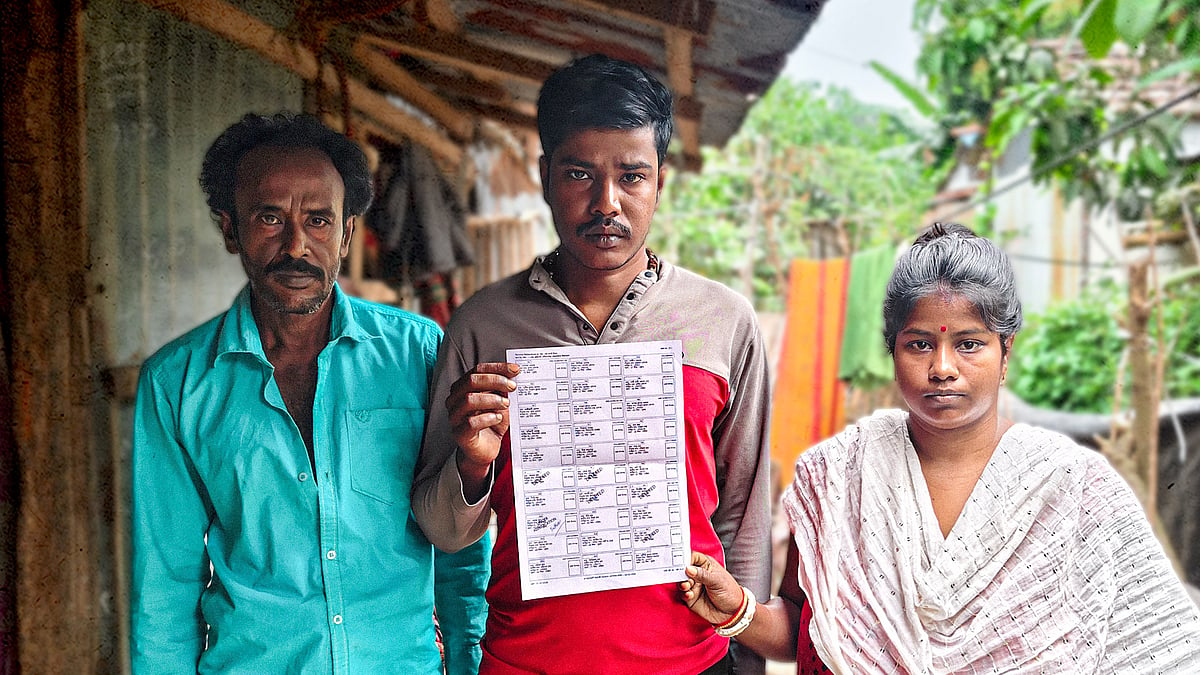 ‘Feels like a betrayal’: SIR deletions hit BJP’s own Hindu refugee base in West Bengal
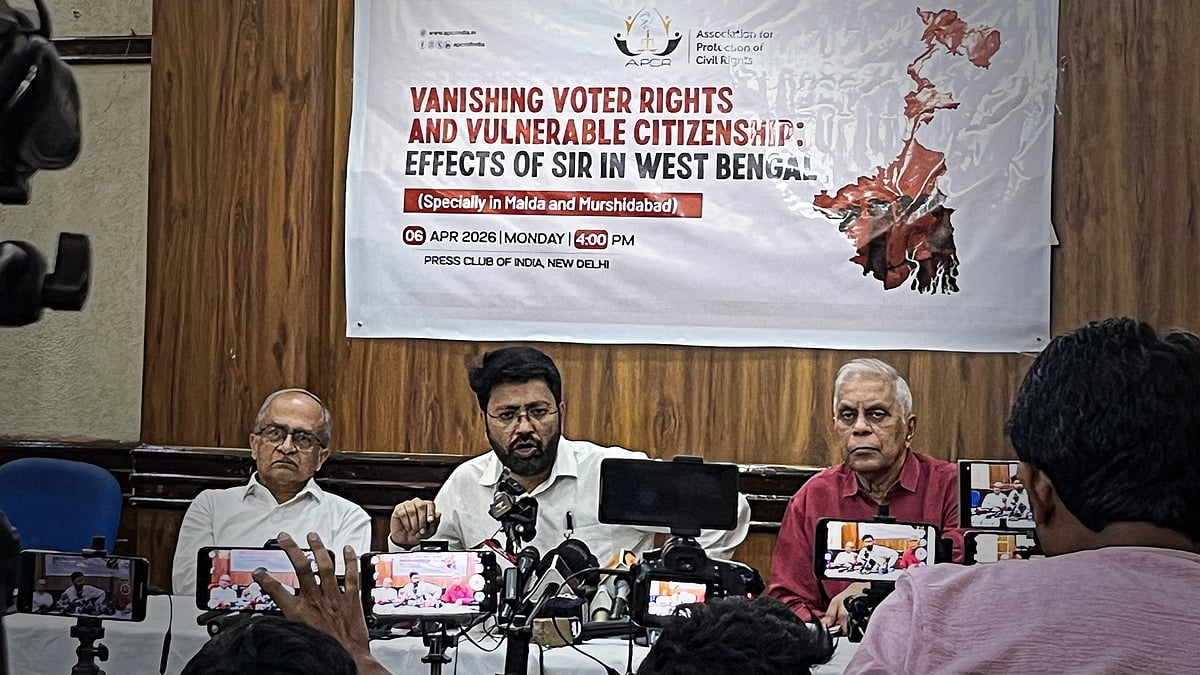 Amid Bengal voter roll uncertainty, activists flag ‘disproportionate’ exclusions