Under the same sun: Why the Indian summer is never shared equally
Infrastructure and income dictate who finds relief in the shade and who remains trapped in the heat as one city splits into two distinct experiences of the summer.

One hot summer morning in 1935, Hindi poet Suryakant Tripathi Nirala came across a woman worker hammering stones to pieces by the roadside in Allahabad. His poem “Wah todti patthar” (She breaks stones) places the quiet dignity of her toil against the oppressive demands of the unforgiving sun and contrasts it with the shelter and stark inequalities of life under the buildings and mansions around.
She has no escape to the shade. The morning has already turned harsh enough to feel like an afternoon. The heat is not described from a distance; it presses into the body, into the act of labour itself. Nearby stand the built forms of the city, including the atṭalika, rising above and set apart, marking a separation in living conditions.
Nearly 90 years later, that arrangement has expanded, hardened, and settled into the everyday structure of Indian cities. In Delhi, for instance, heat now arrives earlier, stretches longer, and recedes more slowly. A season once understood through peaks has become a prolonged condition that shifts in form but rarely offers full relief.
It has to be said at the outset that heatwaves in India are not confined to cities. Rural areas are equally exposed to extreme temperatures, and agricultural labour also toils under direct and prolonged heat. The inequality shapes outcomes in both settings. In rural areas, vulnerability arises from continuous outdoor work and limited access to cooling or healthcare, while in cities it is further structured by the heat trap, better explained as the urban heat island effect, and by sharp differences in housing, infrastructure, and work conditions. That has foregrounded the challenge in the urban spaces, where these inequalities combine to prolong and concentrate heat stress.
The contemporary moment sharpens this reality further. Recent newspaper reports, drawing on assessments by the World Meteorological Organization and the India Meteorological Department, point to an ongoing heatwave, the likely emergence of El Niño conditions by mid-2026, and the possibility of a below-normal monsoon. These signals together suggest a weakening of the cycle that once moderated summer heat. The expectation of reliable seasonal relief is becoming uncertain.
Heat in cities like Delhi unfolds across months. April begins with intensity. May and June deepen it. By July, even when temperatures dip slightly, humidity rises, and the body’s ability to cool itself diminishes. The air mostly holds on, and the nights do not fully restore. By September and often into October, the heat lingers, less visible but still present. Relief, when it comes, is partial and uneven.
Within this extended season, the experience of heat is shaped by where one works, where one lives, and what one can afford to avoid.
Not everyone can withdraw
For a large segment of the city, including construction workers, street vendors, sanitation workers, and delivery riders, heat is continuous. Work proceeds under it, not around it. Shade is incidental. Rest often means lost income. Advisories to avoid peak hours exist, yet the ability to follow them is constrained by economic necessity. Exposure is built into the nature of work.
Elsewhere in the same city, the day is organised differently. Work shifts indoors. Air is cooled, filtered, and regulated. Exposure becomes intermittent. The body moves between conditioned interiors and brief encounters with the outdoors. Even when heat is acknowledged, it is buffered by infrastructure, resources, and the ability to choose when to step out and when to withdraw. The temperature may be recorded uniformly, but its effects are not experienced uniformly.
There have been efforts at making public policy respond to the risks, though their shortcomings can’t be missed either.
The Delhi Heat Action Plan, as an example, outlines measures such as early warnings, public advisories, hydration points, and limited work-hour adjustments for outdoor labour. There is increasing use of data, including heat hotspot mapping, and coordination across departments. These steps indicate recognition.
The limits of this approach are becoming increasingly clear. Much of the framework remains oriented towards the idea of the heatwave as an event that can be anticipated and managed within specific days. Lived experience follows a seasonal and cumulative pattern. It does not begin and end with official alerts. Fatigue builds over weeks. Exposure is repeated rather than exceptional.
There are also gaps in implementation. Measures announced at the policy level do not always translate into consistent ground-level protection. Informal labour, which constitutes a large share of the urban workforce, remains difficult to regulate. Guidelines without enforcement or income support carry limited weight. Awareness grows, yet protection remains uneven.
The structure of the city itself compounds the problem. Delhi’s built environment absorbs and retains heat. Concrete and asphalt trap heat during the day and slowly release it at night, raising baseline temperatures. Airflow is restricted in dense areas. Green cover, which can moderate local temperatures, is unevenly distributed. Informal housing, often made of heat-retaining materials with limited ventilation, intensifies indoor exposure. Heat is both endured and produced within the urban form.
This is where the recent findings and the analysis of the Harvard Salata Institute become particularly relevant. In its work on heat adaptation in India, the Institute argues that heat must be understood as a system-wide risk that cuts across health, labour, urban design, and governance. Responses that remain fragmented and address symptoms in isolation are unlikely to match the scale of the challenge. Adaptation, in this view, requires changes in how cities function under sustained heat.
Seen against this framework, Delhi’s response appears partial. A movement away from complete unpreparedness is evident, yet systemic adaptation remains limited. Labour protections are narrow. Urban design has not shifted in ways that reduce heat exposure. Housing conditions for the most vulnerable continue to amplify risk. Data is improving, but its translation into structural change remains uneven.
The broader climate signal underscores the urgency of this gap. If El Niño conditions lead to weaker monsoon performance, as current forecasts suggest, the traditional sequence of heat followed by relief may weaken. Instead of a reset, there may be only a reduction followed by continued stress. The distinction matters because it extends the burden of heat rather than containing it.
In this context, the image from Nirala’s poem acquires a different weight. The woman breaking stones under a harsh sun was not an isolated figure of the past. She is recognisable in the present, as a dispersed presence across the city. The city around her has grown denser and more heat-retentive, and the season she works through has lengthened.
The challenge, then, extends beyond managing extreme days. Recognition of the full duration and uneven distribution of heat becomes essential. Policies framed around episodic events struggle to address a condition that unfolds across months. Measures that rely on advisories have a limited impact where economic necessity dictates behaviour. Responses that do not engage with the built environment leave the drivers of urban heat intact.
Adaptation is underway, but its depth and scale remain in question. To return to Nirala is not to seek closure, but to recognise continuity.
In times of misinformation, you need news you can trust. We’ve got you covered. Subscribe to Newslaundry and power our work.
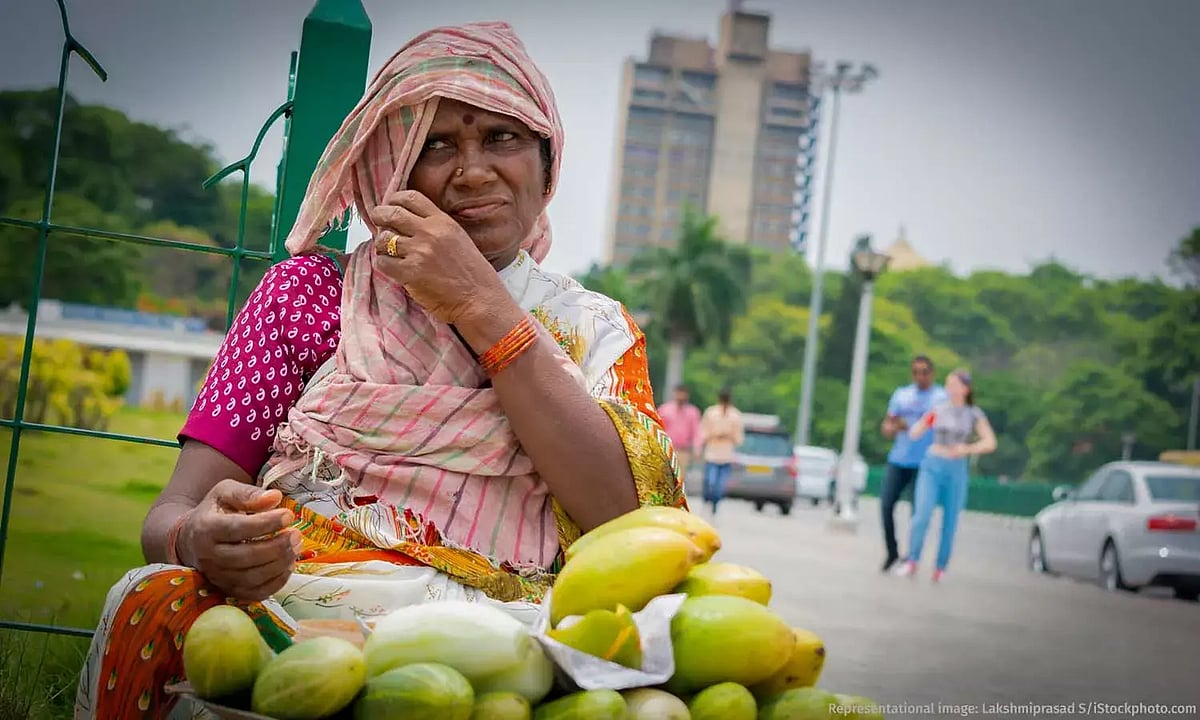 As India braces for summer, informal workers have little heat protection