Labelled a terrorist, questioned as journalist: A Palestinian man’s year in Israel prison’s ‘real hell’
CNN reporters met colleague Ali al-Samoudi after he walked out of prison. They could barely recognise him.

When Ali al-Samoudi walked out of Israeli prison last week, his colleagues at CNN, who had worked with him for years, could barely recognise him. According to a CNN report by Jerusalem correspondent Jeremy Diamond and reporter Abeer Salman, the 59-year-old Palestinian journalist had lost 60 kilograms, nearly half his body weight, over the course of a year in detention.
He was never charged with a crime.
Samoudi, a veteran journalist with four decades of experience who was at Shireen Abu Akleh’s side when she was fatally shot by Israeli forces in 2022, was held under administrative detention – a mechanism that allows the Israeli military to imprison Palestinians without trial for up to six months at a time, renewed indefinitely.
When he was detained in April 2025, the Israeli military publicly labeled him a terrorist, claiming he was suspected of financing Islamic Jihad. Not only was he never formally charged with financing terrorism or anything else, but according to what he told CNN, his interrogators never once raised the terrorism allegation during questioning. What they did ask about was his journalism. “My arrest is part of the Israeli war against the Palestinian press and media. To silence my voice and block my camera and break my pen, and thus prevent me from practicing my right that all laws and international norms guarantee: the freedom of the press,” Samoudi told CNN.
Samoudi is one of 105 Palestinian journalists detained since October 7, 2023, the majority without charge, according to the Committee to Protect Journalists – a scale that made Israel the third-worst jailer of journalists in 2025, behind only China and Myanmar.
‘Real hell’
According to CNN, Samoudi described what he endured inside as “a real hell... in every sense of the word”. Movement within or between prisons, CNN reports, reliably brought violence. “One time after I returned from a visit with the lawyer, they threw us on the ground, on our faces and they started hitting us,” Samoudi told CNN. “An Israeli officer stood and stepped on my head like this and pressed my face into the ground for four minutes until I suffocated.”
Books, pens, and paper were banned. The shampoo he received each week was labeled for dogs. Breakfast was a spoonful of labneh and a quarter spoon of jam. Lunch was four spoons of rice with two thin slices of a vegetable. Dinner, which Samoudi described with bitter irony as “deluxe,” consisted of two spoonfuls of hummus, a spoonful of tahini, and an egg.
The most haunting account in the CNN report is what Samoudi witnessed happen to others. One of his cellmates, Louay Turkman – a 22-year-old from Jenin, also held without charge under administrative detention – fell gravely ill one night. Guards refused to take him to the clinic. The next morning, they still refused. Samoudi and fellow prisoners carried him out to the yard on a mattress. He died there. “He did nothing,” Samoudi said, his voice cracking, as per CNN. “Why? Are we not human?” Israel’s Prison Service did not respond to CNN’s questions about Turkman's death.
Israel’s Prison Service did not respond to CNN’s request for comment on his detention.
We take no ads, bow to no government or corporation, and answer only to you, the reader. This Press Freedom Month, pay to keep news free.
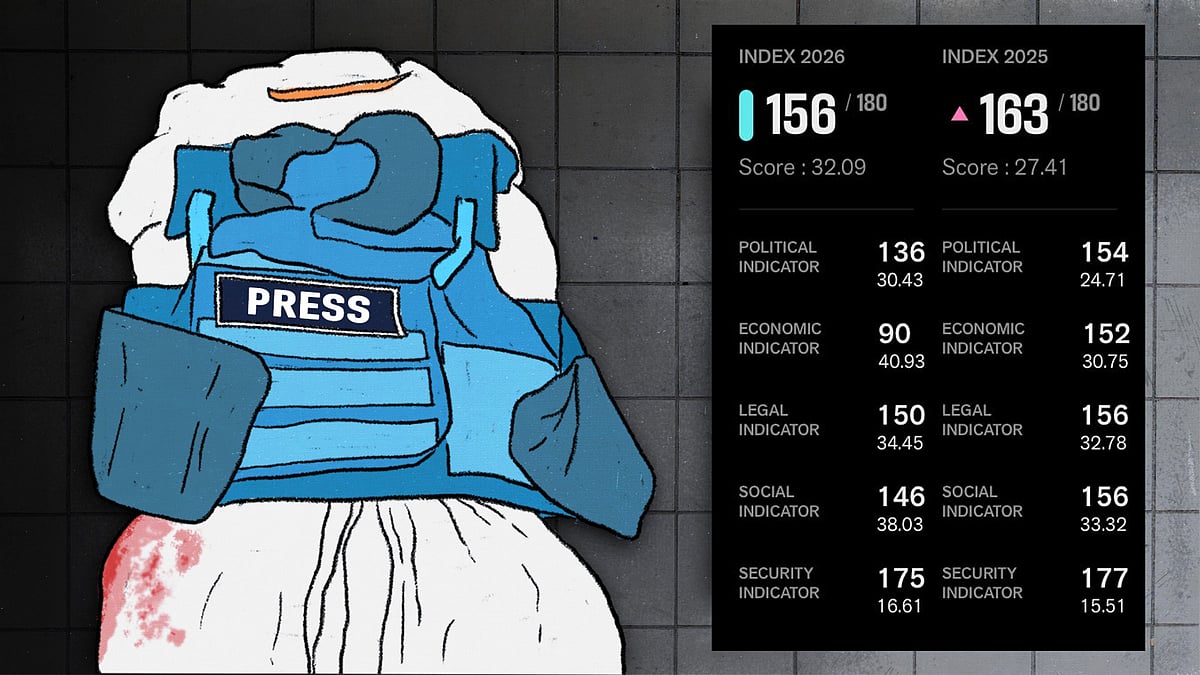 Palestine freer for journalists than India: It’s the Press Freedom Index again