A camera, a sleeping drunk man, welder who thought it was ‘a rally’: Inside Delhi’s new ‘cooling zone’
The Delhi government, under its Heatwave Action Plan, has established one cooling zone in the entirety of the capital.

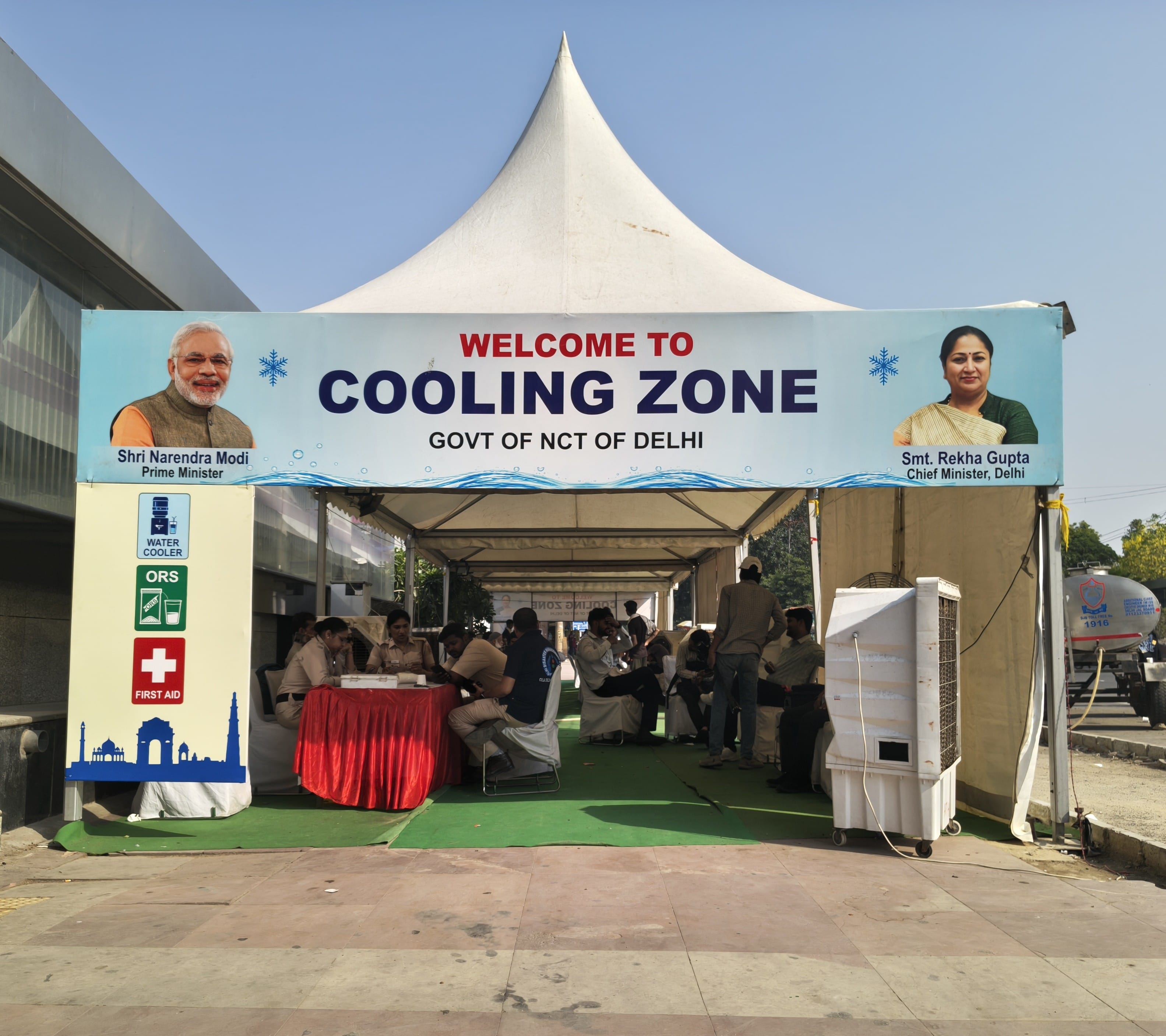
It is 38°C. The sun hangs directly overhead Jama Masjid metro station, unforgiving and exact. At the entrance to what the Delhi government is calling a “cooling zone,” smiling headshots of Prime Minister Narendra Modi and Chief Minister Rekha Gupta greet you.
The place is mostly empty.
Danish, 25, a welder who works in the market nearby, squints at the banners. “I thought it was a programme, or a rally, when I first saw the pictures,” he says. He steps in anyway. “Cold water is a boon, everyone will benefit from it.”
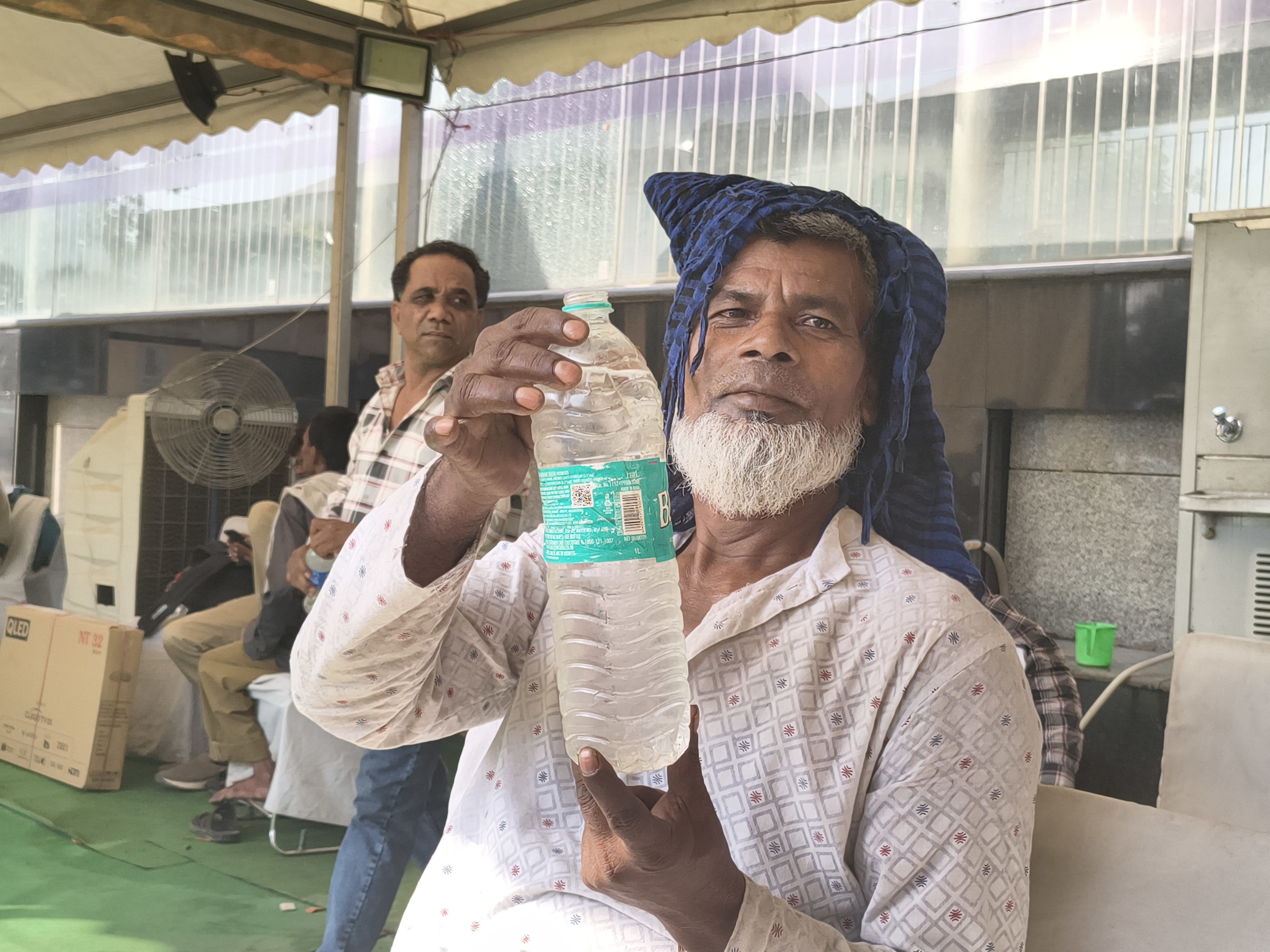
There is a tent that holds 75 chairs draped in white banquet covers, 10 air coolers, a cluster of fans, and a stainless steel water dispenser offering all-you-can-drink lukewarm-to-cold water. It is open 24 hours a day, seven days a week.
Two men run it. Eidu, 50, is from Allahabad. Sachin, 20, is from Badhaiya in Uttar Pradesh. They were hired through a contractor. For the next two months, the tent is home – four chairs pushed together make a bed. Food comes out of their own pockets, bought from nearby hotels.
“We have to make sure none of this is stolen,” says Eidu. “I sleep when he is awake, and he sleeps when I am awake.”
Sachin handles the physical work: hauling water from a Jal Board tanker parked outside to fill the air coolers. The same water goes into the drinking dispenser. When asked whether it is clean, Sachin shakes his head, unknowingly.
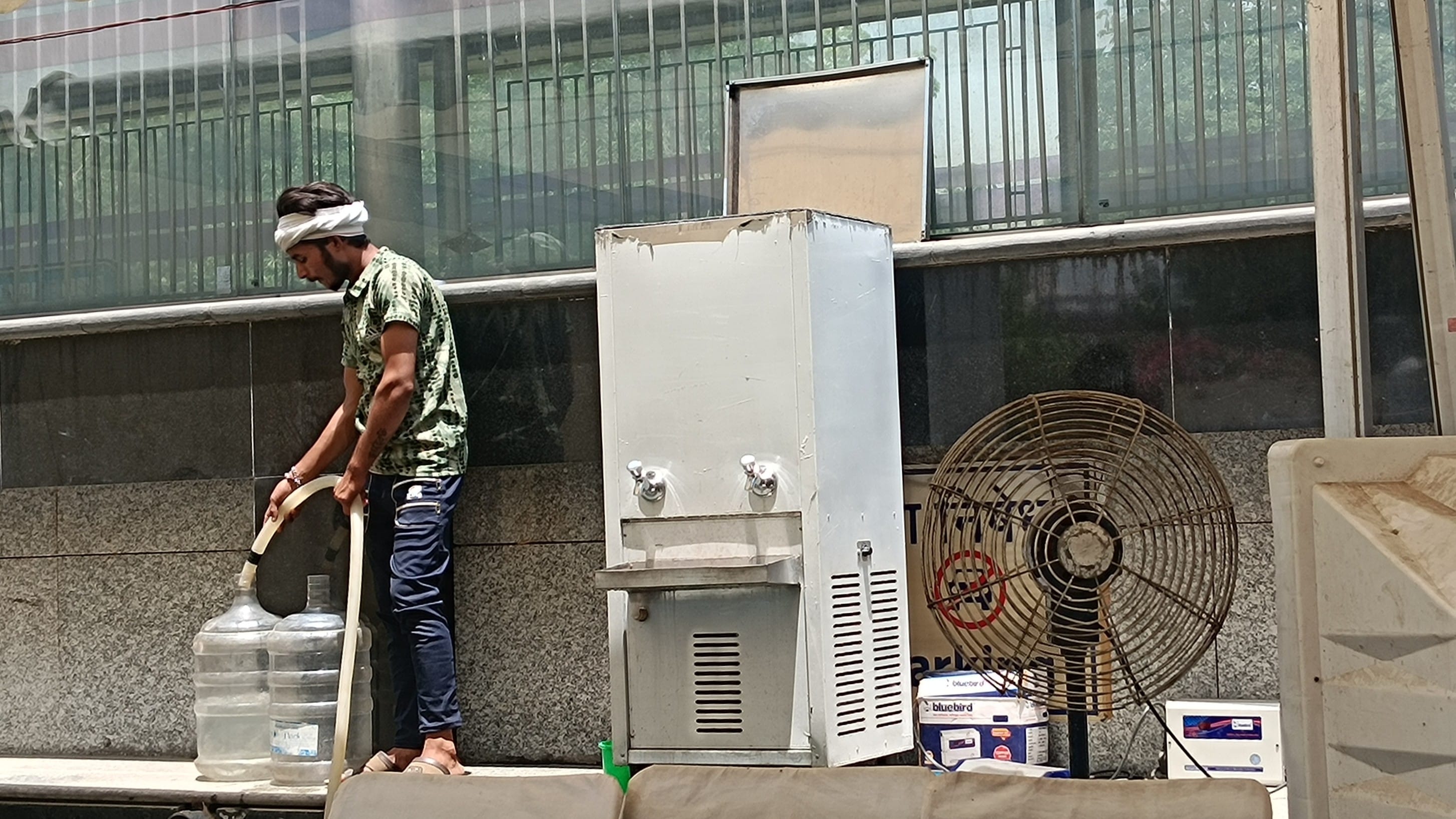
The Delhi government, under its Heatwave Action Plan, has established one cooling zone in the entirety of the capital. News agency ANI reported that cooling zones – plural – have been set up across crowded areas, bus stands and metro stations. Only one could be found.
Delhi’s population is estimated at 2.3 crore. If every resident took turns sitting in the tent’s 75 chairs for 10 minutes, it would take 2,129 days for each person to feel a breeze of cool air. Restricting the calculation to the daily footfall of Chandni Chowk: 46 days. To just the constituency’s population: 11 days.
The Heatwave Action Plan for Delhi 2025 identified 10 hotspots — areas where vulnerable populations overlap with vulnerable conditions. They include Jahangirpuri, Sanjay Colony and Mayapuri, among others. Jama Masjid is not on the list.
Dinesh Kumar Paul, from the SDM office, explains the choice of location. “The place is always crowded. Many tourists come here.” On whether a single set-up is adequate for a city this size, he refers to 13 mobile cooling vans distributing water and ORS sachets across Delhi's vulnerable areas. “These measures will be effective,” he says.
‘Why will I take my rickshaw there?’
By afternoon, auto-wallahs pull up mid-trip to fill their bottles. A Quick Response Team vehicle arrives with a resupply of ORS sachets, caps and gamchas. Police officers stationed at the entrance oversee the distribution – one sachet, one gamcha, one cup, one cap (a particular favourite among children), or basic medicine from the first-aid box. All of this on request. All of it animatedly demonstrated to the camera-person of a digital news platform, while officers are interviewed nearby.
Pratik, 15, from Badarpur, asks for a paper cup and is told to wait. “They should at least have glasses,” he says, “for an emergency”. He works evenings at a biryani shop and has his own heat story. “We have power cuts. Luckily, we have an inverter, but that only works for an hour.” He sits down directly in front of a cooler, closes his eyes, and lets the air hit his face. A minute later, he gets up and walks back out.
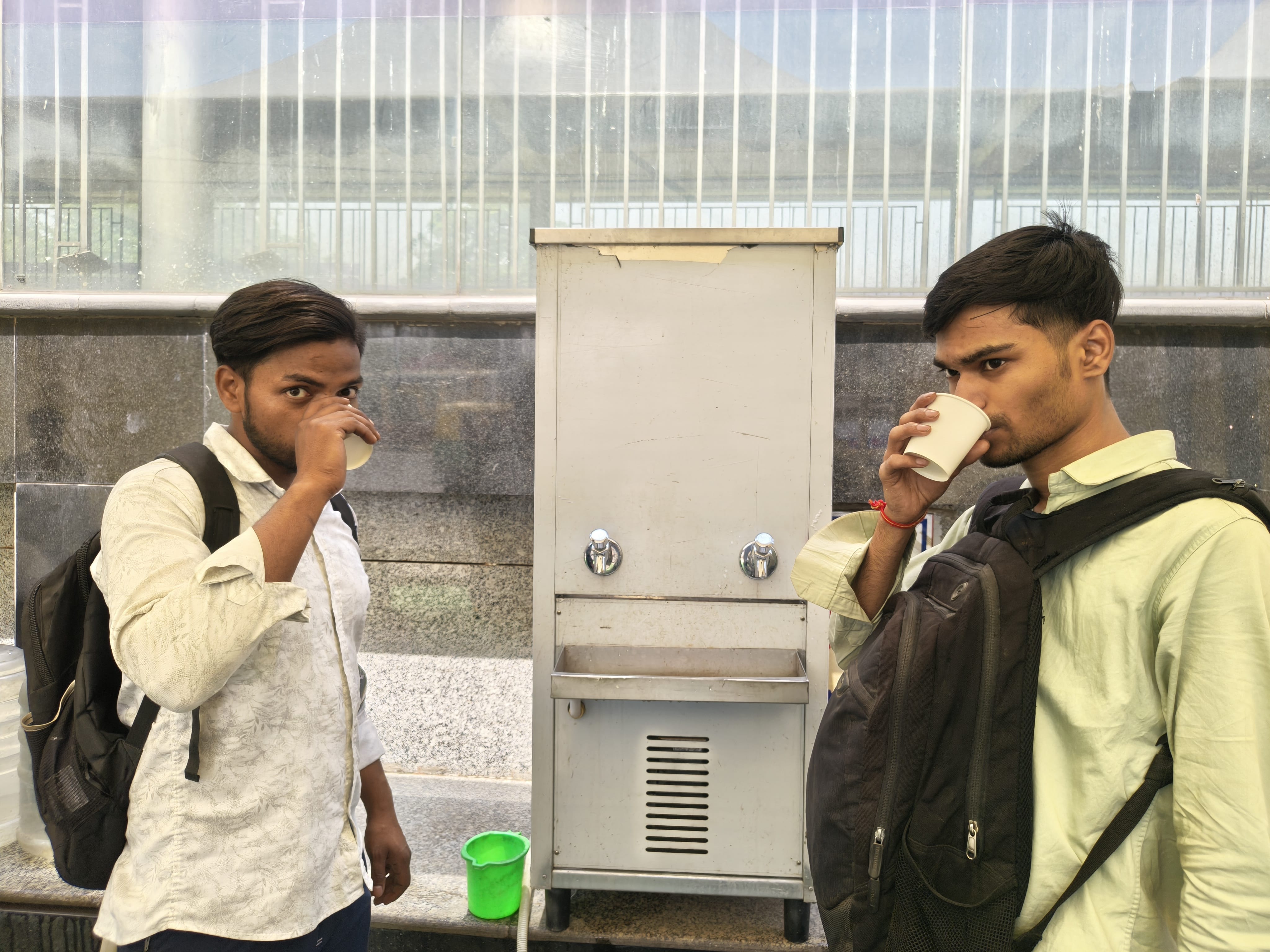
In a corner chair, a seemingly drunk man stretches, yawns, and returns to sleep.
The place is now half-full.
A few hundred metres away, Asif, 52, takes a break from pedalling his rickshaw in the shade cast by the canopy attached to its seat. He knows the cooling zone exists. He is not going. “We work here. Why will I take my rickshaw there? There should be a stand with shade for us here,” he says.
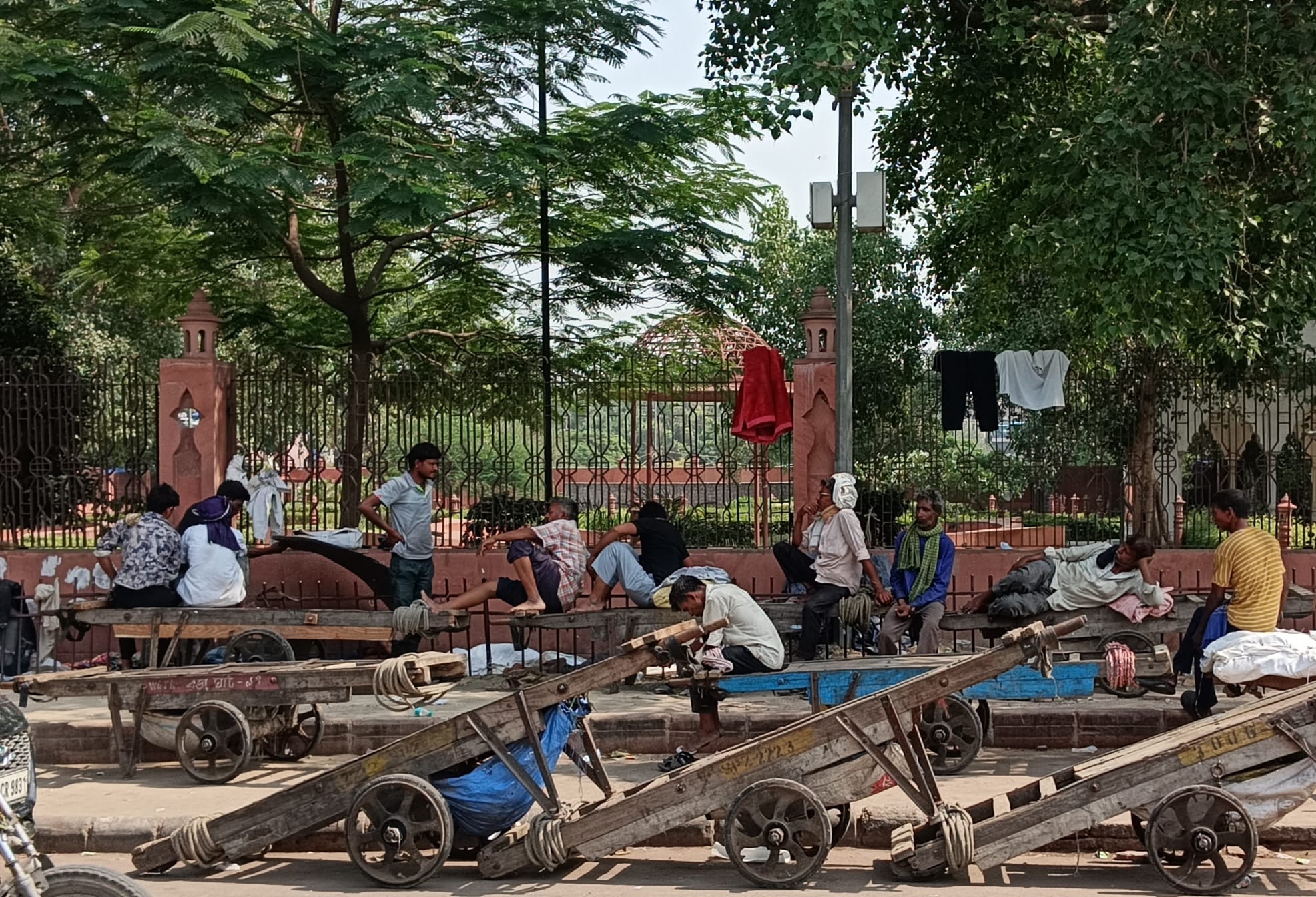
Hand-cart pullers idling nearby echo the same calculation. Their employers call without warning, to lug heavy sacks at any hour. Going to the cooling zone means risking a shift, and the income that comes with it.
Around 4 pm, Mohammed Kaleem parks his rickshaw to fill water. He is disappointed. “I thought the water would be cold,” he says. “Touch this – is it cold?” It isn’t. Water is refilled so often that it has no time to chill. Will he come back? “Tourists can come sit here. But we work the entire day. I can’t be coming here.”
The Intergovernmental Panel on Climate Change has predicted a rise in the frequency of hot days, nights and heatwaves across the world. HeatWatch recorded at least 84 heatstroke deaths in Delhi last summer. Delhi NCR faced 11 heat and severe heatwave days in 2025. Slum pockets and low-income areas are known to be the most vulnerable.
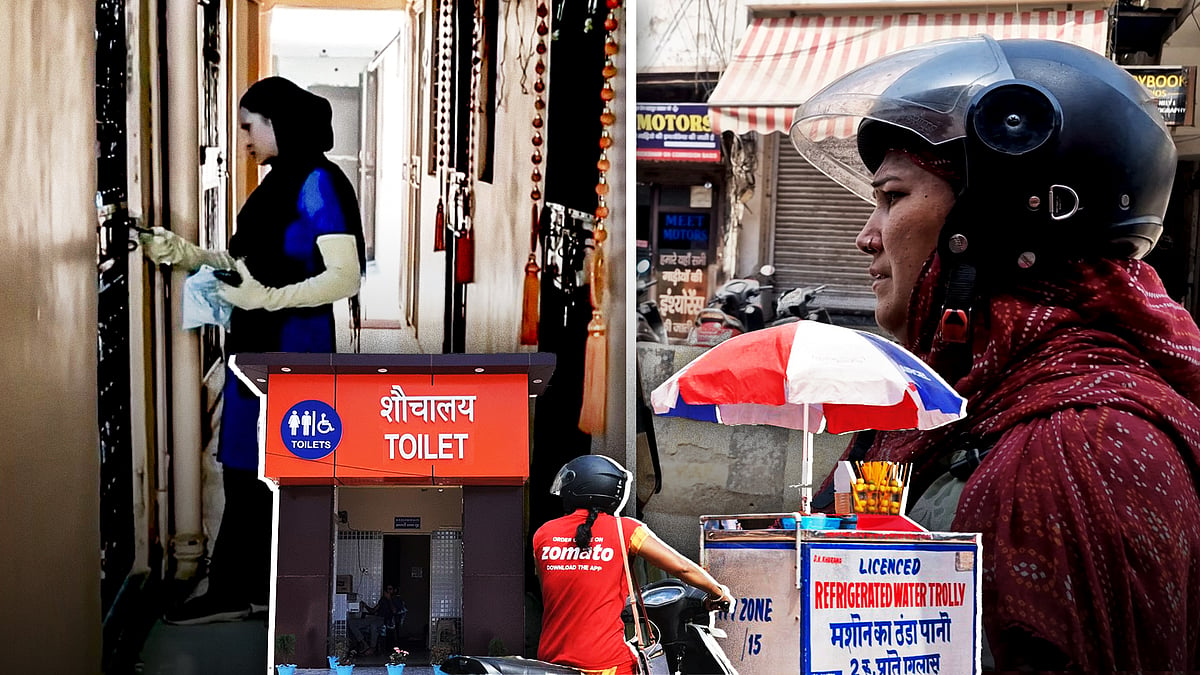
The women of these areas bear a disproportionate share: they must work through the heat and arrange water, food and basic services for their families. From observation, the cooling zone is not drawing them in. On the rare occasion a woman does stop by, she is accompanied by a male relative.
As evening approaches, the place is barely occupied. Children drift in and out, asking permission to drink water from the cooler.
The drunk man, meanwhile, is awake again. He sways gently in his chair, still drowsy. Apparently, it is also an excellent place to sleep off a few drinks.
We take no ads, bow to no government or corporation, and answer only to you, the reader. This Press Freedom Month, pay to keep news free.
 Delhi’s women gig workers are battling far more than the punishing heat