In Bengaluru and Hyderabad, BLOs point to crushing workload, physical exhaustion
“No matter how much we explain, many residents aren’t able to understand. They need us to fill everything for them,” says a BLO.

Parveen Begum puts her pen down and drops her writing pad onto the table in front of her. “Please give me a couple of minutes, my hand hurts,” she tells the sympathetic couple seated across from her. The table at the Anganwadi centre in Hyderabad’s Baggikhana slum is buried under a stack of enumeration forms.
Parveen points to them with a tired smile.
“I must have filled around 40 forms today. Yesterday it was 57.”
For the past three weeks, this has become routine. An Accredited Social Health Activist, (ASHA) since 2018, Parveen has spent the last three months working as a Booth Level Officer (BLO) for the Election Commission's Special Intensive Revision (SIR) of electoral rolls.
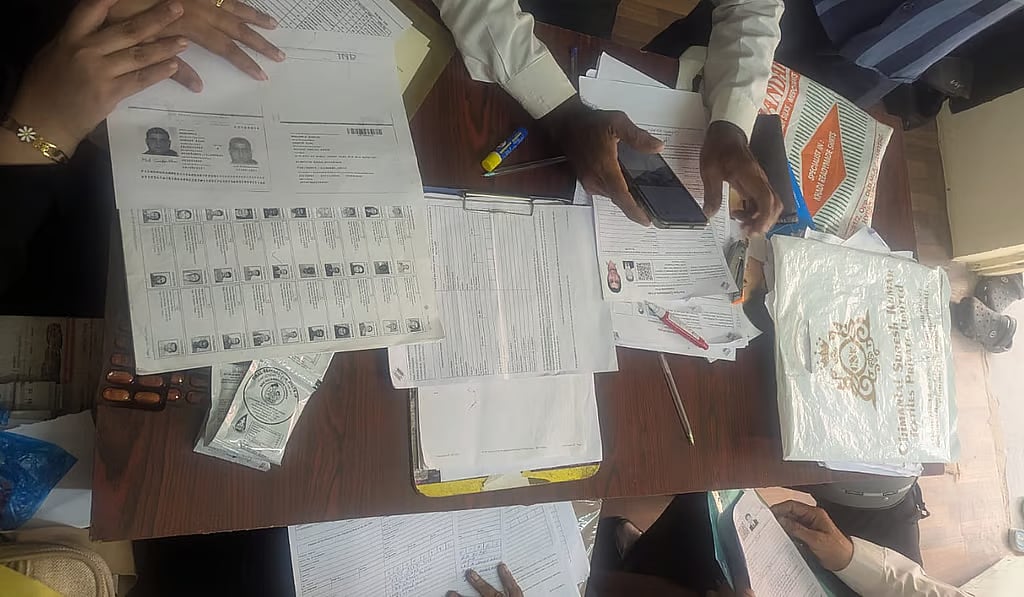
Before the enumeration began, she spent nearly two months assisting the pre-SIR mapping exercise in Telangana, matching existing voters with the 2002 electoral rolls to verify records. As the exercise enters its final stretch, the workload for Booth Level Officers (BLOs) has intensified.
TNM spoke to a few BLOs in Telangana and Karnataka involved in the current phase of the SIR, which involves distributing, collecting and verifying enumeration forms. This phase was scheduled to conclude on July 24 in Telangana and July 29 in Karnataka. Many BLOs said the timelines were unrealistic given the volume of work, and had called for an extension to complete the exercise. The ECI on July 15 revised the schedule and extended the house visit deadlines.
'Distributing forms was only half the work'
Assigned to a polling station in Hyderabad’s Khairtabad Assembly constituency, Parveen is responsible for around 1,200 registered voters and their enumeration. She has already distributed forms to almost every household in her area, with only about 80 to 100 left.
“But that was only half the work,” she says.
“With SIR ending in 10 days, I have to fill out many forms because people are unable to do it themselves. I know this community well, so identifying people wasn't the difficult part. But the work just stretches. I’m here until 11 at night on most days,” Parveen told TNM on July 14.
Her phone rarely stops ringing.
“There are calls from people worried they’ll lose their voter ID, people who don't understand the mapping process or those who don't have the required documents.”
Parveen is assisted by four to five men residing in Baggikhana including the slum’s president Poorna Chandra, a local Congress leader.
“Some assistance from the government would be helpful. We all are helping Parveen how much ever possible but there has to be an extension for BLOs. A month’s time is hardly sufficient,” he remarks.
In Secunderabad constituency, sanitation assistant with the Greater Hyderabad Municipal Corporation (GHMC) Anand Kumar along with two of his employees Sagar and Babu report similar experiences. At one home, they spend nearly 25 minutes patiently helping a couple fill out just two enumeration forms. “If it was a family of four people, it would take longer. Sometimes up to an hour,” Sagar remarks.
Shoukath, the resident they spoke to, plies them with many questions which Sagar patiently explains. It took a total of 25 minutes for Shoukath to fill out her form and that of her husband, Sadiq Ali.
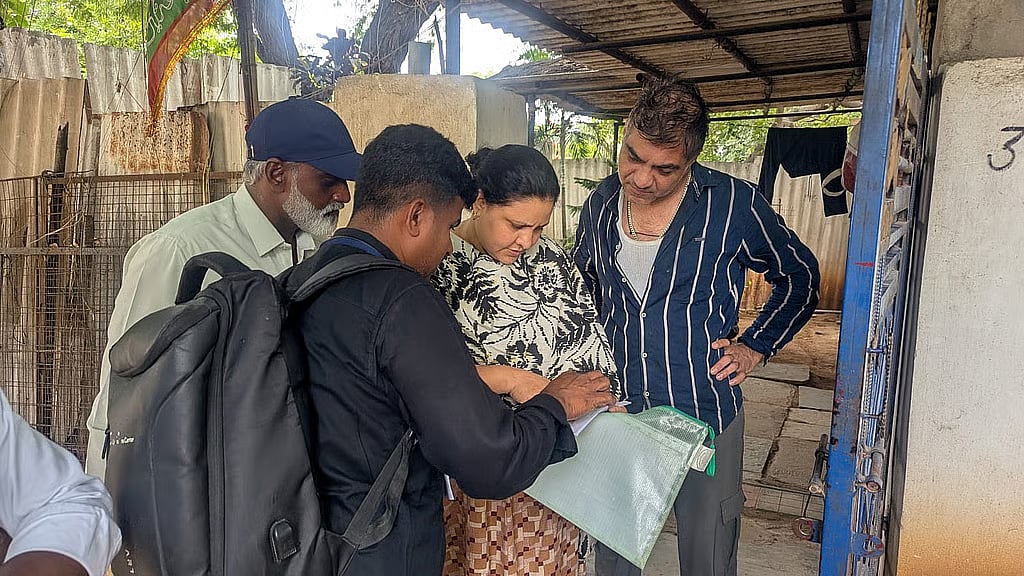
“It is stressful,” Sagar says. “No matter how much we explain, many residents aren't able to understand. They need us to fill everything for them.” For many residents, particularly elderly voters and those with limited literacy, BLOs have become the first point of contact for navigating a process they find confusing.
'Finding people is harder than finding forms'
In Bengaluru’s Yeshwanthpur Assembly constituency, government school teacher Shanta* (name changed) has spent the past two weeks carrying a heavy backpack of forms while trying to locate nearly 1,000 registered voters. When TNM met her on July 13, she had distributed only about 600 forms.
“It’s really hard to find addresses,” she says. “Just look at this—there are only door numbers.” Many streets have no names or numbers. Houses are not numbered sequentially. Signboards are faded or missing altogether.
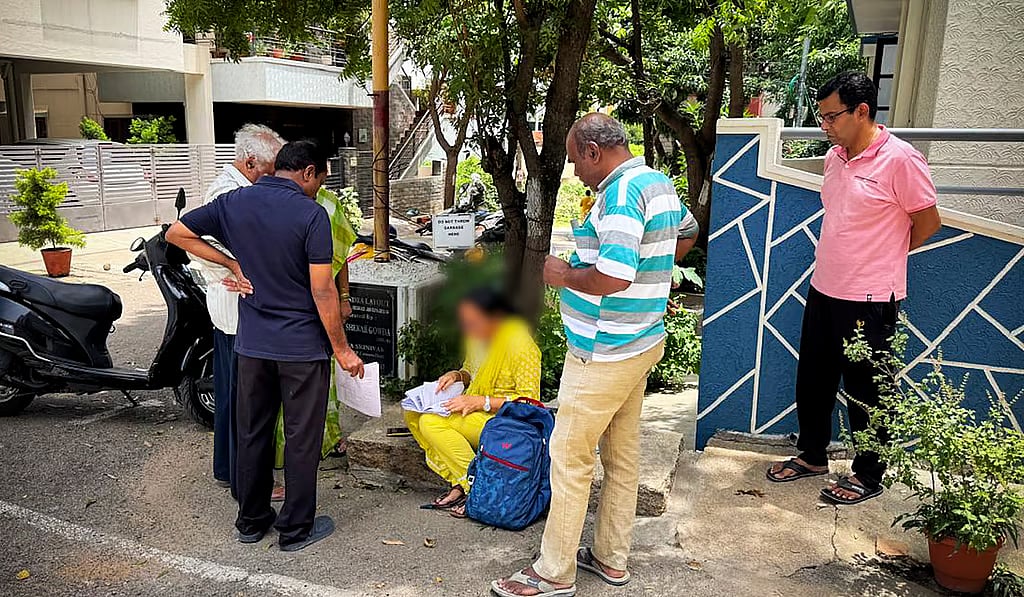
Initially, Shanta promised residents she would return to collect completed forms. She soon realised that was impossible.
“Now, when people call, I ask them to come and give me the form wherever I am.”
Elizabeth* (name changed), another teacher working as a BLO in Pulakeshinagar, says the problem goes beyond incomplete addresses.
“Many people in my area are dead or have shifted elsewhere. We don't have phone numbers or updated addresses. Unless the voters contact us themselves, it is almost impossible to find them.”
Entire neighbourhoods have transformed over the years.
“This area had many old houses. Builders demolished them and built apartments. How do we track where those people went?” Without any way to verify their whereabouts, BLOs are instructed to mark such voters as “shifted”.
“We don't know what happens after that. We've simply been told to classify them that way,” Elizabeth adds.
Seated next to Anand in an area of Secunderabad constituency in Hyderabad, Bharat Rashtra Samithi’s (BRS) Booth Level Agent Shafath Ali says that owing to several retired Osmania University (OU) employees shifting out of their allotted polling station, it has been hard to track people.
“Especially when you consider that the university area is interspersed with several slums, we don’t know where anyone is. House numbers have changed, people have left, some still own properties but live abroad. It is difficult to reach out to people,” Anand says.
“We ask residents about their former neighbours. Sometimes they don’t have details,” Shafath adds.
Physically daunting work
Many BLOs in Karnataka are government school teachers, several of whom are nearing retirement. Elizabeth says balancing teaching with election work has become physically exhausting.
“Many teachers are 57 or 58 years old. We teach in school and then come here to do this work. The constant travelling is very hard,” she states.
Grace*, another teacher working as a BLO in Pulakeshinagar, says the voter lists themselves make the exercise harder. “People from the same family have been allotted to different BLOs. The lists are not in serial order either. We keep searching street after street.”
Although BLOs have officially been instructed to visit each household only three times, Grace says that target is unrealistic.
“This is my fifth visit to this apartment complex alone,” she says. Repeated visits have become necessary because residents continue to have questions about the process, she says.
Despite weeks of fieldwork, Shanta had uploaded only four forms when TNM met her.
Little pay, lot of work
At the start of the SIR process in India, the Election Commission announced that a BLO would be paid Rs 12,000 annually. The announcement was made in August 2025. On July 14, 2026, it was announced that a special honorarium of Rs 6000 would be given to BLOs for SIR related work.
But BLOs TNM spoke to said that the payment hardly suffices, with several adding that they are yet to be paid. On the condition of anonymity, one BLO in Hyderabad pointed out how for three months of election related work, she had earned a total of Rs 1500. “The payment isn’t commensurate with the workload. The money doesn’t even cover my travel expenses,” she adds.
Another BLO in Hyderabad said that no payment was released by the EC yet since the SIR work commenced. A similar story pans out in Bengaluru where a BLO says that even aside from SIR specific work, she hasn’t got paid for her work as a booth level officer in the last four years.
This report was republished from The News Minute as part of The News Minute-Newslaundry alliance. Read about our partnership here and become a subscriber here.
 India is nowhere near ready for a nationwide SIR. A passport scare showed me why