‘Once they see the money, they keep building’: Inside Delhi’s PG ecosystem built on a hostel shortage
The Satya Niketan collapse killed seven. Behind it: a hostel shortage and a rental market without a functioning compliance system. Newslaundry visited PGs across North and South campus, where students pay up to Rs 30,000 a bed for windowless rooms, single staircases and lanes no fire tender can enter.

On the first floor of a building in the main market of Satya Niketan is a restaurant. The second floor houses a hotel. The third floor is locked. The fourth floor is a boys’ paying guest accommodation with five rooms, let out on double and triple occupancy. On the fifth, on a terrace lined with garbage and dirt, another room has been built. A telephone tower looms over the structure.
For Arnav Yadav, a first-year student at Motilal Nehru College who moved to this PG in Delhi from Firozabad for higher education, the building has become a source of fear. On Sunday, a PG building in the same neighbourhood had collapsed, killing seven. “I am sure this building is illegal too. I am scared this incident can happen anywhere again in Satya Niketan,” he said.
The building that came down on Sunday housed Hostel Daze, a boys’ PG. The collapse has since set off the familiar machinery of official response.
In an official release, the Municipal Corporation of Delhi said that it has so far identified 1,355 buildings across Delhi where PG facilities are operational, accommodating approximately 27,000 occupants. The MCD said its enforcement drive covers violations of the Master Plan of Delhi and the building bye-laws, unauthorised construction, misuse of properties and dangerous structures. The release does not specify PG-specific permissions, licences, occupancy limits or safety standards though a proposed Delhi government framework, drawn up after the collapse, seeks to bring PGs under a formal regime.
But what fell in Satya Niketan was as much a building as it was the arrangement that thousands of students in the capital live on top of: a public university that cannot house its own students, and a private market that expanded to fill the gap. Add to the mix a civic compliance system that has looked away. Be it fire-escape requirements to floor limits written into the building bye-laws to the near-total absence of rules on what a PG may charge.
Newslaundry visited PG accommodations and spoke to residents, operators, brokers and landlords in the student neighbourhoods around Delhi University’s North and South campuses to understand how students live, what they pay, and what they give up in order to study in Delhi.
This is partially because of the lack of public-funded hostels. According to a press release by Delhi University, it had 3,422 hostel seats at the university level. With the proposed addition of 3,922 new seats, the total is set to more than double, to 7,344, across a university with around 90 colleges.
Newslaundry has sent questions to the Delhi University administration on hostel capacity, allotment criteria, eligibility rules and the status of hostels currently under construction. The story will be updated if a response is received.
Life in PGs: tiny rooms, rents from Rs 13,000, no ventilation
Eight major Delhi University colleges are situated in and around Satya Niketan. Of these, only two – Sri Venkateswara College and the Faculty of Arts at South Campus – have hostel facilities. A large number of the rest end up at Satya Niketan, which has 299 houses, several of them operating as PGs.
Newslaundry visited the girls’ PG run by Hostel Daze, located above a restaurant a short distance from the boys’ PG that collapsed. It is a five-storey structure with the ground floor rented out to food shops – the same configuration as the building that came down.
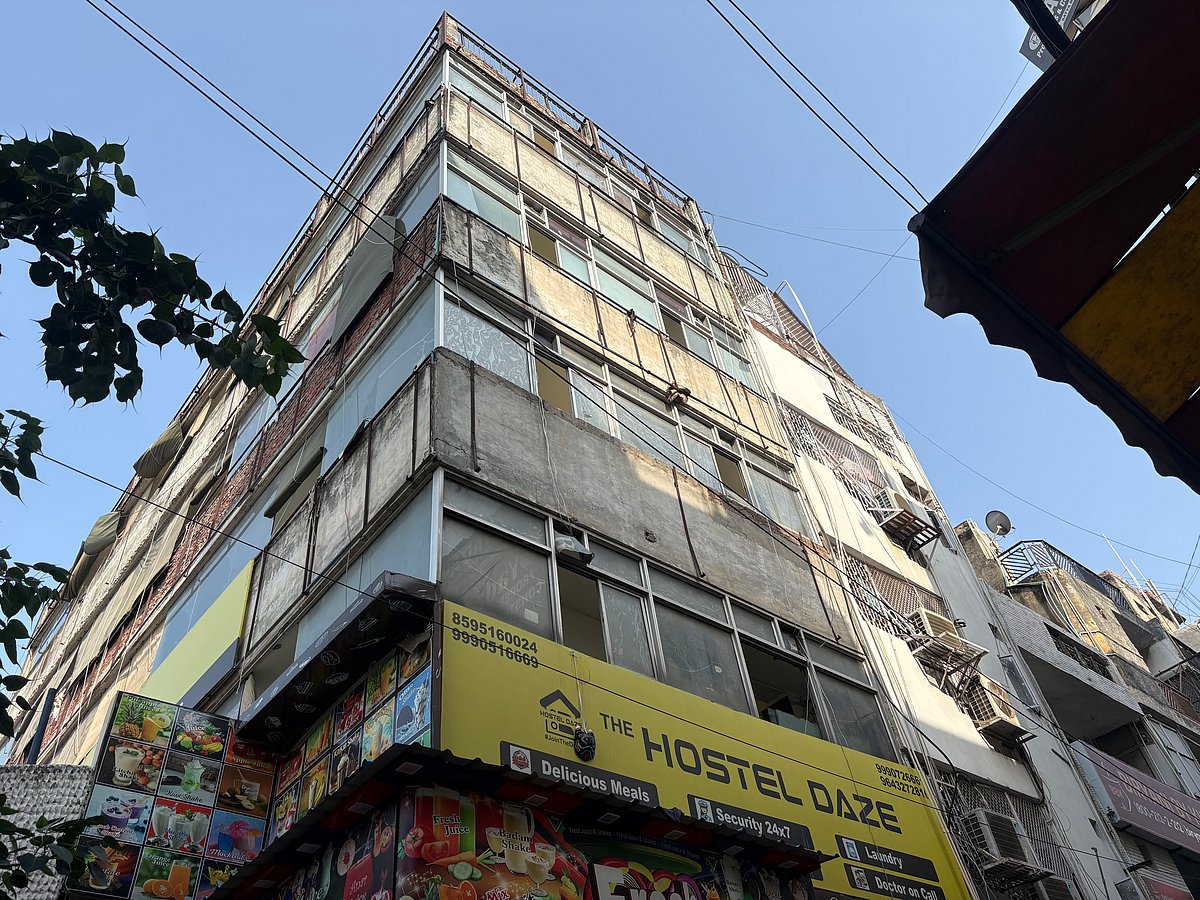
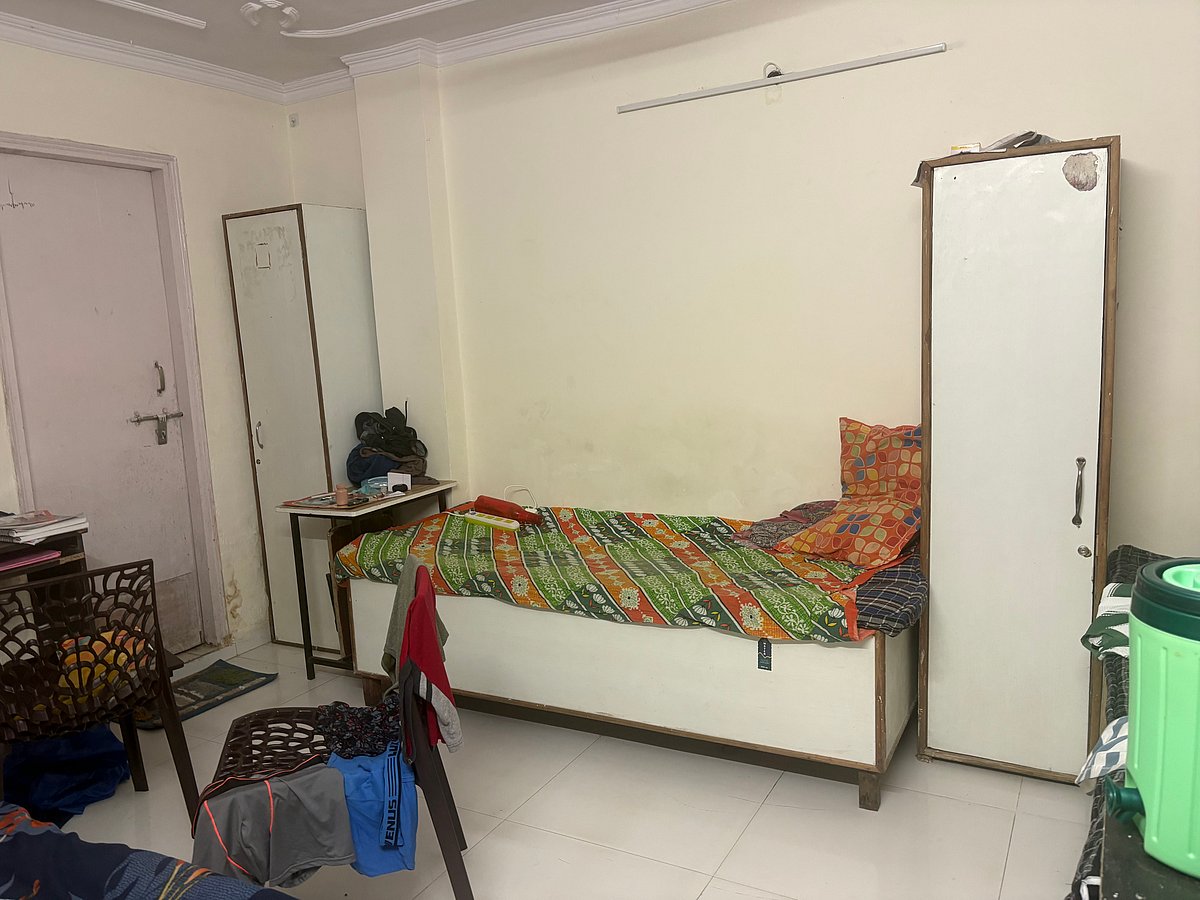
The four floors above had five rooms each, with a total occupancy of 40, let out as single and double-sharing. Newslaundry was shown a triple-sharing room. It was cramped, with no ventilation, and housed three students. A student living on the first floor of the Hostel Daze girls’ PG, who studies at a nearby nursing institute and spoke on the condition of anonymity, said she pays Rs 17,500 for a double-sharing room.
“Since the incident, I do not feel safe living here. I am here to pack my things. I will find accommodation elsewhere…Most of the girls have left and do not want to stay in this PG.”
The building was front-facing with large windows on its façade, but the rooms themselves had no windows. The passage on every floor was narrow and the stairs extremely steep. Electric wires jutted out near the staircase. The building had a single point of entry and exit. Large black and grey sheets had been hung across the front to cover the Hostel Daze signage, though the logo – the words “Hostel Daze” written across the outline of a house, on a yellow backdrop – remained visible.
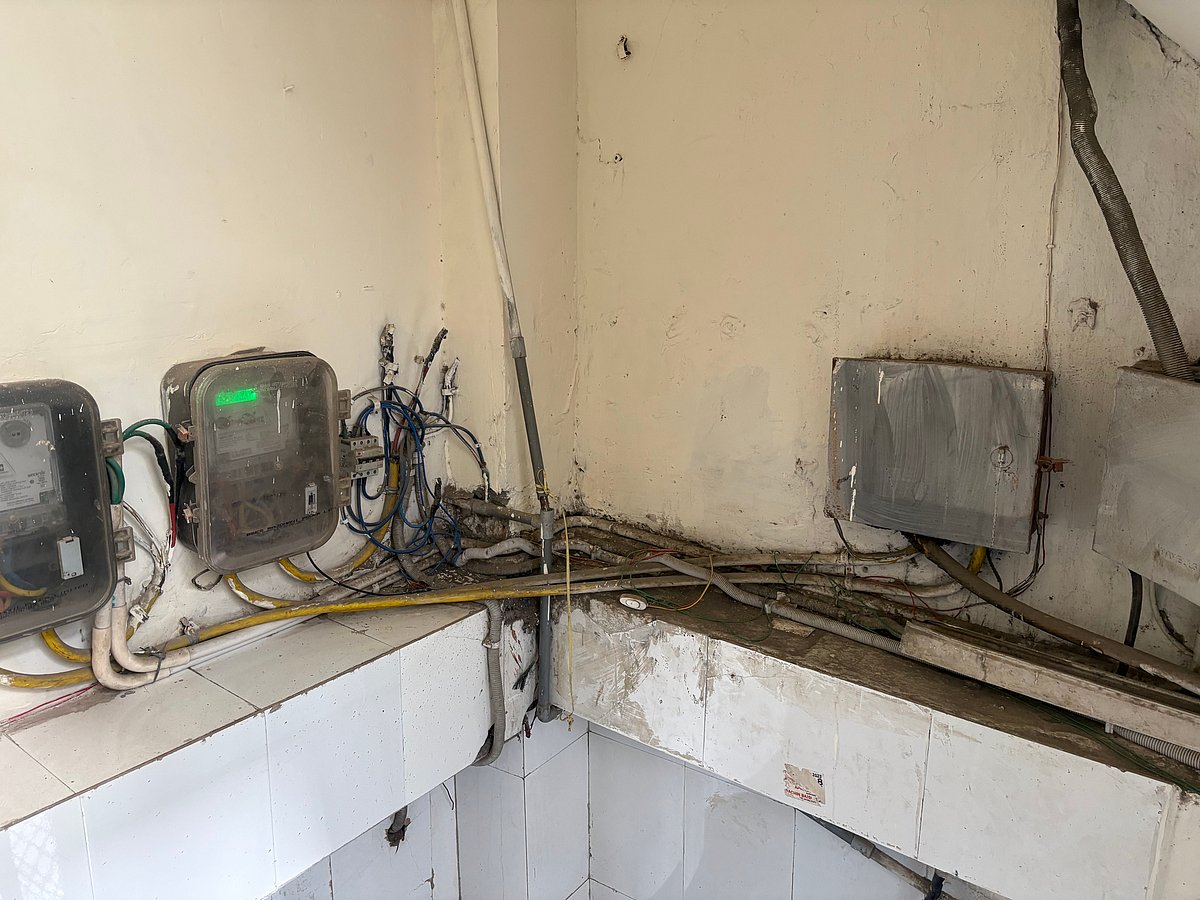
Delhi’s building bye-laws lay down requirements intended to ensure that occupants can escape safely during a fire. Depending on a building’s height and use, these include multiple staircases, safe means of escape and exits leading directly to the street. As Newslaundry has reported earlier, buildings are also required to have prescribed fire-safety equipment, including fire extinguishers.
Another PG, in one of the lanes off the main Satya Niketan market, was under MCD inspection when Newslaundry visited on Tuesday. The PG has five floors with four rooms on each, which works out to eight girls per floor. A first-year Delhi University student from Uttarakhand was moving her luggage out with her family. Her father said, “I am taking my daughter back home for a few days. She is unhappy and scared.”
Ren, a third-year student at Sri Venkateswara College, described her room at another Satya Niketan PG as “cramped and stuffy”. She lives in a single-occupancy room and pays Rs 11,000, without food. Her building has four floors with 10 girls on each, and she said rooms had also been built on the terrace.
Moti Gaon: where the rent falls and the lanes narrow
A short walk from the main market are the tight, stuffy lanes of Moti Gaon, with dangling electric wires and steep stairwells. Lokesh Kumawat, a third-year student at Delhi College of Arts and Commerce, described the area as particularly congested. “Should such an incident happen in Moti Gaon, it would be difficult for rescue teams to even reach there,” he said.
One five-storey building there operates as a boys’ PG, with three rooms on each floor priced at Rs 11,000 a bed. A second-year student at Ram Lal Anand College, who wished to remain anonymous and has since decided to move out of this PG, said: “Students who want cheaper accommodation come to Moti Village. Look at this building…I am leaving after this incident. I am going to my friend’s flat in South Extension and will look for a rental flat myself."
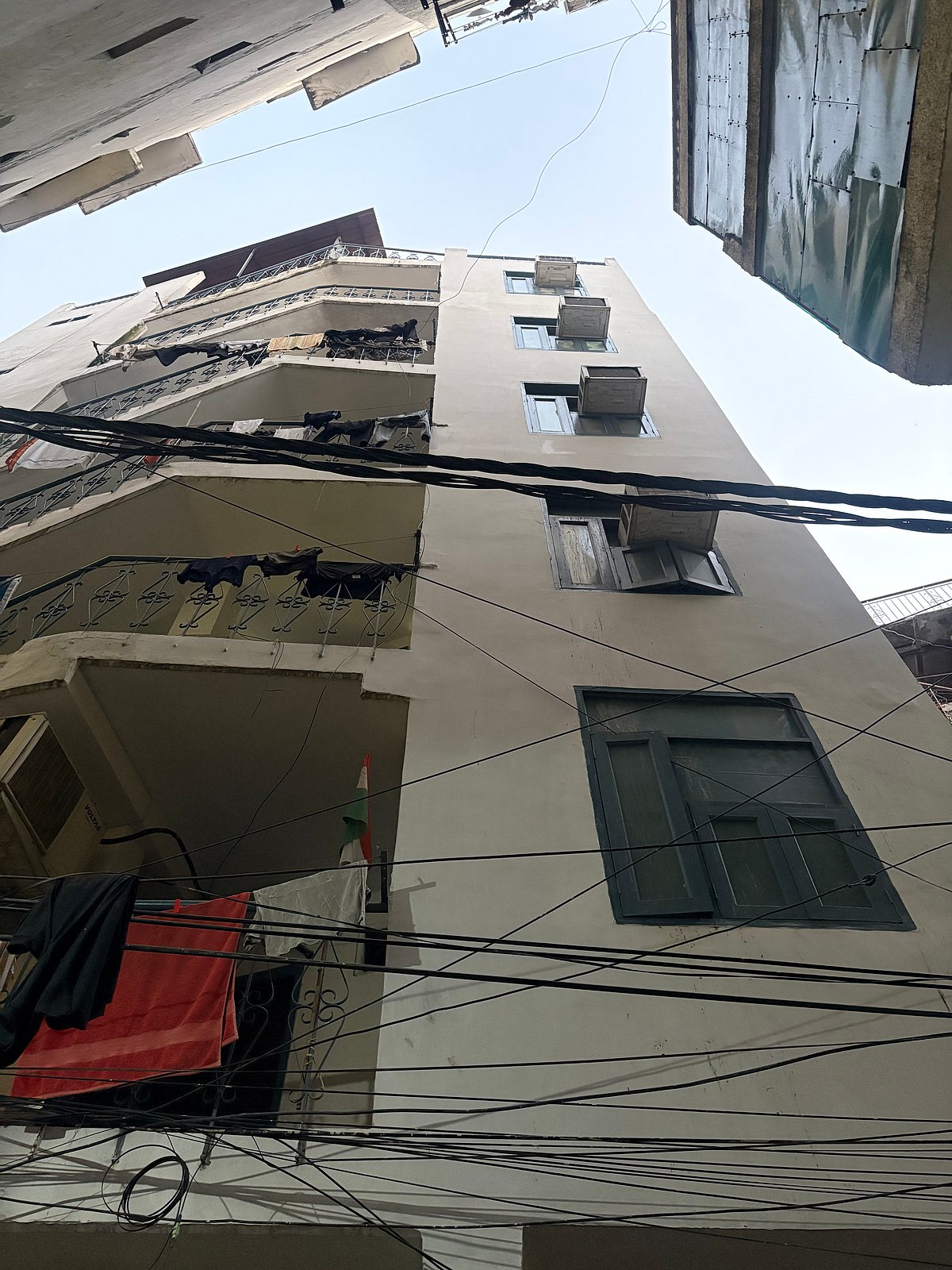
Chetan, who rents a flat in Moti Gaon, said Satya Niketan can be “very expensive for some people so they come to Moti Gaon”. “The alleys are narrow, cramped and dangerous with wires hanging everywhere. However, there is no other option. I have been living here for almost two years and my rent is under Rs 10,000.”
North Campus: paying more for safety
The shortage of affordable and safe accommodation is not a South Campus problem. The same pattern runs through the student neighbourhoods around Delhi University’s North Campus, such as Kamla Nagar and Malka Ganj, where cramped buildings, poor ventilation and high rents are part of everyday life.
Kamla Nagar’s rise as a PG hub followed a decades-long transformation driven by the expansion of DU’s North Campus, and the area’s shift from being a planned residential colony.
Newslaundry visited Malka Ganj, near Kamla Nagar. Most of the area is packed with buildings that have commercial kitchens on the ground floor and PGs above them. This arrangement carries its own fire risk for the students upstairs. The roads and buildings are so tightly packed that only a two-wheeler can pass.
In one street, we waited for students to return from college. One building there, a PG, is six storeys tall. The ground floor has a reception where the warden sits, the floors above accommodate students, and the kitchen is on the sixth floor.
A second-year English Honours student at Ramjas College, who wished to remain anonymous, said three people stay in one room, with each student paying Rs 8,500 per bed and Rs 500 for electricity. At the start of the stay, they were also charged Rs 3,000 as maintenance. They had signed an agreement, and the student alleged that it described the building as a commercial property.
“The mess and sanitation are in good condition, but the ventilation isn’t proper at all because the windows just open towards the gallery. There is no sunlight. They do provide us with a fridge, washing machine, and other basic amenities. But since I didn’t get a hostel at Ramjas, I had to choose a private PG,” he said.
Ram, another Ramjas student who stayed on the ground floor, said a false ceiling collapsed in his room without warning. “In the morning after having breakfast, I was watching something on my phone. It was a holiday and suddenly, around 9 am, the false ceiling fell inside the room,” he said. He said he escaped because the ceiling came down over the bathroom side of the room. It was a triple-sharing room, and his roommates were out.
“I still remember how traumatising it was. I filed a complaint, and they just closed the room for two months. Later, I was shifted to another room. The PG wasn’t well-ventilated either, and the food wasn’t good. Students always fear they won’t get their security deposit back.”
Raj Sekhar, a third-year student in Hansraj College’s Chemistry department, left his PG in Chandrawal area, where he said he paid Rs 12,000 a bed, over poor conditions and food. “Ventilation wasn’t proper; there was no window, just a small exhaust fan…I have been staying in a flat. It’s farther from college, but in much better condition than those PGs. I am from UP, so I didn’t get a college hostel, because UP, Haryana, and Rajasthan aren’t considered far from the college,” he said.
Kapil, from Hindu College, stays in a PG where only the rooms facing the front balcony get proper ventilation. The food quality is poor, he said, and when he complained he was told: “You have not come here to study but to raise issues.”
The Hindu College hostel, Kapil claimed, has been under construction for three years. He said he would prefer a hostel, both for the ventilation and because it would let him live among his peers.
Newslaundry has written to the principals of Ramjas College, Hansraj College and Hindu College seeking details on the status and timelines of hostel construction and current hostel capacity.
In the morning after having breakfast, I was watching something on my phone. It was a holiday and suddenly, around 9 am, the false ceiling fell inside the room.
Ram, a Ramjas College student
The gender premium
There is another pattern that runs through the North Campus accounts: women pay more to live in what they call a safe locality, and more again for a room with a window.
Priyanshi, from Zakir Husain College, said that with no hostel at her college she moved into a PG near GTB Nagar and paid extra for a room with windows.
“The food was not good, but the building and the locality were in better condition, even though there was no proper lighting and no windows. I was paying 18,500 for a double-sharing room. I chose my PG in GTB because it was in a better, safer location, even though it’s far from my college. I spend 80 rupees daily on travel, plus 1,000 for electricity. They provide most of the amenities, including four meals a day…my college fees is Rs 14,000 per annum, but most of my money goes toward the PG,” she said.
Two first-year students from St Stephen’s College, who also wished to remain anonymous, described the same calculation. They live in the Hudson Lane area and pay around Rs 30,000 per bed, inclusive of amenities and four meals a day, for a safer locality. They alleged that PG owners exploit tenants through routine rent increases: they said the rate was Rs 27,000 earlier and has since been raised.
Indrani, a third-year English student, was paying Rs 15,000 for a double-sharing room but has since moved to a double-storey building in Christian Colony, off Vijay Nagar. “The lanes and roads are in bad condition, but since it is a student area, it feels safe. Per month it comes to around Rs 6,000, just without AC.”
Smita, a first-year Economics student whose college has no hostel, said: “Rs 13,500 for triple-sharing, including amenities, plus 10–12 rupees per unit for electricity so the total comes to around 15,000 per month.” She stays in a three-storey building where the owner lives on the ground floor, one floor is let to students and one to other tenants. The building was in good condition.
“If there were a hostel, we would have to pay less, it would cost less. We are doing this for our own safety,” she said.
There is another pattern that runs through the North Campus accounts: women pay more to live in what they call a safe locality, and more again for a room with a window.
The PG boom, and the business behind it
Satya Niketan was developed by the Delhi Development Authority in 1968 under the Jhuggi Jhopri Removal scheme, with residential plots laid out at up to around 40 square metres. Nearly six decades on, many of those plots are barely recognisable, redeveloped into multi-storey buildings for hundreds of students.
Vikas Vashisht, a real-estate agent in Satya Niketan, traced the boom to the hostel gap. “Due to lack of hostel facilities in most of the nearby colleges, PGs started flourishing in Satya Niketan for student accommodations. This boom happened in the last 10-15 years,” he said.
On pricing, he said: “If the rent stands at Rs 15,000, I think it is justified if a PG is providing meals, Wi-Fi, laundry and other housekeeping facilities.” PG operators lease the property from landlords and have their own rent to pay, he pointed out. He claimed rents do not usually rise every year because competition in the market is intense. There is, he said, space for every budget. He said a student looking for something cheaper simply moves from Satya Niketan to Moti Gaon.
Prashant Panwar, who runs two PGs in Satya Niketan, said he spotted the opportunity in 2016 and started his business in 2018. “Increasing rent is usually dependent on the landlord. I am a leaser, in case the landlord increases the property’s rent, we usually ask Rs 500-1000 extra in the next term from the tenants, but this is based on mutual understanding,” he said.
Electricity, according to Panwar, is billed at Rs 12-14 a unit and split between the students sharing a room, which works out to roughly Rs 6-7 per unit per person. He said his PGs have fire extinguishers on every floor, and that health department personnel had in the past inspected the premises.
The ease of getting an electricity connection is itself part of the pattern. In a November 2025 judgment (BSES Yamuna Power Limited v. Bhagwanti & Anr.), the Delhi High Court ruled that electricity companies can grant or continue power connections to a property even if it has unauthorised construction. The court said that checking a building’s documents and approvals is the MCD’s job, and that the discom’s role is only to disconnect the connection once the MCD acts through sealing or demolition. The court reaffirmed the principle in an April 2026 order.
In practice, this means a PG operating in a building with illegally added floors can still run on a residential-rate meter, so long as the civic agency hasn’t flagged it. Newslaundry has sent questions to the Delhi Electricity Regulatory Commission. The story will be updated if a response is received.
Panwar said, “Mostly, those who are operating PGs are leasers. If they know a building is in a poor condition, just to further their business, they should not take the building.”
Like Satya Niketan, the rental market around North Campus too reoriented itself around students, said a homeowner. “A major reason is that some families wouldn’t vacate the house once they moved in, so owners started grabbing that opportunity and preferring students, since they will leave once their course is done. People build extra floors as market demand increases, and once they see the money in it, they get greedy and keep building. PG agreements are renewed every year, so we can increase the rent according to the agreement and the law,” he said.
How two floors become six
Another landlord, who also spoke on the condition of anonymity, explained how the buildings grew. There are broadly two categories of land in Delhi, he said: land allotted by the DDA, and agricultural land subsequently converted to other uses.
Many properties that were originally two-storey buildings have had floors added over the years, taking them to five or six storeys. In Delhi, he said, this is particularly common in buildings used as PGs, and in many cases the additional construction is illegal.
As per the MCD building bye-laws, a builder is permitted to construct a maximum of stilt parking plus four upper floors – five levels in total - or parking and three additional floors on standard residential plots, considering the specific height restriction and the area. Many PG buildings have six levels, and the ground is put to commercial use. The landlord said many bypass the process, with money changing hands under the table. “It is very rare that builders get the land maps checked in Delhi,” he alleged.
In response to Newslaundry’s questionnaire, the MCD said the Satya Niketan building that collapsed had not been inspected before the incident, and that its sanctioned use was not on record, though the owner had paid conversion charges for “other use”. On PGs more broadly, the civic body said it does not register or license paying-guest accommodations, though the activity is permitted under the Master Plan of Delhi once conversion charges are paid. It also said it holds no PG-specific data on past inspections or violations, which are handled under the Delhi Municipal Corporation Act like any other building, and that no structural-safety rule applies specifically to PGs beyond the stability certificate required of all buildings at the plan-sanction and completion stage. Read their full response here.
On PGs specifically, the second landlord said there are no dedicated official norms governing their operation in Delhi. Operators are nonetheless required to maintain fire-safety equipment and obtain no-objection certificates, he said, but securing an NOC is difficult, because buildings are required to have two stairwells, which is usually not the case in Delhi’s PGs.
Delhi’s fire-safety system also turns on a referral from the civic agency. “If the civic agency refers a building to us, and it matches with the compliances, then we give the NOC,” said Delhi Fire Service chief AK Malik.
Newslaundry has asked the Delhi Fire Service how many PG buildings in Satya Niketan, Malka Ganj, Kamla Nagar and Mukherjee Nagar have been referred to it by the civic agency, and how many hold a valid NOC. The story will be updated if a response is received.
Some legal protections do exist on paper, though they are framed around tenancy rather than safety. Section 44 of the Delhi Rent Control Act binds “every landlord” to keep the premises in good and tenantable repair. Separately, Delhi Police requires landlords to inform the local police when they take in tenants, for verification.
Newslaundry has written to the Delhi Police seeking data on tenant-verification compliance by PG operators around North and South Campus, and on enforcement of the security measures prescribed for paying guest accommodations. The story will be updated if a response is received.
Delhi also has a temporary legal framework covering certain unauthorised constructions. The Delhi Laws (Special Provisions) legislation has, through successive extensions, kept enforcement action against specified categories of unauthorised development in abeyance while the government works on regularisation and other policy measures. The protection is not blanket: the law specifies the categories and cut-off dates to which it applies, and excludes certain forms of post-cut-off construction and commercial use. The current legislation has been extended until December 31, 2026.
However, the MCD’s own response indicates that its enforcement action is directed at broad building and land-use violations rather than any defined PG-specific licensing regime. That gap is the whole business, according to Paras Tyagi, founder of the Centre for Youth Culture and Environment.
“There is a tenant agreement, and it favours whoever is managing the property. There is no license or protocol required to operate a PG in Delhi. It’s a booming economy, and nobody wants to bring it under regulation. They can charge whatever they want. If the government were to regulate this, agreements would have to mandatorily disclose commercial use, the electricity rate charged per unit, and compliance with fire safety, FSSAI food safety, health, and labour department rules, among others,” he said.
Tyagi also raised a more basic question: whether students are given rent receipts at all.
Newslaundry has sought comment from the Delhi government’s Department of Urban Development on the timeline and contents of the proposed PG licensing framework, including whether it will cover occupancy limits, rent disclosure and mandatory fire-safety clearance. The story will be updated if a response is received.
Our new project visits the landscape described in Vande Mataram as it stands today, to ask what has become of the country the national song sings about. Support it here.