Students, creators, journalists: The 17 arrested by Delhi Police for demanding an FIR
Students, content creators, and independent journalists came to Delhi to cover a protest and back a woman journalist. Now they face FIRs, a Rs 15,000 bail bond and carry memories of Tihar.

Adarsh is a third-year BSc student from Bareilly district, Uttar Pradesh. He wants to pursue a career in journalism, and has been making videos on social issues for about a year, covering problems in his village such as unbuilt roads, waterlogging, and garbage.
Managing his own expenses, he took a train from Bareilly on October 1 and reached Delhi on the morning of October 2. He came to Delhi to cover the protest against Chief Election Commissioner Gyanesh Kumar after learning that some voters from his village had been deleted from the electoral rolls. He said he had never covered a protest before.
“It’s not just our village’s problem. It’s the whole nation’s problem,” he said.
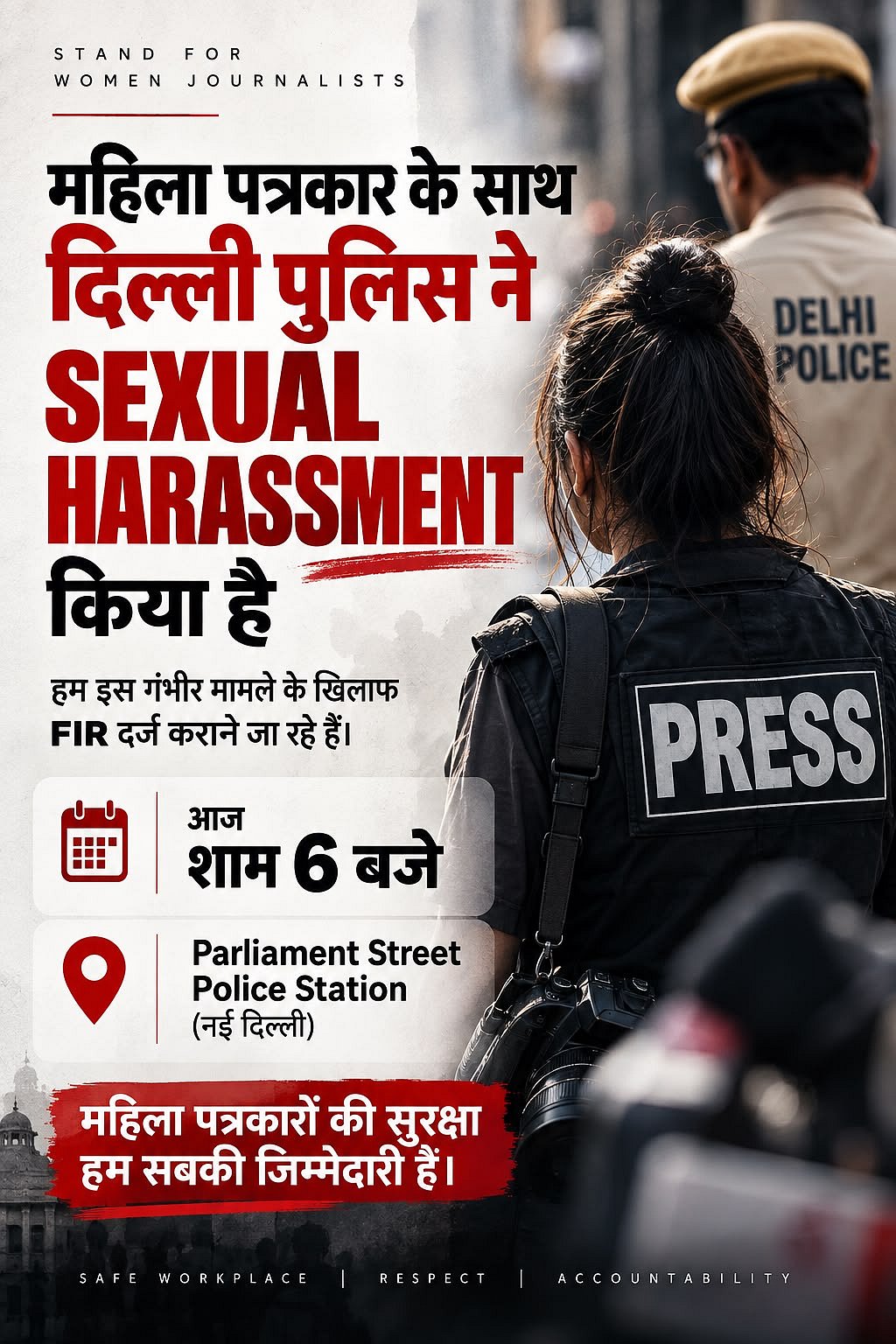
But when Adarsh learnt that a woman journalist was allegedly sexually harassed and assaulted by ACP Vivek Bhagat of the Delhi Police while she was covering the protest on October 2, he felt that he should stand with her. From October 3 until the morning of October 5, he was among the journalists, content creators, and others who had gathered outside the Parliament Police Station demanding an FIR against the officer.
“On October 5, I was just making videos of the protesters, while they were talking to the police. I was not involved in the conversation. Suddenly police personnel came and put us in a bus,” he said.
Adarsh is one of the 17 people arrested in connection with the protest outside the Parliament Street police station who were later released on bail. Newslaundry spoke to him and several others, among them students, content creators and independent journalists, who had come to Delhi to cover the protest and others to stand with the complainant.
What the police did
Around 20 people were detained early on the morning of October 5, and 17 of them were formally arrested that afternoon, according to arrest memos the court examined.
The Delhi Police told the court that the 17 were part of an unlawful assembly that obstructed a public space where a prohibitory order under Section 163 of the Bharatiya Nagarik Suraksha Sanhita (BNSS) was in force. They allege that, while being detained, the protesters manhandled and assaulted police personnel, injuring a woman police official, and damaging public property. Police have booked the 17 under relevant sections of the BNS and the Prevention of Damage to Public Property Act. All 17 are now out on bail. Two of the accused have alleged custodial violence and the court has called for a report from the DCP, New Delhi, and ordered that the CCTV footage from the police station be preserved.
The Delhi Police, meanwhile, has received three complaints of sexual harassment against its personnel; two by women journalists, and one by a Cockroach Janta Party (CJP) protester.
Why they came
Those booked in the case came from different parts of the country
Gajendra Singh, a Noida-based independent journalist who runs the digital outlet News Diggy, has widely covered the Cockroach Janta Party (CJP) protests, the Congress party’s Chatron Ka Goonj and other such events.
Some of the people at the protest in front of the Parliament Street police station are associated with News Diggy, including the complainant. Gajendra learnt what had happened to her, he supported her demand to register an FIR against the accused officer. He also called on people to sit there and demand the same. He also called on people to sit there and demand the same.
Speaking to Newslaundry, he said, “Jo humare saath galat hua hai, hum awaaz uthayenge. As a journalist, yeh kaam main nahi chhodunga.” [We will raise our voices against the wrong done to us. As a journalist, I will not give up this work.]
Anuj Bhagat, a content creator and a friend of Gajendra’s, is from Deoria, Uttar Pradesh. Before getting into journalism and content creation, he prepared for the UPSC civil services examination in Mukherjee Nagar, Delhi, from 2019 and 2023. When that didn’t work out, he started teaching and opened a coaching centre in Allahabad, where he prepared students for competitive examinations. About two years ago, he began making political and news-related videos on Instagram, and started covering protests and political events.
Anuj said he came to Delhi on October 4 after Gajendra had asked him to help make videos of the protest in front of the police station and reach out to his media contacts for coverage. Staying with friends in Delhi, he came to the protest site during the day.
“If there is injustice anywhere, you have to stand up, whatever the consequences. The complainant and Gajendra are my friends, so I will always support them,” he said.
Dharmender, 25, is a student from Aligarh, Uttar Pradesh, who is in the final year of his B.Ed at a college in Meerut, Uttar Pradesh. He said he had gone to the CJP protest back in July and, this time, went to show his support after learning about what allegedly happened to the woman journalist. He does not regret protesting in front of the police station.
“I did not think much. I went there to support her. If standing in support is the right thing, then I will do it. Marna hai to ek din. Kuch karke jaana hai,” he said.
Kunjal, a content creator who lives in Gurugram, makes news-related videos while also working another job. A native of Kota, Rajasthan, she has lived in the NCR region for the past six years and was part of the gathering at the Parliament Street police station on October 4. The complainant is her friend, and so is Gajendra. Kunjal said she was there to support them. She had also covered a CJP protest earlier, but said she was at this protest because of her friends.
She said, “I was released on a personal bond, but I was very afraid during the process. This is not the way the police should behave.” She said she would continue to stand with her friends and support them. “I am a woman. I should stand for women’s safety,” she added.
Ash (name changed), a 19-year-old student of Shiv Nadar University, records videos for different student unions and recently started her own page. She told Newslaundry that her parents do not know about the FIR or the incident; they only know about the detention.
“My parents don’t want me to attend any protest,” she added.
Although she was released on a personal bond, she told Newslaundry that she was afraid throughout the process, from her detention to the FIR.
Others at the protest who were arrested and charged by the Delhi Police included artists, and activists from people ranging from Madhya Pradesh to Hyderabad. An activist from Hyderabad told Newslaundry that they had previously come to Delhi to attend the CJP protests in July and have been living in the city since.
The Rs 15,000 bond
The October 5 orders set different terms for the women and the men.
Four women were granted bail on a personal bond of Rs 15,000 alone, with no surety. The 13 men were granted bail on a bail bond of Rs 15,000 with one surety of the same amount. The orders record that the bail bond was not furnished that night, and the men were sent to judicial custody for a day, before they were released by the court on October 6.
Of the 13 men, five were able to furnish sureties, while the other eight must furnish the surety within 14 days. If they fail to do so, they could be arrested, according to the advocates who represented the accused.
For Dharmender, a major concern after his arrest is the Rs 15,000 surety amount. “I’m worried about how I will arrange the money. I will ask for help or somehow arrange it through other people,” he said, adding that Gajendra supported him during the process.
Some people, however, have already found help. Gajendra said, “I got help from some people to submit my bail bond.” When asked who paid for him, he declined to say. His friend Anuj managed to pay the amount with assistance from the Indian Youth Congress (IYC).
Adarsh cannot afford the Rs 15,000, and said he will ask others for help to pay it. The police, meanwhile, asked him to submit the Rs 500 he had on him when he was detained, but he claimed he did not receive it back when he was released on the night of October 6. The accused collected their personal belongings from the police on October 8.
The Tihar experience
After his detention, Gajendra was scared for a while. He had never been detained before. “Why are journalists being detained? How are they treating journalists like this?” he asked.
Dharmender said, “After my MLC, I was thinking about what would happen to me. I thought they would let me go home from there. But instead they took us to Tihar Jail.”
His family knows that he supports protests and stands against what he believes is wrong. “My family knows, and they support me. They tell me to stand against what is wrong.”
Anuj had been detained once before, at a CJP protest, after an altercation with some right-wing influencers who knew him. Police detained him along with them but released him later that evening. However, he said this was the first time had been arrested, booked in an FIR and kept in custody in Tihar Jail. He said he knew there could be consequences for covering protests and raising questions about the system.
What affected him more was what he saw inside Tihar Jail. Anuj alleged that some of the other people detained with them were assaulted and called “cockroaches” by other prisoners. Newslaundry has emailed Anand Mohan, Director General (Prisons), about the allegations that other inmates assaulted the detainees. The copy will be updated when a response is received.
Despite being detained and spending time in custody, Anuj said he would continue to support his friends and colleagues. He said he would participate again if a similar protest took place. “We have not stepped away. We are also thinking of taking the case legally and will approach the High Court.”
Their lawyers told Newslaundry that their bail conditions don’t prevent them from participating in lawful protests, i.e. those organised with permission from the police. Advocates Simon Farouqi and Abhist Hela are representing the 17 accused. Farouqi is part of the Indian Youth Congress (IYC) legal team, while Hela is an independent lawyer.
Adarsh, meanwhile, said he was not afraid while in detention, but the language used by some prisoners in Tihar made him uncomfortable. Despite what happened, Adarsh said he would participate again if another protest took place.
“I don’t want to hear from my children or the coming generation that when all this corruption and wrong was happening in the country, what were you doing?” he added.
He said he did not regret anything from his detention to the FIR, but doesn’t know what impact it could have on his future. “I have not done anything wrong,” he stated. But he has one question for the government: “Why was I sent to Tihar? For what crime?”
A quarter-century of Modi governance calls for questions and a hamper. To mark the occasion, we have offers for subscribers and other readers.