Around Jantar Mantar in 15,967 steps
Delhi Police shut the metro, the internet and the roads. The protesters got their reels.

Early in the morning at Janpath market, on the road that leads to Jantar Mantar, the Delhi Police are hungry. With barbaric arms and pillow paunches, they bang the bus in which they’ve been paraded here like cattle in trucks, “Please feed us, give us some food!”
At the end of this road, three young protesters are twisting and twirling at the crossroads, recording themselves dressed in oversized T-shirts, studded Crocs, baggy pants, patterned bandanas and denim military hats. They too are hungry, subsisting so far on a diet of Instagram reels, chewing the feed.
This is a battle between muscle and memes, the Indian state and ragebait.
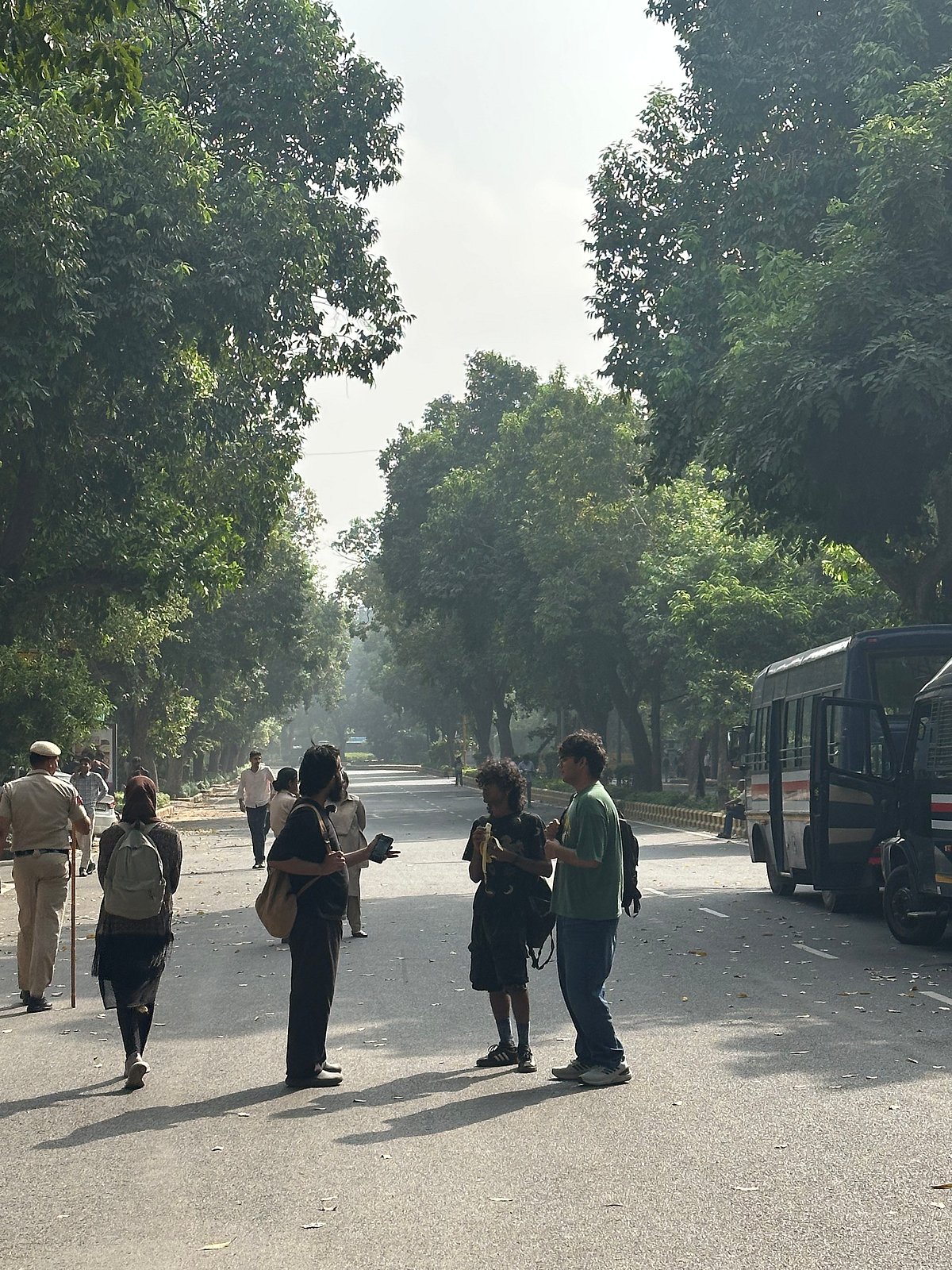
Around the protesters is a stillness and quiet, but an alertness stifles the air. In an irritating rotation, loudspeakers repetitively blare the guidelines of Section 163 of the Bharatiya Nagarik Suraksha Sanhita, a provision in the law that, among other things, empowers the state to ban public gatherings.
Abhinaw, Mohini and Faraz, with their group of friends, are some of the earliest protesters on Janpath who were not allowed to make it to Jantar Mantar. In what seems to be the anticlimactic theme of the day, talking over each other, they say, “We had to walk from this lane, we had to walk from that lane. We’ve walked so much. But they’re not letting us go ahead.”
“At least the weather is pleasant,” declares Mohini, a 20-year-old student of the University of Delhi.
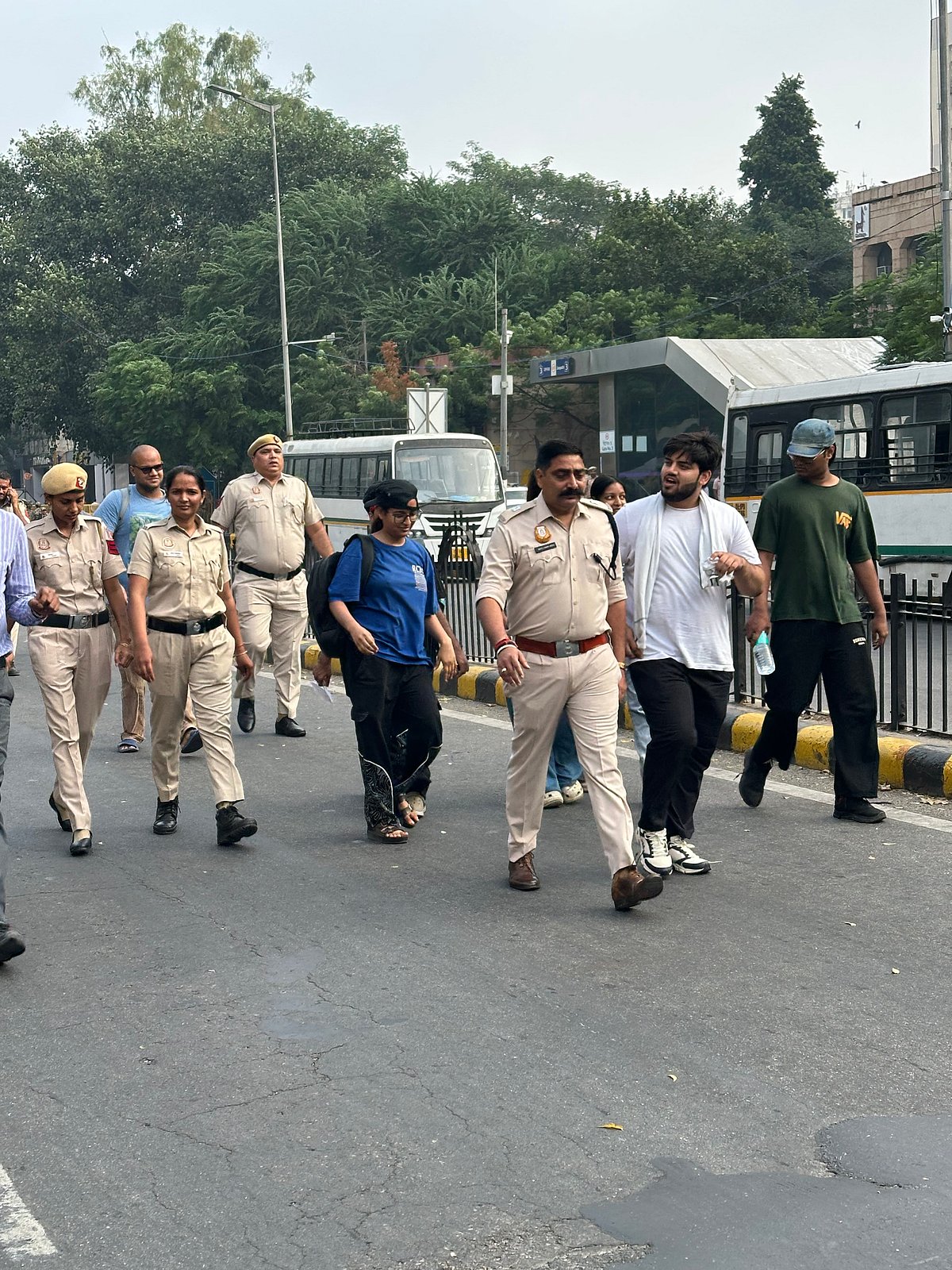
Even allowing for what the Delhi Police saw on October 2, a chase that reminded pre-Instagram Indians of the childhood game of chor-police, their preparations for October 10 are a consequence of what, in modern parlance, is called spiralling. The authorities have scenariomaxxed. With barricades chained together, a city-wide internet shutdown, preventive instructions to cab services, and 57 metro stations closed, reaching the protest site is just an exercise before it is an exercise in futility. As some carefully dispersed protesters take a walk between one barricade and another, a gentleman with a local taxi business on Janpath tells them, “Today you will lose weight.” Just a few minutes away, the Delhi Police are feasting on aloo-puri.
Abhinaw, Mohini and Faraz are in their early twenties and spend about four to eight hours of their day on Instagram. The range of time they spend there is vast because they’re self-aware enough to be embarrassed to share the specifics.
Since the Cockroach Janata Party (CJP) started its protests in Delhi, they’ve shot all kinds of reels, from trippy dance steps to fit checks. In a moment of friendly altercation between the friend group, Mohini screams at Abhinaw, “People are losing their names in SIR and you are dancing.” When I ask why that makes her upset, she just giggles. A friend of hers butts in to say, “She just didn’t like the dance step. And you know I was talking to my sister, and she said we should not trivialise the issue. But we need the humour.”
The cockroaches are the crème de la crème of internet brainrot. Their real charm is their spontaneity. And the spirit of this spontaneity has seeped into the whack variety of reels and content that has come out of the CJP protests. From a sweaty nightclub at the protest site to the emergency of a “certified pookie bhaiya”, these protests have pleasantly been an unanticipated equaliser. And while it may be true that all protest sites are a carnival, a gala where rules are overruled, what sets the CJP apart is how fun they make it to have fun. “Whenever there is dread, you should have fun. Reels are our coping mechanism,” shares Mohini.
In the next lane, on Tolstoy Marg, Mohak Gupta, a 22-year-old student from Amity University, who has recorded a man doing push-ups at the protest site, says these reels are “funny, you don’t take them seriously. It’s a way of dissent.” In a curly haired mullet, an oversized T-shirt with constellations embroidered on it (he says he thrifted it from a place called Kabootar Market), faded denim jorts, socks with Vincent van Gogh’s starry nights revolving on them, and a pair of chic Sambas he inherited from a friend, this is very much a protest trying to find its place between the trendsetter and the trend follower.
Mohak, however, identifies as a shitposter. He spends six to seven hours on Instagram over the weekend. Mohak is very insistent on clarifying that posting this content is necessary. In his words, “Memes always help, but we also need substance.” He is well informed about the issues he is here for, and asks, “We are asking for the resignation of the Election Commissioner. Why is the BJP getting involved?” His favourite piece of content to come out of these protests is a rap song by Karma called Public Notice. Mohak doesn’t shy away from sharing that he once ended up in a music video too. And as he thinks while he speaks, he says, “People really don’t like sad things. We saw the brutality last time. That left an impact. We’re not scared of being hit now. You’ve seen those Subway Surfers reels, right?” and with this, he believes he has made his point.
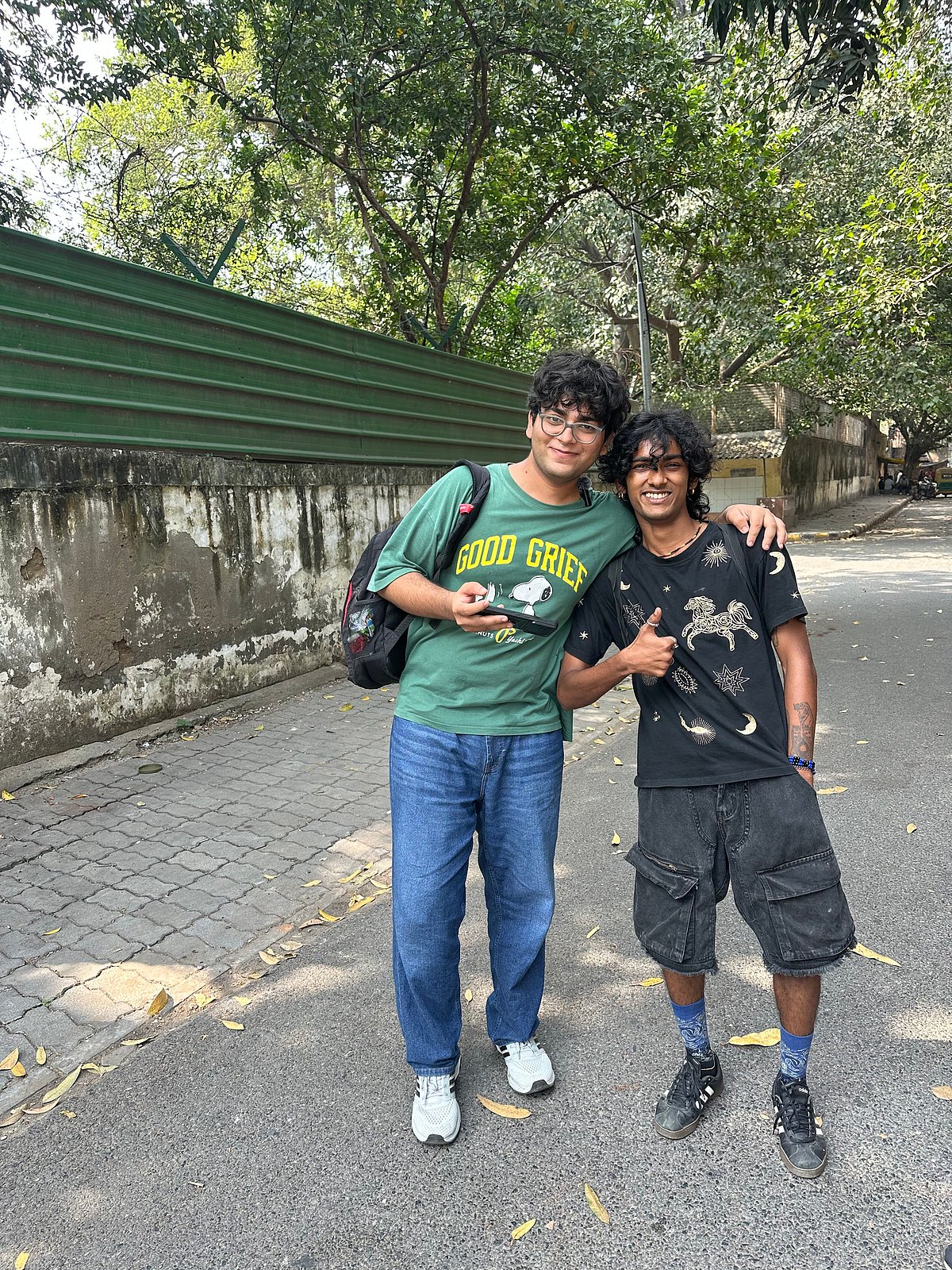
Just like Mohini, Mohak believes being on Instagram is like a defence mechanism. “It’s how we cope; it’s serious, but we’re coping in a funny way. We’re all scared about getting detained, getting into legal trouble. We’re all young. But something seriously wrong is going on in this country. Mumma Papa also hit us a lot while we were growing up, we make fun of it and cope. What else can we do?”
On a usual Saturday morning like this, Mohak would be sleeping after a night of going out. Around seven to eight people left with him to reach Jantar Mantar. He is the only one who made it, and now he has a speaker blasting music in his backpack. Being by himself is all the reason for him to meet new people at the protests. He says he has met “very cool people, people with spine” here and made a lot of friends. And in the trademark spontaneity that comes with a CJP protest, he declares, “It’s like Hinge bro.”
Just as our conversation ends, a bus full of detained protesters whooshes by. From inside it, Mohini waves with a cool smile.
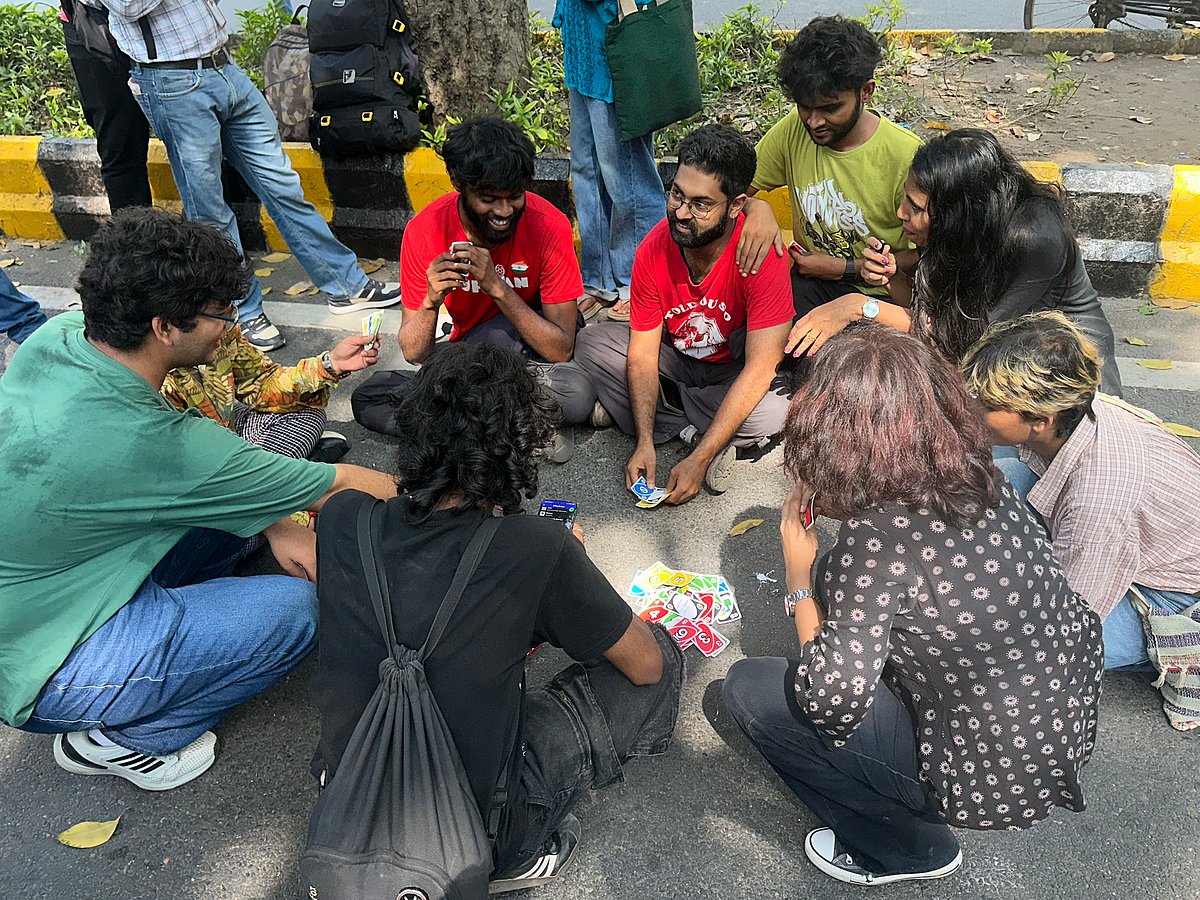
As more time passes, and we near noon, the emptiness of the streets begins to feel a little bothersome to the countable few who have managed to reach. Protesters begin to move away from the barricades in search of more like them. They don’t go too far before they find a spot in the middle of Tolstoy Marg to sit and play UNO while vibing to music playing from Mohak’s backpack. That card games are back in fashion seems to be the only benefit of suspended internet. As the game progresses, someone is given a dare: “Go touch a policeman and come back.”
It is a protest for merchants of shenanigans. In the quietness and the glowing sun, central Delhi’s bougainvillaeas and colonial architecture are prey to the reign of the monkeys. Next to the birds in the free sky is a breed new to this wildlife ecosystem. They are a species called drones. In what appears to be a game of catch and chase, the forces create a ruckus, and the protesters disappear into thin lanes like cockroaches hiding in the sink drain. Eventually, they come back, like cockroaches often do, and the cycle repeats itself. Amidst all this, reporters with Lenovo tablets and phone cameras sometimes outnumber protesters, with many from the press struggling to distinguish themselves as the police detain protesters. Some policemen are more responsive to a reporter rabidly screaming, “I am from the press!”, while others show their power by pushing them against the wall and detaining them.
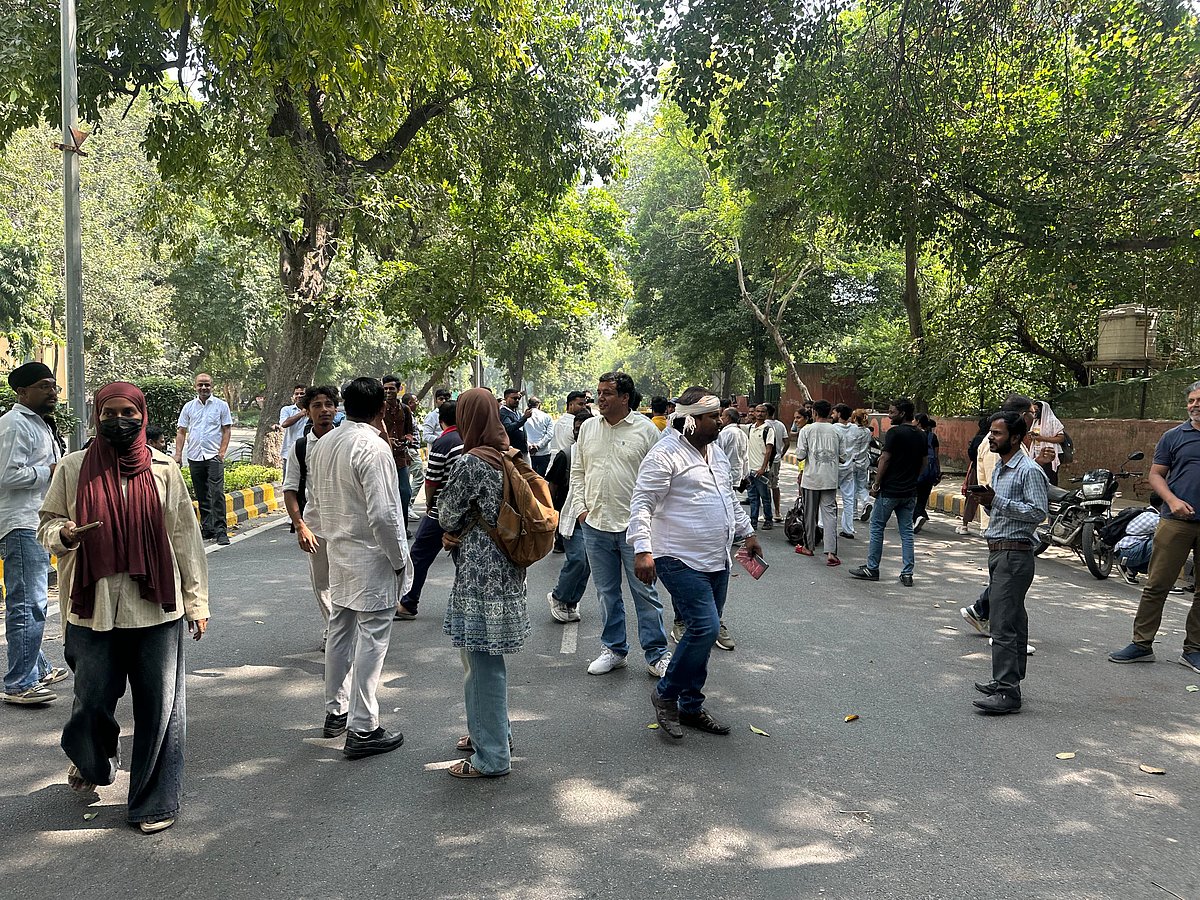
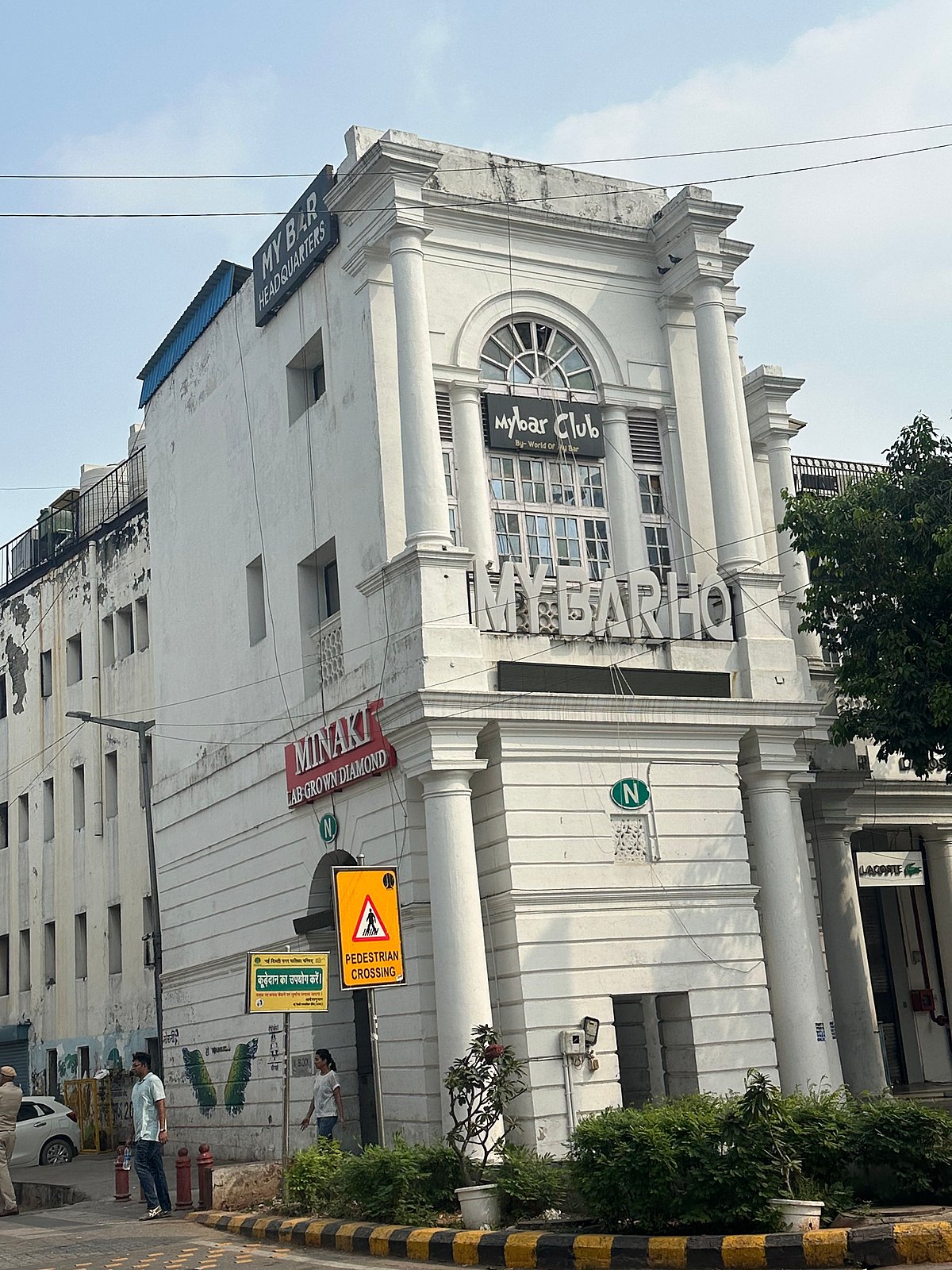
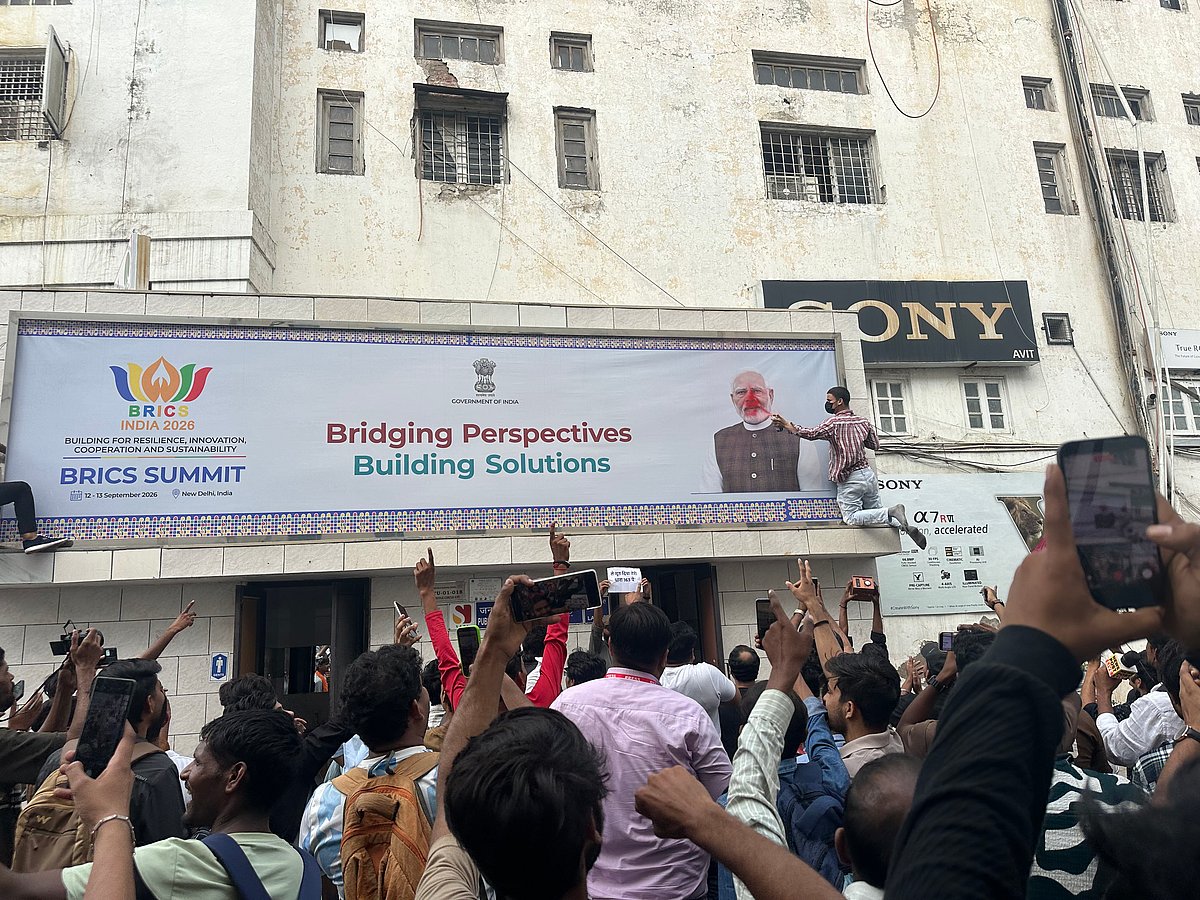
About a fifteen-minute walk from Tolstoy Marg towards Connaught Place, where the colonnades hold things in place, the force presence is daunting. But away from the eyes of the forces, on Middle Circle Road, right across My Bar Headquarters, the erstwhile it-girl of hangout spots, is a gathering of protesters sloganeering. On this road is a hoarding of the BRICS Summit featuring Prime Minister Narendra Modi. It reads, “Bridging Perspectives. Building Solutions.” Standing in front of it is 20-year-old Bhumi from Tilak Nagar. She says, “I think the public is fed up with all this behaviour.” It is her third protest, and she has already formed an age-gap friendship with a 32-year-old woman. And in this she thinks, “That’s the best part about Gen Z, that they can turn a serious situation into fun. If people thought it would be stressful, they wouldn’t turn up in such large numbers. It’s like a hangout only.” When asked why she would like to hang out at the protest of all places, she says, and you can hear her smile, “Just to be a part of history.” On Abhijeet Dipke, she says, “He is doing press conferences which our PM doesn’t. So I think there is hope in him.” Disillusioned with the current media system, Bhumi shares reels on Instagram because “there are so many news reporters and other people who are against this, who set a false narrative. I think people need to see the true side.”
The last time Bhumi came to the CJP protests, she experienced getting tear-gassed for the first time. And while the millennials would turn that into a trauma-addled personal essay, not this generation. Bhumi says, “It was a fun thing.” Instead of running away from tear gas, she and her friends ran towards it for a “one-time experience.” It burned a lot.
Within seconds of this, while Bhumi is talking about how the protests are an escape from the suffocations of Indian culture, and it is “hope” once again that brings them here, two protesters have climbed the two ends of PM Modi’s hoarding. The crowd cheers them on as one of them spray paints the Prime Minister’s face with a searing red and from the other end, the poster is ripped and its peelings fall onto the ground. A man on the road strips it from the hoarding to chants of “Inquilab Zindabad!” Bhumi is a thrilled witness to this history.
Another five-minute walk from here, near the barricades leading to Janpath, a cackle of five girls has occupied a scooty not their own. With mischief in their voices, they ask questions like, “Have you heard that slogan? Chhappan inch ka chhota bandar, bhaag Narender, bhaag Narender?”, and laugh amongst themselves. They’re in high school. Four of them are 17, and one of them is 15. It is their first protest ever, and through an odd combination of adolescent frankness and shyness, they cannot stop giggling while wearing headbands on their heads. They are Prachi, Dishu, Yashita, Siya, and Swati. They self-identify as dheet and chunt, or stubborn and clever.
On another second Saturday, they would either be watching films or reading books. (One of them has just finished reading Gunahaon ka Devta by Dharamvir Bharti.) So it was the shock of Prachi’s life today when her father woke her up in the morning, told her to get out of bed, pack garam patti and food, and then dropped her off at the protest site. She only had one reaction, “Are you kidding me?!” They came out all the way for their voting rights. “We are going to vote. Next year,” they say. And they would like to see how much this government fears the kids. In what, at first impression, is a deceptive flock of chortles, these girls have a deep-seated anger about PM Modi’s comment about “culture shock.” To them, the real culture shock was the rape of a 17-year-old girl in a park near one of Delhi’s most prestigious women’s colleges, Lady Shri Ram College for Women.
The five found out about these protests through social media, and have a chest of reels on their phones for “memories.” And wrapped up in this is the same complaint about big news channels not covering issues properly. They are corrupted. The girls have become their own documentarians, taking the tide away from TV’s attention economy and onto social media. By her own count, Prachi spends about 21 to 22 hours on Instagram, and knows it is independent media that posts on Instagram and YouTube.
Even as the roads around Jantar Mantar remain vacant for vast stretches, the CJP is aware of the engagement metrics of reach and messaging that lead to potent virality. It is a movement born from a feral beast – the roach and rodent-infested corners of the internet. In a post made from the official CJP handle, they urged protesters to “Create content, bring your tripods and mics along. Like, who doesn’t want to go viral?” Even as Abhijeet Dipke, Ashutosh Ranka and Saurav Das were detained as soon as their flight landed in Delhi, Dipke was seen urging people to record. The police got their aloo-puri; the protesters got their reels. The state can shut the metro, the internet and the roads, but it hasn’t yet figured out how to starve a feed. It takes 15,967 steps to not reach Jantar Mantar. It takes one reel to reach everyone else.
All photos courtesy Muskan Nagpal.
Complaining about the media is easy. Why not do something to make it better? Support independent media and subscribe to Newslaundry today.