Neha Bora, the angriest person in town: A profile of rage
Angry, detained, back on the street. Neha Bora tells Nidhi Suresh what it takes to rage in public.

There is a moment: Neha Bora is being detained in a police bus that protesters have managed to stop. Neha and the other activists leap out. Footage of that escape spreads online within minutes.
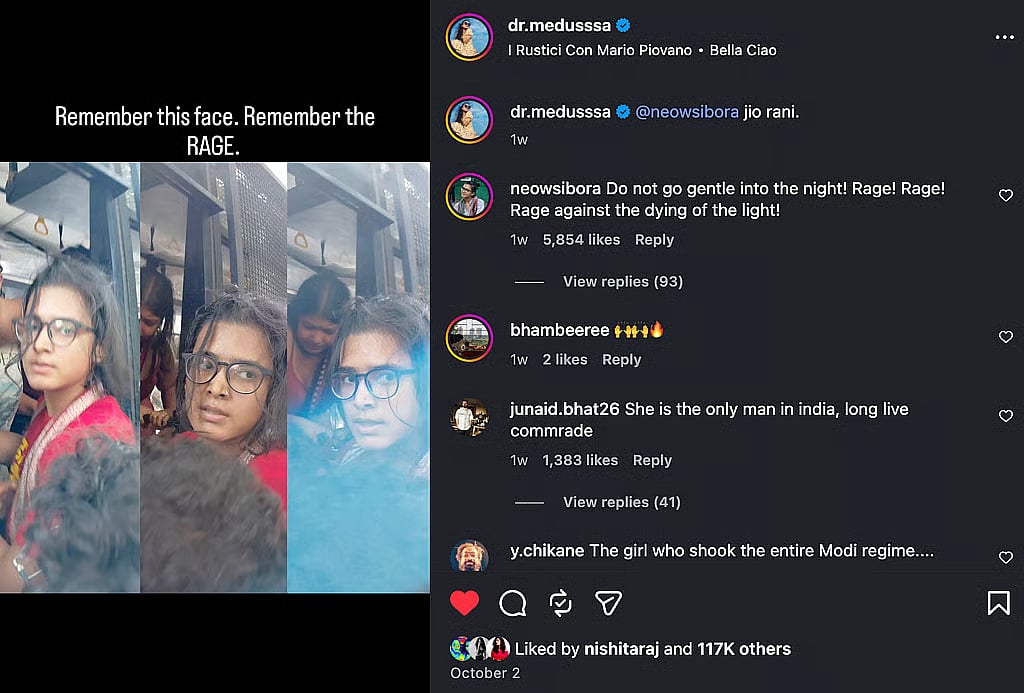
Madri Kakoti, an assistant professor at Lucknow University, sees it, takes a screenshot, and posts it on her popular Instagram channel, Dr Medusssa. In the frame, the activists are about to jump from the bus. Neha turns back and looks straight into the crowd, which today also means looking into the camera.
“Remember this face. Remember the RAGE,” Madri wrote. Beneath it, Neha replied with lines from Dylan Thomas’s famous poem: “Do not go gentle into the night! Rage! Rage! Rage against the dying of the light!”
Anger is having a moment.
Not the anger kept behind closed doors. Not the anger dissected by friends. Not the anger swallowed into the body only to return in a dream at night.
This anger has moved from memory to muscle. It is out on the street. It is loud and embodied. It is in your face, on your screen, and in your living room. It is standing up and lashing out.
It is not male.
This anger is Neha Bora.
I met Neha Bora, president of the All India Students’ Association (AISA), on October 11, in a detention centre on the outskirts of Delhi. Neha uses the pronouns they/them.
Since October 2, AISA has put out several calls for citizen protests against the Special Intensive Revision of voter rolls, demanding the resignation of Gyanesh Kumar, India’s Chief Election Commissioner.
Neha has been at each of these protests, making fiery speeches, running, scaling barricades, being dragged away by security officials, bruised, and detained. In the last two weeks, Neha has been detained more than 10 times, sometimes more than once in a single day.
That day, as soon as we entered the detention centre, Neha dropped a bag on the floor and lay down. “Detentions have become my rest hours these days,” they said. “Let’s do the interview now. What else is there to do here?”
During the July 2026 NEET paper leak protests, Neha sat on a hunger strike for 23 days. The country watched as Neha occupied a corner under a shade in Jantar Mantar, their body growing weaker and weaker by the day. Other activists fanned them, pressed their legs, and carried them to the washroom.
This time, Neha is not in one corner. They are whizzing through the city, yelling into the camera, detained again and again by an aggressive State that is manically trying, but failing, to keep them off the streets.
“Anger is perhaps what defines this country right now,” Neha said. “If dominance or suppression was the language of the State, helplessness and fear were supposed to be how common people felt. But that feeling has broken free now.”
Personally, too, Neha feels the rage. “If the police are pulling you by the neck, digging their nails into your body, what else is one supposed to feel but utter outrage?”
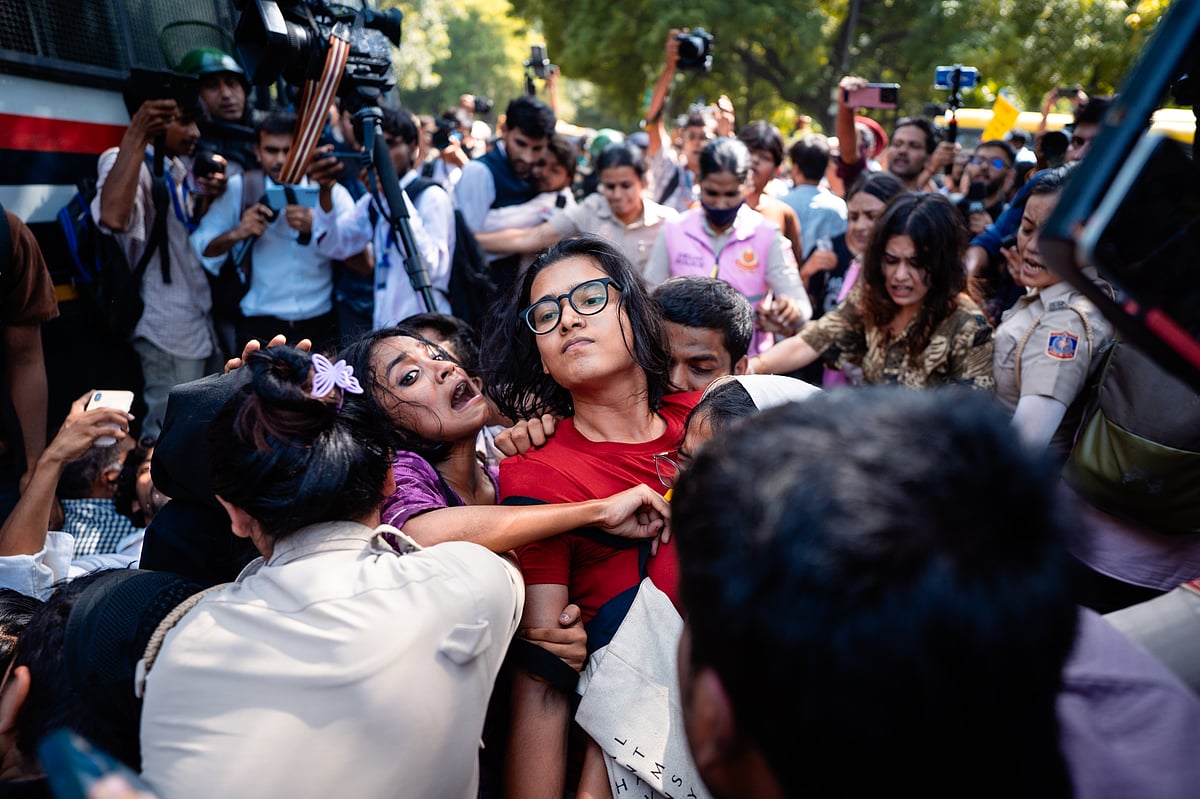
A video of Neha, showing bruised biceps and triceps, also went viral. Such images travel, Neha explained, because they are making people feel the anger they have been feeling for a while.
It was this very impulse that guided Madri Kakoti to post that image.
“The look Neha gives in that split second is not new. That is exactly the look women have given men on the streets a thousand times. It is exactly the look I want to give people who are abusing and trolling me,” she said. “Even though Neha doesn’t say one word in that image, that one look of fury said so much.”
Anger has been the driving force for most political movements. Yet the anger that is taken seriously and considered politically valid is most often male.
Everyone else’s fury is dismissed as “hysterical,” “emotional,” “inconvenient.” Everyone else is expected to master the art of being palatable, while male rage breaks chairs, burns buses, and demands change.
At this moment, though, a slow shift in the ownership and performance of rage is becoming visible on the streets.
Women and queer people have occupied the front lines of this protest. They are the ones throwing themselves in front of lathis and detention buses, standing as human shields in front of male protesters.
The masculine State sees this.
On October 2, I watched a police official brief his male colleagues on how to handle protesters. “Whether it is a male or female protester, push the women constables in front. Let them handle it first,” he said.
The cost of taking to the streets day after day, is written on the bodies of the protesters.
At the detention centre we were in, a young girl was limping, another had a concussion from the day before, and a man had bruises on his neck.
Beyond the physical injuries, over the past week, I’ve witnessed protesters being subjected to communal and casteist slurs, and women and queer people being assaulted. Still, they had chosen to step out on the streets, to rage, and to be detained again.
Neha and the other activists are well aware of what they are up against.
“We’ve taken to the streets knowing that we can be detained, roughed up, bruised,” Neha said. “But what about the people who are being bruised, broken, raped, and killed for no fault of theirs?”
Neha pointed to the rape cases in Hathras, Unnao, and Delhi, and to instances of Muslim men being lynched by Hindutva mobs.
“We live in a society where people are being killed for merely existing,” Neha said. “That’s why it’s important for people to come out onto the streets and make the choice that crores of Indians cannot make. The bruises will heal, the swelling will go down, and the bones will be set. But this country cannot continue like this.”
These days, detaining Neha takes not one, but at least six to 10 security personnel, grabbing from every direction.
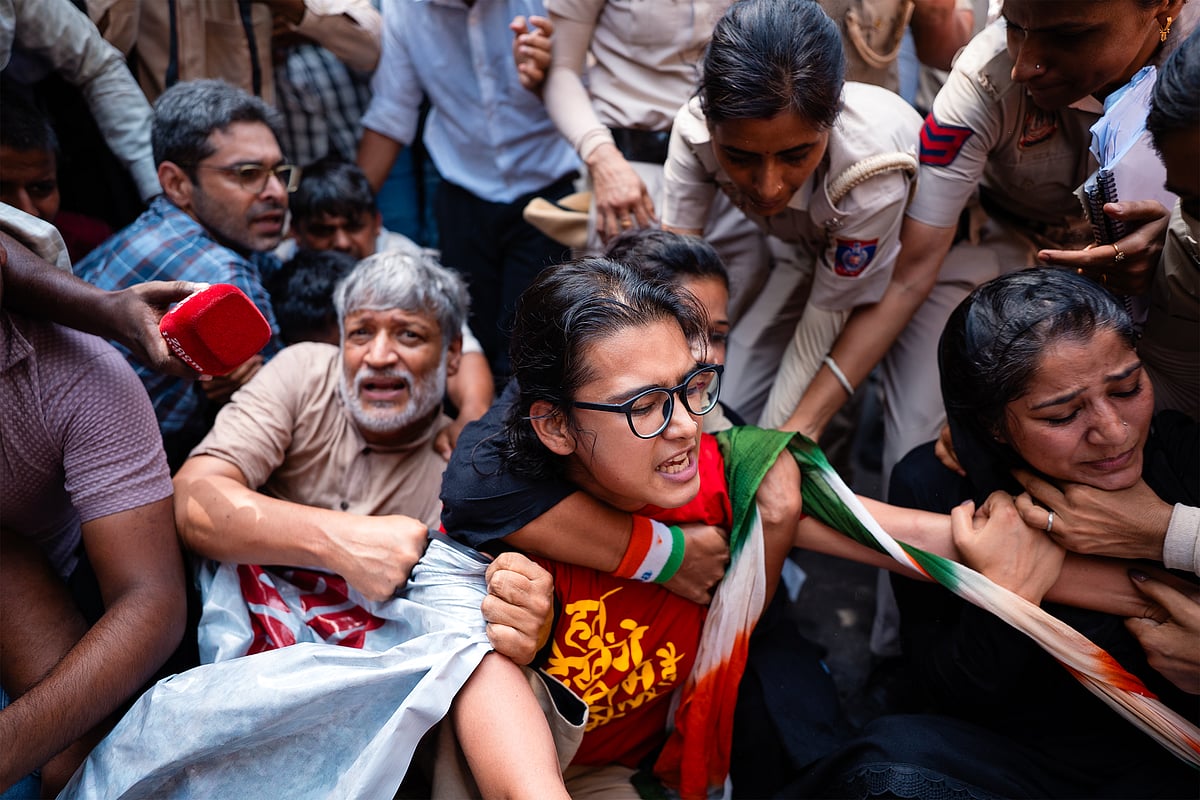
“When you’re out on the streets with thousands of people, you feel like you’re not so small,” Neha said. “But the moment I’m detained, I realise that this is, after all, a human body, and if there are five or six people, they do have absolute control over me.”
Dark and angry moments in history also render themselves to absurd humour.
For the last two weeks, almost every day, the State machinery has played a game of cat-and-mouse with Neha, the ninja. Very often it is the same police officials doing the chasing and the catching. “Now they smile at me after catching me,” Neha said.
There is one image of Neha lying on a pavement, a fist propping up their head. Unlike most visuals of Neha’s anger, this one shows a smile, as if resting. But Neha is not resting. Around them is a blur of khaki: six aggressive hands gripping their arms and legs, seven people bending over their body.
The police were trying to detain Neha, and they were very frustrated.
Despite multiple detentions and constant surveillance, Neha kept slipping away and coming back out to protest. “The seniors started shouting at the junior officials, and then they began fighting among themselves. So I just put my hand under my head, and a journalist caught the moment. It was really funny,” Neha said.
The anger Neha produces every day is too much for one person to sustain. Neha knows it. It demands energy, attention, and health.
Stamina for such sustained rage is only possible when an organisation, well-oiled in taking on the State, stands behind it. For Neha, that organisation is AISA.
“Social media might want you to believe this is about one person. It’s not. What people have done with my image online is entirely on them,” said Neha, who has warned against the fetishisation of the individual in politics.
Every morning, three or four activists from AISA take their bikes out to scout for places where barricades have been put up. They are in touch with journalists, who tell them about security arrangements.
“We have non-AISA members who let us use their devices when we switch off ours. We have a big social media team. There is a system in place to make this work,” said Neha.
Once, when Neha was detained, the police took their phone away for a few hours. “They came back to me very frustrated and asked how I had managed to tweet during detention,” Neha said. “I laughed and asked the officer, ‘You think only I have access to my social media?’”
For all the fury Neha holds, none of it is destructive. If anything, it comes through as creative, constructive, and even refreshing.
“Men usually break things when they’re angry. They make it about themselves. But Neha and their comrades are simply evading the police and seeking change,” said Madri Kakoti. “Neha is focused, cool-headed, and does not react impulsively. That is exactly what makes them scary to the regime.”
Neha's is a particular brand of anger: a feminist rage rooted in the workers’ movement and the labour struggle, the causes closest to AISA’s left politics.
There is no doubt that it is tiring, Neha said, and that they all pay a price for throwing themselves, body and spirit, onto the streets.
“My comrades and I would love to sleep for weeks. We would love for our clothes not to be torn, our bodies not to be brutalised. But we cannot rest as long as we are ruled by this regime’s iron fist.”
If anger brings exhaustion, it also brings release.
Unlike sadness, cynicism, or fear, anger is cathartic. It has movement. It has courage. And for today’s youth, it has finally arrived.
“It’s just so beautiful. It feels like all the anger we bundled up in our hearts finally has an outlet. It feels a little like justice,” said Neha.
This piece was first published by The News Minute. Become a joint subscriber here.