CPCB has an explanation for missing Diwali data. It doesn’t have a solution
As many as 45 of Delhi’s 59 CPCB monitoring stations lacked hourly data for at least one pollutant at some point of time during Diwali night.

Delhi-NCR’s Diwali was its most polluted in five years and, by official data, the fourth most polluted day of the year. But once again, it exposed gaps in pollution data and the government’s system to measure and publicise air toxicity.
What created concern among researchers, journalists and environment and public health activists was the missing AQI data, particularly levels of the most polluting PM2.5 and PM10 particles. Many Central Pollution Control Board monitoring stations did not even show these numbers for several hours while other platforms and Delhi Pollution Control Committee’s monitors recorded severe toxicity.
In fact, as many as 45 of Delhi’s 59 CPCB monitoring stations lacked hourly data for at least one pollutant at some point of time during Diwali night. For the same period, DPCC stations showed pollution levels as high as 60 times the normal limit.
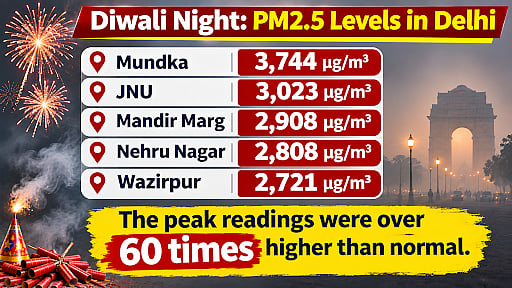
This impacted the credibility of the air pollution data released by the government the following day, as the average AQI was recorded lower than its actual value.
Manoj Kumar, an analyst at the Centre for Research on Energy and Clean Air (CREA), wrote on X : “From midnight on 8 November until 5 am on 9 November, 227 hourly PM 2.5 observations were missing across 59 CPCB monitoring stations in Delhi. Only 14 stations reported complete data, while the remaining 45 had at least one missing hourly observation.”
He said, “A key concern is that many missing readings occurred when concentrations approached the monitoring instruments’ upper measurement limit of 1,000 µg/m³ (micrograms per cubic meter). These observations should not simply be treated as missing when calculating hourly or daily averages or deriving AQI. Doing so could underestimate pollution levels.”
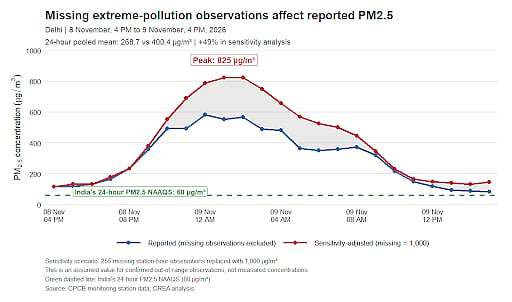
According to Chandra Bhushan, an environmental expert and CEO of non profit organisation iForest, the CPCB should have explicitly disclosed, the day after Diwali, that data from several monitoring stations had not been included in the 24-hour average.
Sunil Dahiya, founder of Envirocatalysts, said, “We have seen in the past too whenever the pollution levels approach 1000 microgram per cubic metre, the data from some CPCB monitoring stations go missing.”
The CPCB however, issued a two-page official clarification on this matter, making several points.
CPCB’s response
According to the CPCB, its air quality monitoring stations have a measuring range of 0 to 1,000 µg/m³. This means that when pollution levels exceed this limit, the equipment considers the reading to be outside its prescribed limits. Such readings are not accepted as data, and the hourly data is not included in the 24-hour average for the respective station.
The CPCB has also acknowledged that this may cause gaps in the data during highly polluted occasions like Diwali. However, the board says that internal discussions and consultations with experts are ongoing on how to process data in such situations.
Another major question concerns the maximum limit of the AQI. The CPCB's National Air Quality Index stops at 500. The board has clarified that “the capping at 500 is a designed feature of the index”.
According to the central pollution watchdog, even if the number exceeds 500, it does not change the ‘severe’ health warning category. The CPCB cited the AQI systems of the US and China to support this.
The AQI is based on eight pollutants: PM2.5, PM10, carbon monoxide, nitrogen dioxide, sulfur dioxide, ozone, ammonia, and lead. The highest sub-index among these pollutants determines the final AQI. It is generally calculated based on a 24-hour average, while an eight-hour average is used for ozone and carbon monoxide.
Regarding the issue of higher pollution levels being displayed on private apps and other platforms than the official AQI, the CPCB states that different platforms use different sensors, data sources, and calculation methods. Some use low-cost sensors and instant readings to provide AQI, while the CPCB’s AQI is based on instruments calibrated to prescribed standards and averaged data. Therefore, the two cannot be directly compared.
The board has also stated that the AQI is intended to understand the health effects of long-term exposure to pollution, rather than minute fluctuations.
But even with this clarification, some crucial questions remain.
If pollution levels exceeded the instruments’ measurement limits on Diwali night, where is the actual record of the toxic air people breathed at that time? Is the current monitoring system capable of accurately recording extreme pollution events? Doesn’t limiting the AQI to 500 make it difficult to assess the true intensity of severe pollution? And when will the changes be made to the monitoring system to prevent such data gaps?
‘CPCB should have published the data with a caveat’
Since CPCB data is widely used by researchers, academics, journalists and even the judiciary, the absence of readings during periods of extremely high pollution could distort the understanding of the actual situation and have serious implications for policymaking.
Dahiya argues that CPCB should have made the data public with an appropriate disclaimer rather than leaving these gaps unexplained.
“Most people who analyse air quality data rely primarily on CPCB data rather than other sources such as DPCC. When an agency whose data is widely used by researchers, academics, journalists and even the judiciary fails to report readings exceeding 1,000 micrograms per cubic metre, it understates pollution levels for those particular hours as well as the 24-hour average. This creates a false sense of improvement.
“I would therefore argue that any policy analysis based on such incomplete data would be inaccurate and fail to present a comprehensive picture of the situation. CPCB should have published the data with a caveat stating that readings from these monitoring stations carry a high degree of uncertainty when pollution levels exceed a certain threshold. This would allow end users to make better-informed decisions. Otherwise, it risks paralysing the entire policymaking process."
Echoing Dahiya’s concerns about the reliability of air quality data, Kumar suggests three measures that CPCB could adopt to improve transparency and ensure that extreme pollution episodes are more accurately reflected in official records.
First, observations exceeding the instruments’ measurement limits should be flagged as ≥1,000 µg/m³ rather than simply treated as missing data. Second, CPCB should clearly disclose how such observations are handled when calculating 24-hour PM2.5 averages and AQI. Finally, the measurement range of monitoring instruments should be expanded to better capture episodes of extreme pollution.
“Accurate air quality reporting is essential, particularly during extreme pollution episodes,” Kumar said.
This report is part of a collaborative campaign to tackle air pollution. Here’s how you can join the Fight To Breathe. Click here to power this campaign.
 No work, little compensation: Delhi’s construction workers pay the price for its toxic air
 On paper, Delhi is controlling its dust. On the ground, it isn’t