From banned to behemoth: Unpacking the 100-year legacy of the RSS
You’ve heard the praise. You heard the propaganda. Now hear the facts.

In an era of high-octane Bollywood hagiographies – the latest example being Shatak featuring Ajay Devgn – and endorsements from film celebrities, the RSS is often presented through the lens of “selfless service”. But behind the nostalgia of khaki knickers and nationalist fervour lies a complex, century-old evolution.
Let’s Talk About: RSS is a three-part series that cuts through the propaganda to offer a factual, nuanced exploration of this cultural behemoth. We explore the roots, structure, ideology, journey, misconceptions, and various conflicting opinions from people inside and outside the Sangh ecosystem.
The series begins with former members like Shardool, Rajsekhar, and Indreneel on their journey from childhood indoctrination to disillusionment. Parallely, this episode explores the birth of the RSS under Keshav Hedgewar in British India, its early challenges and the formative years that set the stage for its future growth.
In Part 2, we delve into the chaos following Independence. Just as MS Golwalkar sought to scale the RSS amid the chaos of Partition, the assassination of Mahatma Gandhi threw the organisation into an existential crisis. We tackle the contentious truth behind Nathuram Godse’s ties to the Sangh and the transition to the Golwalkar era, featuring panellists like renowned academic Walter K. Andersen, journalist Arun Anand, and The Caravan’s executive editor, Hartosh Singh Bal.
In Part 3, we follow the Sangh’s shift under the leadership of Balasaheb Deoras, who embraced politics as a tool for expansion. From the Emergency to the Babri Masjid demolition and the rise of Narendra Modi, the episode tracks how the RSS consolidated the Hindutva establishment.
Besides, we also hear stories of internal friction. We speak to Bhanwar Meghwanshi, a Dalit activist and former RSS member, who left the organisation after members of the Sangh refused to eat food prepared in his home.
Are they nationalists tirelessly working for the glory of the country? Or are they an organisation lighting the fires of communal discord in khaki knickers? This series invites you to move beyond the noise and decide for yourself.
From Manikarnika Ghat to the Kashi Vishwanath Corridor, Banaras is being reshaped in the name of development. Our new NL Sena asks who pays the price. Power it here.
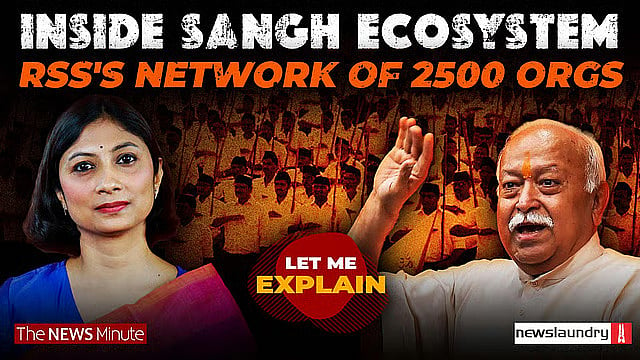 The RSS: 100 years, 2,500 organisations