Concrete over commons: How Delhi’s vanishing wetlands are choking on bureaucracy
From schools built on ponds to untreated sewage flow, a trail of missed deadlines and failed demarcations is leaving the city's 1,045 water bodies in peril.

Chote Lal, a longtime resident of Khichripur in East Delhi, recalls, “Around 15 years ago, a talab (pond) existed here.” Once a vital lifeline for the village, this talab was where residents gathered to bathe and collect rainfall to sustain the community, while children played across a landscape free of concrete.
Today, that landscape has vanished, replaced by a Kendriya Vidyalaya and a School of Excellence, both government schools. Only a small portion of the original water body remains, now choked with water hyacinth and reduced to a garbage dump.
Chote Lal and fellow resident Ram Chand, who moved to the area in 1976, further recall how the landscape has changed over the decades.
“Cattle used to drink from this talab,” they explained, speaking to Newslaundry. “While this wetland wasn’t vital for us, it was for the villagers who lived here before our arrival. There was always water here, but the government eventually filled it in with soil to create land for the two schools and the road to a nearby residential colony.”
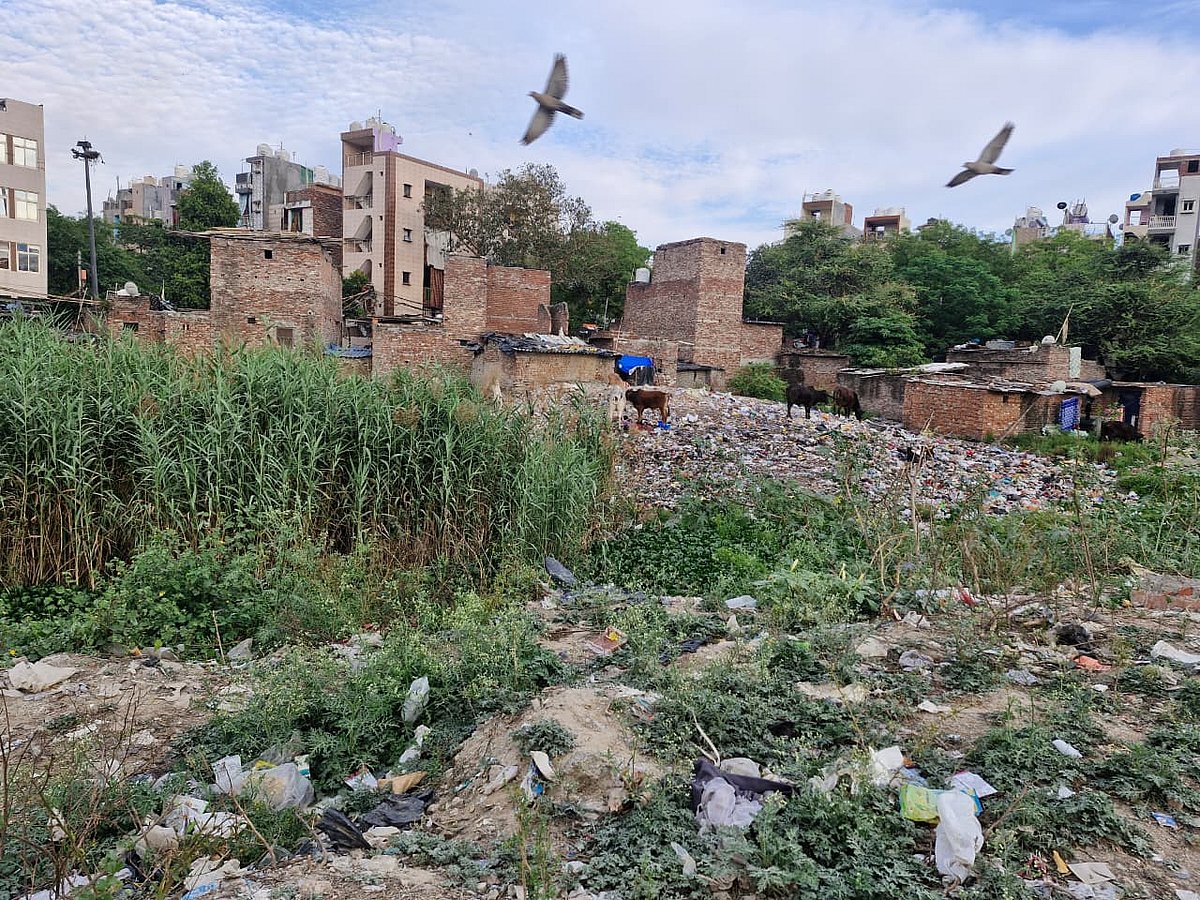
Environmental activist Anand Arya remarked, “These 2.25 hectares (covering the erstwhile talab) were granted protection by the Supreme Court in 2017, in a case where I intervened. The court ordered that such wetlands must be protected. On December 11, 2024, it gave directions to state authorities like the State Wetland Authority – the nodal agency under the Delhi government responsible for the city's wetlands – to demarcate all wetlands and conduct ground-truthing (site visits to verify their existence). To identify wetlands, some surrounding areas were also marked as ‘zones of influence’ from where water flows into the wetlands. But I am not sure if digital demarcation has been done correctly.”
In the Supreme Court case, Anand Arya vs Union of India, advocate Jayant Bhushan, appearing on behalf of the petitioner, stated in December 2024 that Delhi has achieved only 20 percent wetland boundary demarcation and 46 percent ground-truthing, based on data from the Union environment ministry.
And therein lies the problem. While the State Wetland Authority (SWA) — which was constituted in 2019 and functions under the Delhi Parks and Gardens Society (Department of Environment) — has identified 1,045 water bodies, actual on-the-ground work appears stagnant. According to information on its website, the SWA last met in 2022. Furthermore, while a budget of Rs 35 lakh each was allocated for 2023-24 and 2024-25, there is no clarity on actual expenditure. Newslaundry has reached out to the SWA for clarification, and will update the copy when we receive a response.
The Supreme Court also directed state authorities to create a website to compile all details of demarcated wetlands. Unfortunately, in Delhi, no such dedicated portal exists. What’s more, the Delhi government has not submitted sufficient details regarding the boundary demarcation process even after the court’s order, according to Arya.
The authority is responsible for directing various departments within their jurisdictions to restore and manage wetlands, including the MCD, DDA, DJB, and the Forest Department. However, with 631 water bodies prioritised for rejuvenation in the first phase back in 2023, coordination remains fractured and progress remains largely on paper.
Encroachment
This bureaucratic vacuum has left the door open for permanent encroachment, according to details of a status report submitted by the SWA to the National Green Tribunal on March 9, 2026.
In Shakarpur Khas (East Delhi), the water body no longer exists because the area is now heavily built up. In Gharoda Neemka Bhangar (East Delhi), the land is currently occupied by an ayurvedic hospital under DDA jurisdiction, rendering revival impossible.
Even where land remains free of concrete, legal and jurisdictional limbo persists. In Lampur and Asola, the DDA has yet to assess the encroachment status because the authorities haven’t completed the ground demarcation. In Dabri, investigators have already identified encroachments, including residential buildings and temples.
Paras Tyagi, founder of Centre for Youth, Culture, Law and Environment (CYCLE), a non-profit that works with rural and urban villages of Delhi, told Newslaundry, “The government is not willing to remove encroachments or properly demarcate water bodies. They have failed to create awareness among people about wetlands and their protection.”
Problems remain unaddressed
Conditions are similarly grim at South Delhi’s Maidan Garhi pond, where sewage now flows openly into the water from two separate points, leaving behind a foul smell. Locals once relied on this pond for drinking and bathing. Those days are long gone.
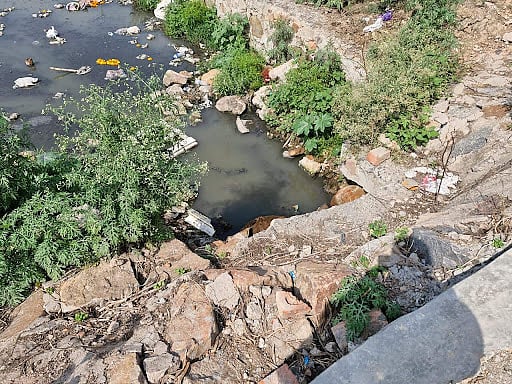
Shreeram Bhagbat, a resident since 1991, noted that while workers once cleaned the pond annually for Chhath Puja, recent ‘beautification efforts’ have achieved only superficial results. “They’ve added staircases, but the water quality has only deteriorated,” he told Newslaundry. Another resident, Yogesh, pointed out the specific sewage inlets, noting that despite new construction, the water remains untreated and entirely unusable.
The stories of Khichripur and Maidan Garhi are not isolated incidents, but rather symptoms of a city-wide struggle. The National Green Tribunal (NGT) has noted that encroachment is widespread, and many wetlands have completely vanished. In Babarpur, for instance, wetlands now lie under a graveyard. In Northwest Delhi areas like Bankner and Bajitpur Thakran, the true scale of encroachment remains unknown as demarcation is still pending.
Wetlands are essential to any urban ecosystem. Beyond maintaining ecological balance and flood control, they function as vital storage systems that recharge depleting groundwater. The Wetland Rules, 2017, mandate the protection and restoration of all such bodies.
‘Concretisation creates barriers’
Manu Bhatnagar, Principal Director of INTACH, emphasises that restoration must prioritise ecology over aesthetics. “Natural flora and fauna must be maintained,” Bhatnagar explains. “Concretisation creates barriers that prevent water from entering wetlands, and boundary walls restrict surface water flow.” He suggests that instead of superficial beautification, authorities should focus on allowing treated water to flow into these bodies to recharge aquifers. “Rather than focusing on all 1,045 water bodies, the focus should be on protecting already demarcated wetlands, with less emphasis on landscaping,” he adds.
Yet, some sites offer a glimpse of what maintenance could look like. At Ghitorni pond, the transformation into a park-like space is evident. High walls and fencing now enclose a manicured seating area where residents gather, and children play.
Having said that, the ‘beautification’ appears largely skin-deep. Upon Newslaundry’s arrival, two workers were busy draining the pond to clear away a thick layer of algae. While the government developed the site nearly three years ago, residents observed that authorities had not actively cleaned the area until now.
Local business owner Shiv Bhardwaj, whose shop faces the pond, noted that conditions have improved significantly since the site was fenced off two years ago. “Earlier, it was much worse,” he said. “After the fencing and wall construction, the area became more manageable, and now they are finally cleaning it.”
Subhash, another resident, agreed that the fencing has deterred garbage dumping, allowing rainwater to collect properly. “It has become much cleaner,” he added. “But this is the first time in two years that active cleaning is taking place.”
We have emailed a series of questions to the State Wetland Authority and will update the copy once we receive a response.
Elections are not just about who wins, but about the questions that often go unasked – and this time, they matter more than ever. Support our new NL Sena on the five upcoming assembly polls to help us follow the missing voters, the shifting politics, and the stories that could shape India’s future.
 If you’re living in Delhi, you’re drinking uranium – and the government knows it