‘Someone who is TMC in the morning can become BJP by night’: Bengal’s week of violence
Six TMC workers, an aide to the CM, and at least two BJP supporters are among those reported killed so far. Police earlier registered 200 FIRs, arrested 433 people, and detained 1,100 more.

On Monday morning, fresh reports of arson emerged from Khejuri, the second such incident in as many nights. The BJP called it an electrical fault. The TMC called it arson. The competing versions have continued to sound the same – in the days after Suvendu Adhikari was sworn in as the state’s new chief minister – as before.
West Bengal has been burning since the BJP swept to power on May 4. The violence has taken many forms: shops gutted, political workers killed, clubs ransacked, statues smashed, and a bulldozer brought in to flatten a party office in central Kolkata. The Trinamool Congress claims six of its workers have been killed. Adhikari’s personal assistant was shot dead last week. The BJP also says its two supporters were targeted in Howrah and New Town.
There is no official number yet for the casualties after May 6; the police had last pegged the number at two. Police have registered 200 FIRs, arrested 433 people, and detained 1,100 more under preventive measures. Five hundred companies of Central Armed Police Forces remain deployed across the state.
The fires near Khejuri
Late on May 9, roughly 125 kilometres from Kolkata, violence broke out within 12 hours of Adhikari being sworn in at Kolkata’s Brigade Parade Ground.
In a village panchayat near Khejuri, around 60 shops were set on fire. Locals and opposition TMC leaders alleged that the attackers were BJP-backed goons. By Sunday afternoon, videos showing rows of scorched shops near the Hijli Mazar Sea Bridge, a popular tourist stretch, were circulating on social media. The TMC leadership accused the BJP of orchestrating the arson, saying that it had wiped out the livelihoods of shop owners across religious divides.
“The districts of Bengal continue to burn in the fire of post-poll violence,” Saayoni Ghosh, a TMC member of parliament, wrote on social media.
Didar Ali, a TMC member of the Nich Kasba panchayat in Khejuri, claimed the attack was preceded by open intimidation. “We don’t know how exactly this happened or who did it,” he told Newslaundry. “But BJP workers had gone around telling people to keep their shops closed. They said they would do whatever they pleased,” he claimed.
The fires broke out at around 11 pm. Some shop owners who sleep near their establishments woke up to the glow of flames and raised the alarm. The shops burned through the night.
Fear, Ali said, now hangs heavy over the area. He claimed BJP workers are threatening TMC workers to withdraw cases against them.
A TMC worker claimed he was assaulted by a BJP panchayat leader and told to withdraw one case he had filed against him, refusing to elaborate further.
Subrata Paik, the local BJP legislator, said the law would take its course, regardless of political affiliations of the people involved. He also rejected allegations of party involvement in the fires, suggesting instead that an electrical short circuit may have caused the blaze. The arson claims, he said, were an attempt to malign the BJP in the aftermath of its victory in the state. The West Bengal Police have similarly dismissed claims of political violence, calling the electrical short circuit explanation the most likely cause.
In a press conference on post-poll violence on May 6, the Acting Director General of Police, Siddh Nath Gupta, admitted that incidents of violence had occurred, including threats, assaults and intimidation. The police have registered 200 FIRs, arrested 433 and detained 1,100 people under preventive measures.
Subrata Paik, the local BJP legislator, said the law would take its course, regardless of political affiliations of the people involved. He also rejected allegations of party involvement in the fires, suggesting instead that an electrical short circuit may have caused the blaze. The arson claims, he said, were an attempt to malign the BJP in the aftermath of its victory in the state. The West Bengal Police have similarly dismissed claims of political violence, calling the electrical short circuit explanation the most likely cause.
The CRPF’s national chief instructed election and police observers last Tuesday night to ensure there is no post-poll violence in Bengal. Directives were issued, including a ban on the use of bulldozers in BJP victory rallies and an immediate halt to vandalism of party offices. CRPF director-general Gyanendra Pratap Singh joined a video conference conducted by the Bengal director general of police. A joint control room with state and central forces coordinates quick response teams to curb further unrest.
State BJP president Samik Bhattacharya has declared a zero-tolerance policy towards such violence. The BJP has also accused TMC cadres of misleading people and carrying out violence in the BJP’s name.
A familiar story in West Bengal
Electoral outcomes followed by retributive violence has been a pattern in West Bengal. But familiarity has not softened its impact.
Late on the night of May 6, an aide to Adhikari was shot dead on the outskirts of Kolkata. The victim, Chandranath Rath, was travelling through the Doharia area of Madhyamgram when his car was intercepted by men on a motorcycle. He was shot at close range and died at the scene. On May 11, three arrests were made by the state police, from Uttar Pradesh and Bihar.
Yet, speaking with Newslaundry, political analyst Bishwanath Chakraborty suggested that there had been a drastic reduction in post-electoral violence in 2026. “This is not even a patch on the violence that took place in 2011 or even in 2021. When the CPI(M) lost to TMC [in 2011] and was voted out after 34 years, a death due to political vendetta was not even considered a death.”
In 2011, at least 90 CPI(M) workers were killed in the first nine months after the results.
“The TMC came to power with the slogan bodla noy, bodol chai (we don’t want revenge, we want change). In 2011, thousands of people were made homeless; people were asked to pay up in return for security. But the 2011 violence fades in comparison to 2021 when the incumbent TMC won the election,” Chakraborty said.
The National Human Rights Commission report on the 2021 violence underscored the “appalling apathy of the state government towards plight of victims”. There are claims and counterclaims on the deaths owing to violence. Some claim that there were at least 50 deaths within a week. There were also several allegations of rape.
In 2026, the response to BJP’s call of no retaliatory violence has been mixed, sometimes mirroring the exact violence Bengal has witnessed previously.
According to Maidul Islam, professor of political science at the Centre for Studies in Social Sciences, “It is difficult to carry out sustained post-poll violence without strong booth-level organisation. The BJP does not yet possess this kind of organisational depth in Bengal. The actual pattern of violence is likely to unfold later rather than immediately.”
“A key factor is that the lumpen proletariat, a social group historically central to organised political violence in Bengal, has not been fully absorbed into the BJP”.
This class is constitutive of Bengal’s long history of both development and underdevelopment. The Congress used this group in the ’70s. The Left also had local strongmen under the control of their leadership and over time they switched to the TMC. Islam called the group “Mamata Banerjee’s most solid support base” and that “they have not abandoned her so far”.
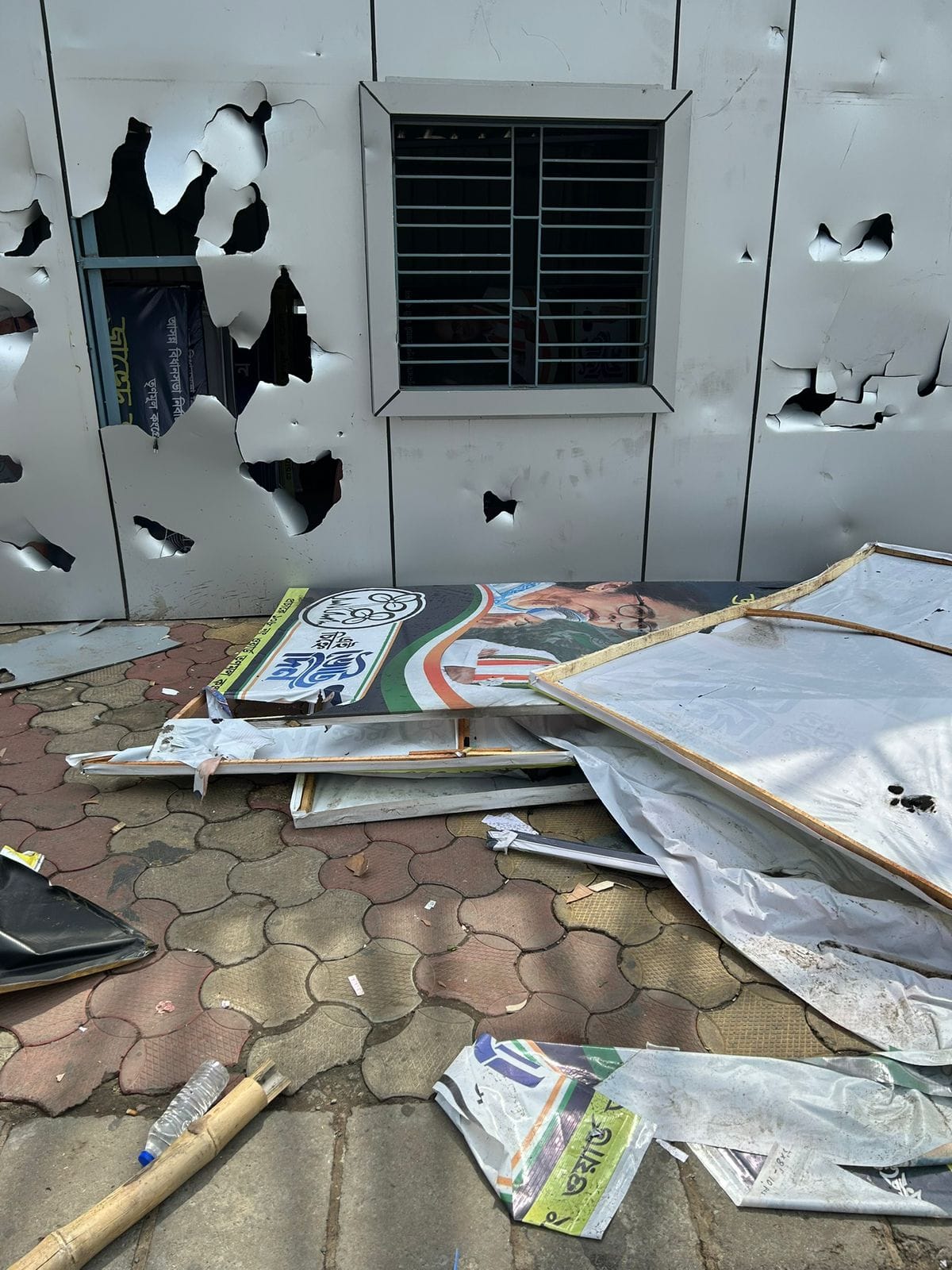
The death of political workers in post-poll violence
The morning after the BJP formed the government in West Bengal, the TMC’s media cell released a photograph. It showed the bludgeoned body of 40-year-old Sahadeb Bag, a TMC village panchayat member, who was killed in what the party described as post-poll violence. He isn’t the only one.
Among the six workers the party claimed to be dead was Biswajit Pattanaik, a polling agent for the TMC, who died on the day the results were announced in Beleghata, a densely populated and politically volatile neighbourhood in east Kolkata. He is survived by his elderly, ailing parents, his wife and four-year-old son.
On the evening of May 4, 45-year-old Biswajit had stepped out of his home after receiving a phone call. His sister, Piyali, said that around 10.30pm, a loud commotion broke out in the neighbourhood. Biswajit’s wife, Basanti, ran outside to find her husband lying on the ground, bleeding heavily.
“No one came forward to help us,” Basanti said. “Everyone saw what happened and stood still.”
Biswajit had been assaulted, his family said. They maintain that he was chased by his attackers, who even forced open the door of the building where he lived. The police, however, have said that while being chased, he ran to the rooftop, where he slipped and fell. The BJP has denied any involvement in the incident.
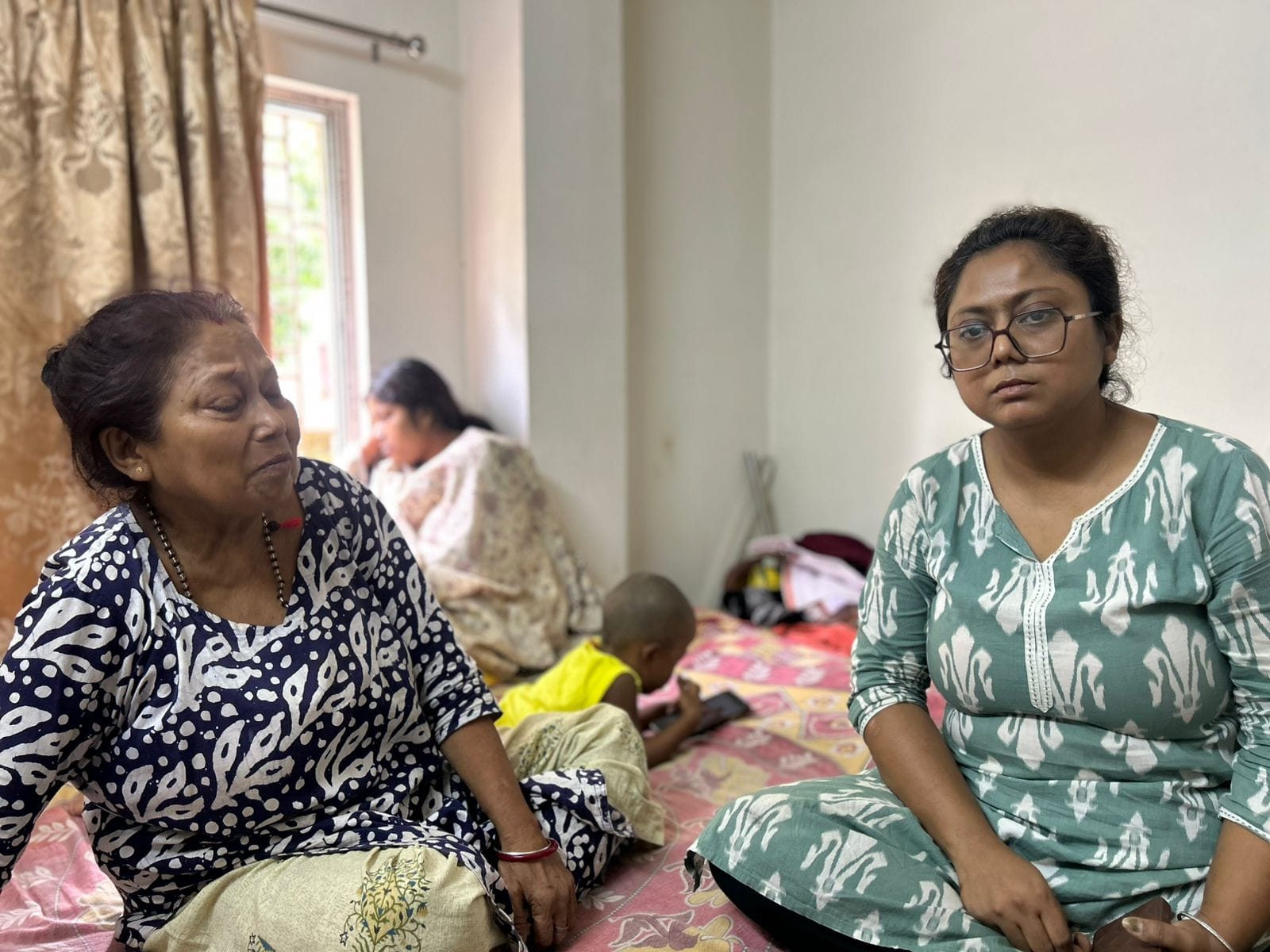
Fear now shapes every conversation. “Nowadays someone who is TMC in the morning can easily change colour and become BJP at night. How do we even know who killed him?”
Biswajit’s death has revived memories of another killing, just over a kilometre away in 2021. Abhijit Sarkar, a BJP worker, was chased and killed, allegedly by TMC goons, on the day of the election results. Outside the Sarkar home, like Pattanaik’s, police personnel stand guard.
Abhijit’s brother, also named Biswajit, recalled showing investigators how his brother had been pursued through a narrow lane and lynched. That case is now being investigated by the CBI.
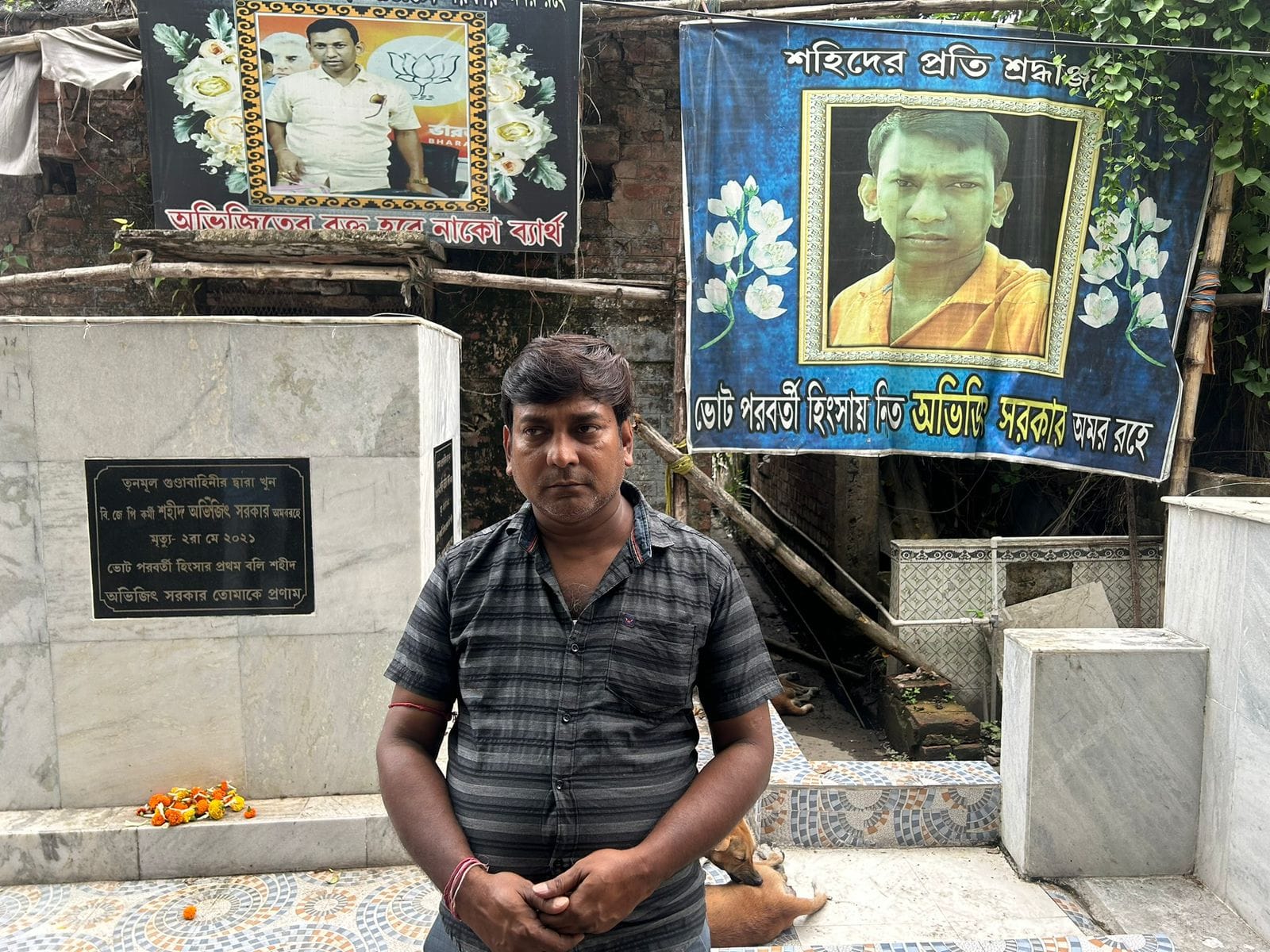
“Post-poll violence is never just one death,” he said. “With one killing, an entire family collapses. People must understand this is not simply the death of a party worker. And yet this has been happening in West Bengal for decades.”
The elections may have ended, but for many families, the aftermath has barely begun to take shape with several groups engaged in turf wars over club rooms, territories of control and money.
And then there is the cultural violence
On the day the election results were announced, West Bengal saw a familiar pattern re-emerge. Coordinated attacks were carried out on local clubs affiliated with the TMC. These neighbourhood clubs, scattered across the state, are often supported through government grants. Mamata Banerjee’s administration had channeled funds to thousands of such clubs under various schemes. By August 2021, at least 25,000 clubs had each received Rs 5 lakh each. In 2025, the government extended a further Rs 1.1 lakh to every registered club to organise Durga Pujas. Aid that critics described as an attempt to secure political allegiance.
Over time, these clubs evolved into informal extensions of party power. The arrangement was rarely acknowledged publicly but everyone knew how it worked. “They became the eyes and ears of the government,” said a Kolkata-based businessman under condition of anonymity. “Soon they were intervening in everything, controlling access to construction materials, mediating family disputes, inserting themselves wherever they could. People felt constantly watched.”
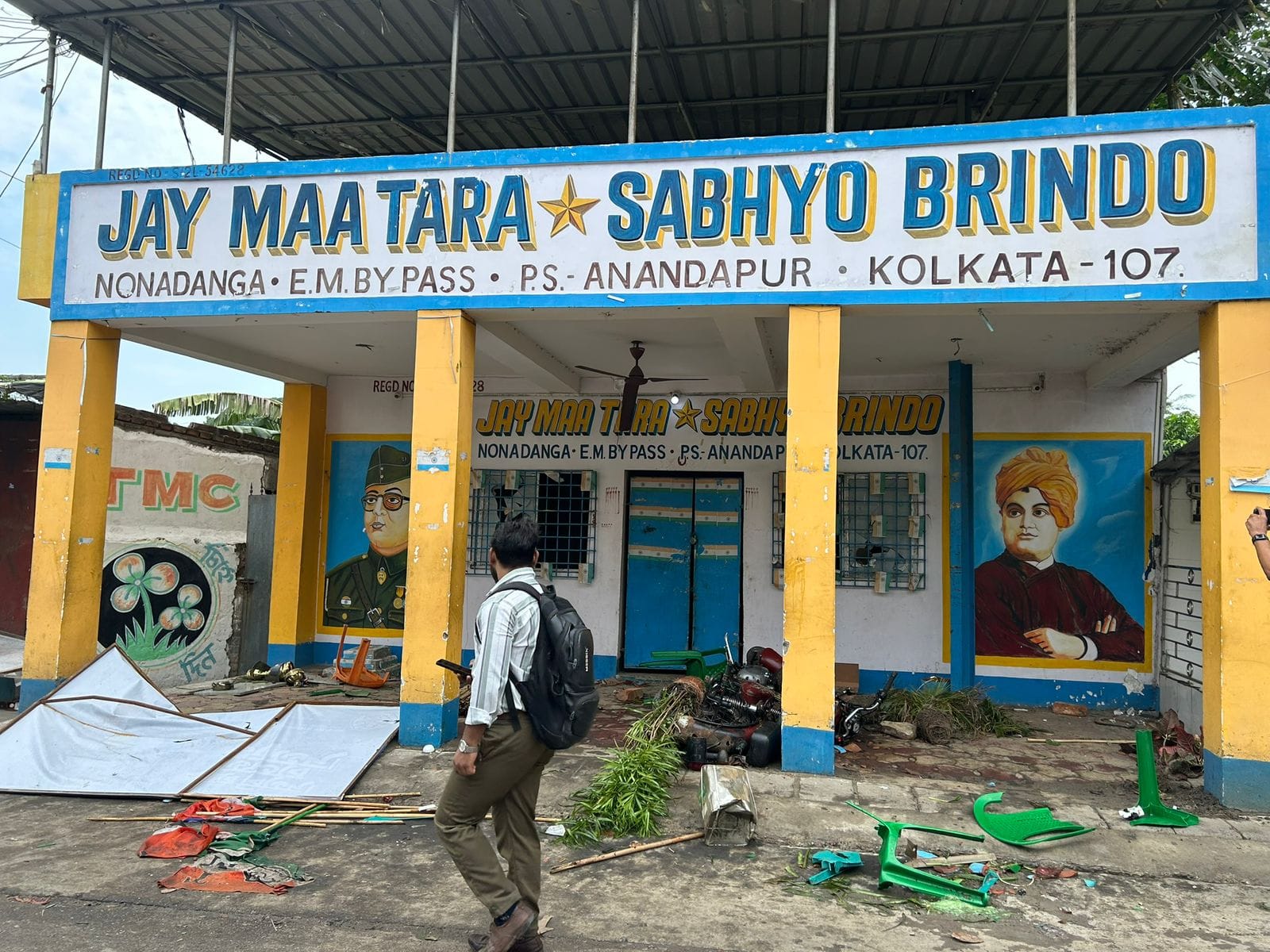
Outside one such TMC-affiliated club, Jay Maa Tara Sabhyo Brindo, along the Eastern Metropolitan Bypass in Nonadanga, a man on a motorbike slowed down long enough to shout an expletive-laced remark, framing the vandalism as deserved retribution, before riding off. “Besh hoyeche, this is what the sons of whores deserved,” he shouted as he locked eyes with me.
The club bore the brunt. Shattered plastic chairs lay across the pavement. Ceiling fans had been ripped out. A motorbike lay overturned and bent out of shape. Barely 200 metres away, a TMC party office had also been vandalised. Similar reports soon emerged from Bhowanipur, the constituency represented by Mamata Banerjee, and from neighbourhoods across Bengal.
In Barasat, on Masjid Bari Road, supporters of the BJP removed the road signs and replaced them with new ones, sporting a different name. It has become Netaji Pally Road. A symbolic act widely interpreted as religious provocation. By evening, near Jadavpur University, BJP supporters smeared saffron paint across the face of a statue of Lenin. In the days that followed, several more Lenin statues were damaged or destroyed. In Bongaon, BJP workers broke a statue commemorating the 1859 Indigo rebellion. The statues of Sidhu and Kanhu Murmu, heroes of the Santhal rebellion, have also been vandalised.
At Ashutosh College, once a stronghold of the CPI(M) and later aligned with the TMC, a group of former students entered the common room and placed saffron marks on portraits of figures of India’s intellectual and social canon: Rabindranath Tagore, Mother Teresa, Raja Rammohan Roy, Ishwar Chandra Vidyasagar, Sister Nivedita. The Akhil Bharatiya Vidyarthi Parishad (ABVP) denied having any links with those involved. But a video emerged of ABVP students storming into the office of the Vice-Chancellor of Vidyasagar University.
“Since the announcement of the West Bengal assembly election results, BJP-backed miscreants have attacked the livelihoods of ordinary people and vandalised statues and portraits of revered figures,” Mayukh Biswas, a member of the CPI(M)’s West Bengal state committee, said. “They are mirroring the political culture that emerged after the 2011 results. In many cases, Trinamool miscreants who switched sides overnight are playing a leading role.”
The changing façade of New Market
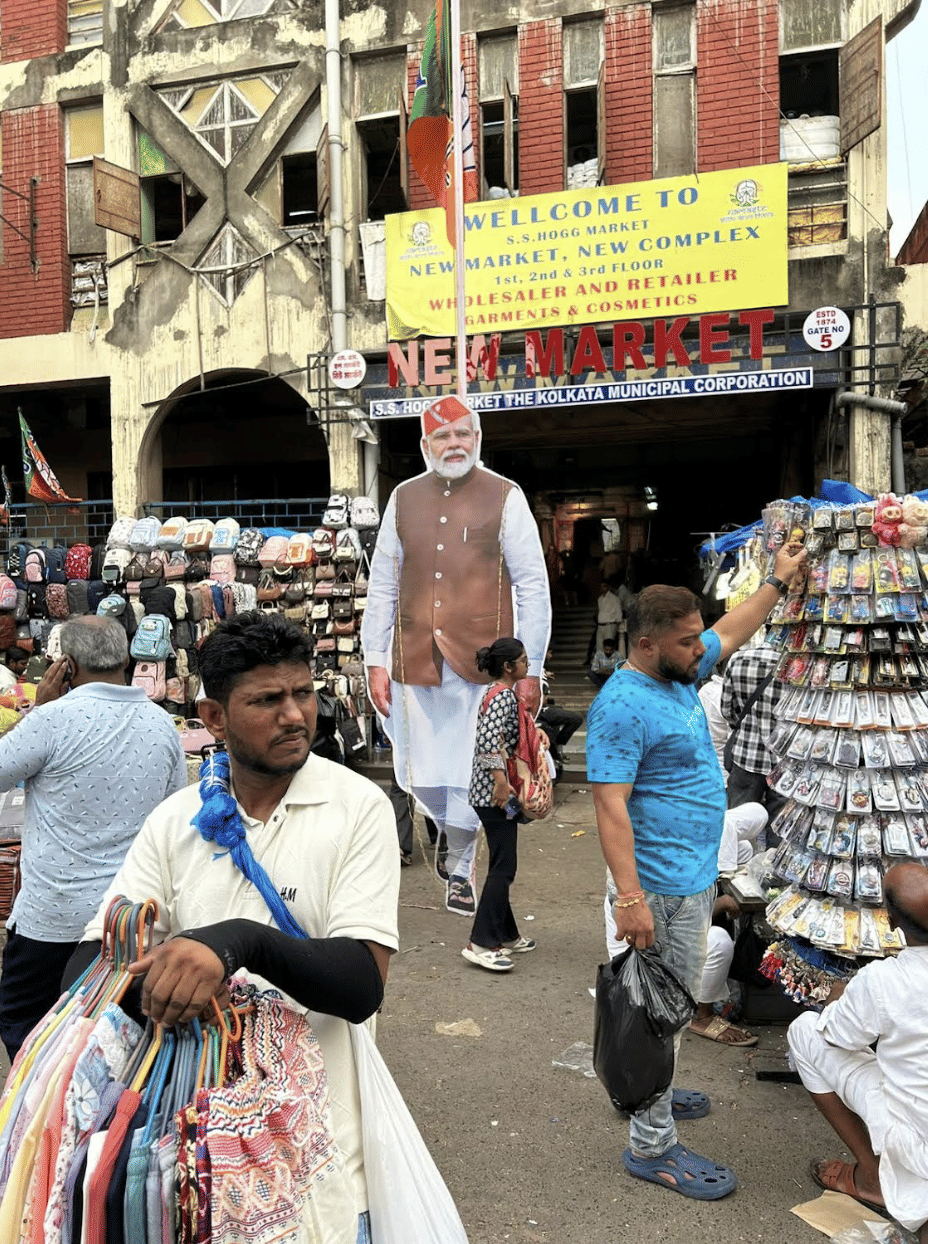
On May 5, a day after the election results were announced, the New Market area in central Kolkata became the site of open intimidation. That evening, supporters of the BJP, celebrating their victory, brought a bulldozer in. A TMC office was torn down. Central forces and city police stood nearby, watching in silence.
Newslaundry reached out to the DGP for comment and sent him a questionnaire. This report will be updated if a response is received.
When Newslaundry visited the area near Lighthouse Cinema Hall, saffron flags fluttered across the streets. Hawkers had reopened their stalls, and shopkeepers had arranged their wares, even as the surroundings bore signs of political takeover.
“There is a lot of money that changes hands in New Market,” said a tailor who has worked in the area for more than 50 years. “Whoever controls the union controls the money. That’s why business will continue as usual.”
What lingers is hazier. “An open question remains: will violence be directed against rival political parties alone, or will it take on a communal form,” Professor Islam said. “Party-society links are deeply entrenched in Bengal. Whether the contest between the TMC and the BJP eventually manifests as Hindu-Muslim violence is, in my view, still being debated and calibrated within the RSS.”
Whatever happens, for many in West Bengal, fear has arrived in a shade that is familiar while also being very new.
We take no ads, bow to no government or corporation, and answer only to you, the reader. This Press Freedom Month, pay to keep news free.